Assessment tools for peripheral neuropathy in multiple myeloma
Article information

Abstract
Advances in treating multiple myeloma (MM) have improved survival, shifting the management focus toward quality of life. Peripheral neuropathy (PN) is a common treatment-related toxicity that significantly impairs quality of life. However, standardized assessment methods for PN in patients with MM are currently lacking. A comprehensive search of multiple databases (PubMed, Embase, Cochrane Library, and KoreaMed) was conducted to identify relevant records. Eligible studies were reviewed in accordance with the Preferred Reporting Items for Systematic Reviews and Meta-Analyses guidelines. Twenty-two studies were included, and 17 PN assessment tools were identified. Nerve conduction studies and the National Cancer Institute Common Terminology Criteria for Adverse Events were the most commonly used clinician-based tools, whereas the Functional Assessment of Cancer Therapy/Gynecologic Oncology Group–Neurotoxicity was the most frequently used patient-reported outcome measure. The use of these tools varies depending on whether their purpose is diagnostic or evaluative. To the best of our knowledge, this is the first systematic review to evaluate PN assessment tools for patients with MM, revealing substantial heterogeneity across studies. By organizing these diverse approaches, our findings can guide researchers and clinicians toward a more consistent and standardized PN evaluation, ultimately improving the management of treatment-related neuropathy in MM.
INTRODUCTION
Multiple myeloma (MM) is a plasma cell malignancy characterized by the infiltration of clonal plasma cells into the bone marrow and overproduction of monoclonal proteins [1]. Over the past two decades, the treatment landscape for MM has evolved with the introduction of novel agents, such as proteasome inhibitors (PIs), immunomodulatory drugs (IMiDs), and monoclonal antibodies. These therapeutic advances have improved patient outcomes and extended survival [2–5]. Increasing attention has been directed toward improving the quality of life (QoL) of patients with MM [6].
Peripheral neuropathy (PN) has a negative impact on QoL in patients with MM [7,8]. Unlike other malignancies, PN in MM can arise both as a treatment-related side effect and as a consequence of the disease itself [9,10]. It may develop even before treatment because of disease-specific factors, including paraproteinemia, hyperviscosity, light chain deposition, and direct nerve infiltration [11]. Known neurotoxic agents, such as platinum-containing chemotherapy, have been widely studied for PN associated with solid malignancies. However, newer agents used specifically for MM, such as PIs and IMiDs, have not been extensively investigated. In addition, the current understanding of the pathophysiology of these newer forms of PN remains limited [12]. Unlike treatments for solid malignancies, MM therapy often involves daily or more than once-weekly administration, with treatment continued until disease progression. PN occurs in approximately 60% of patients receiving bortezomib, a commonly used PI [12,13]. In Korea, approximately 42% of patients receiving bortezomib develop PN [14]. As PN is increasingly recognized as a major adverse effect of MM therapy, the number of clinical trials focusing on its prevention and management has steadily increased.
However, the assessment methods for PN vary across studies, ranging from patient-reported outcome (PRO) questionnaires to clinical grading scales and neurological examinations. Despite the clinical importance of PN evaluation in MM, no consensus has been reached on the optimal assessment tools, and no systematic literature review has comprehensively addressed this topic to date. Therefore, this qualitative systematic review aimed to identify, summarize, and evaluate tools used to assess PN in patients with MM. In addition, we discuss how studies reported PN, specifically the timepoints at which assessments were conducted—before treatment, after treatment, and during follow-up.
METHODS
Search strategy
PubMed, Embase, Cochrane Library, and KoreaMed were systematically searched using predefined terms, such as “multiple myeloma,” “peripheral nervous system diseases,” and “patient-reported outcome measures.” The full lists of search terms and strategies are provided in Supplementary Tables 1 and 2, respectively. This review was conducted between February and July 2025.
Selection criteria
This review included original English-language articles investigating the severity of PN in patients with MM using assessment tools. Animal studies and duplicate publications were excluded from the analysis. Two authors (Kang KW and Park SS) independently screened the initial search results to identify relevant records and eligible studies based on their titles and abstracts. The full texts of the selected studies were subsequently reviewed and included in the systematic review in accordance with the Preferred Reporting Items for Systematic Reviews and Meta-Analyses guidelines [15,16].
Data synthesis
Because of anticipated variations in study design, assessment tools, and reported outcomes, the results were qualitatively synthesized. The findings from the included studies were summarized and compared, focusing on the types of PN assessment tools used and common patterns, such as the frequency with which different tools were used in patients with MM.
RESULTS
Study selection
The database search and screening processes are summarized in Figure 1. A total of 1,187 studies were identified through the database searches. These included 296 studies from PubMed, 654 from Embase, 219 from the Cochrane Library, and 18 from KoreaMed. After removing 178 duplicate studies, 1,009 studies remained. Of these, 951 were excluded based on their titles and abstracts. Full-text reports of the remaining 58 studies were sought and successfully retrieved for eligibility assessment. Consequently, 36 studies were excluded after full-text review because the outcomes were not relevant to the review objectives (n = 24), they did not present results specific to MM (n = 9), the study populations were duplicated, or the datasets overlapped (n = 3). Finally, 22 studies were included in the final qualitative analysis.
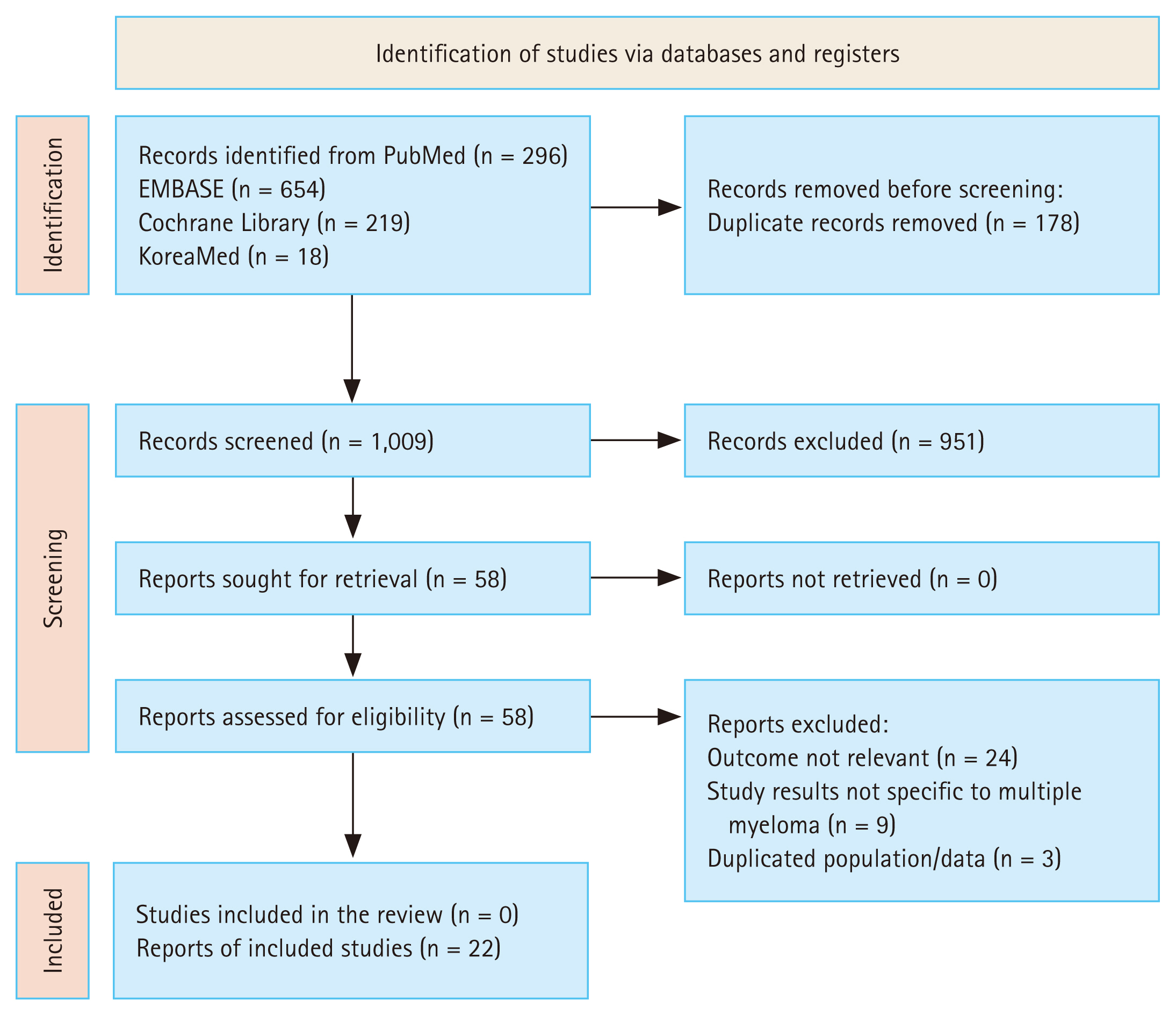
Literature search and study selection flowchart. A total of 1,187 records were identified from four databases. Among them, 1,009 records were screened, and 58 full-text reports were assessed for eligibility. Thirty-six reports were excluded because of non-relevance or duplicate data, leaving 22 studies for final inclusion.
Overview of PN assessment tools used in included studies
Seventeen distinct tools for assessing PN were identified in the included studies. Each tool was analyzed with respect to its purpose—that is, whether it was diagnostic (objective identification of PN) or evaluative (measurement and monitoring of PN severity). These studies demonstrated considerable heterogeneity in both diagnostic and evaluative methodologies. The detailed characteristics of the 22 studies and assessment tools used are summarized in Supplementary Table 3 and illustrated in Figure 2A [17–38].

Commonly used assessment tools in all 22 studies (A), the most commonly used tools for diagnostic purposes (B), and the most commonly used tools for evaluative purposes (C). NCS, nerve conduction study; NCI CTCAE, National Cancer Institute Common Terminology Criteria for Adverse Events; FACT/GOG-NTX, Functional Assessment of Cancer Therapy/Gynecologic Oncology Group–Neurotoxicity; TNS-R, Total Neuropathy Score reduced version; VAS, visual analog scale; EORTC QLQ-CIPN20, European Organization for Research and Treatment of Cancer Quality of Life Questionnaire–Chemotherapy-Induced Peripheral Neuropathy; TNS-C, Total Neuropathy Score clinical version; NRS, numerical rating scale; NPI, Neuropathic Pain Index.
The data stratified according to the diagnostic or evaluative purposes of the assessment tools are shown in Figure 2B and C. The analysis revealed that the National Cancer Institute Common Terminology Criteria for Adverse Events (NCI CTCAE) was the most frequently used diagnostic tool (n = 9). Nerve conduction studies (NCSs, n = 5) and a few other tools, such as the Functional Assessment of Cancer Therapy/ Gynecologic Oncology Group–Neurotoxicity (FACT/GOG-NTx, n = 3), reduced version of the Total Neuropathy Score (TNS-R, n = 3), and Total Neuropathy Score clinical version (TNS-C, n = 3), were also utilized for diagnostic purposes. For evaluative purposes, the NCS was the most frequently employed (n = 8), often in conjunction with PRO tools, such as the FACT/GOG-NTx (n = 7), TNS-R (n = 5), European Organization for Research and Treatment of Cancer Quality of Life Questionnaire–Chemotherapy-Induced Peripheral Neuropathy (EORTC QLQ-CIPN20, n = 5), and visual analog scale (VAS, n = 5).
This variability in tool selection across studies underscores the lack of consensus on standardized PN evaluation criteria in clinical trials. Although some studies predominantly relied on clinician-based grading systems, such as the NCI CTCAE, others incorporated structured PRO tools to capture the subjective aspects of neuropathic symptoms. This methodological heterogeneity may have contributed to inconsistencies in outcome interpretation and comparability across trials.
Assessment tools used for PN in MM
The assessment tools used for PN in the studies included in this systematic review are summarized in Table 1.
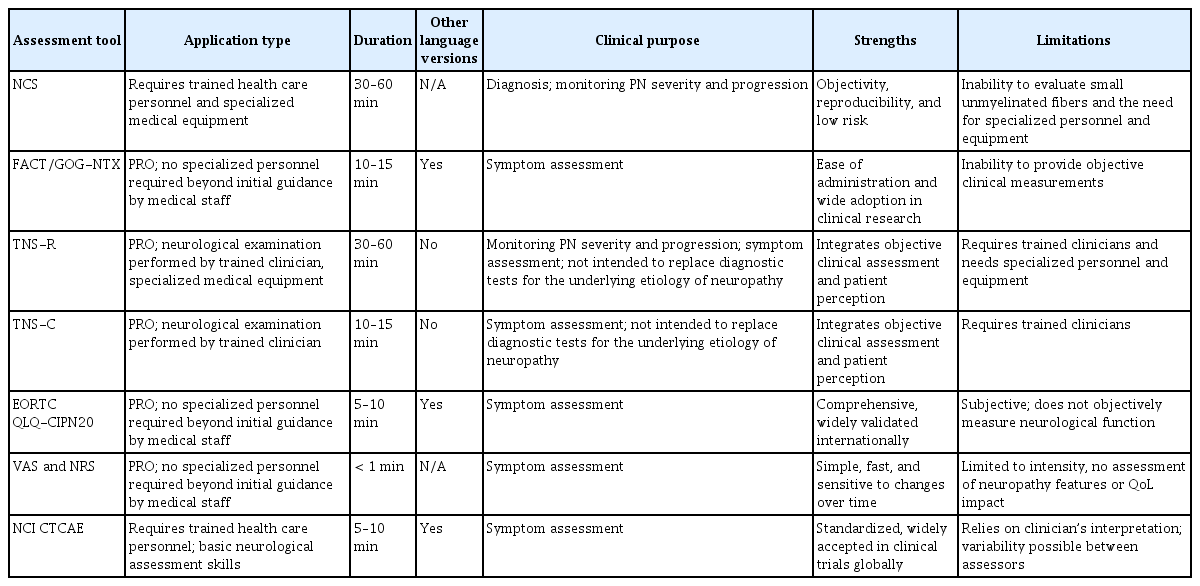
Summary of assessment tools for PN in patients with MM
NCS
NCS is a widely used, noninvasive electrodiagnostic method for evaluating the functional integrity of the peripheral nervous system [39–41]. Compound muscle and sensory nerve action potentials are recorded following electrical stimulation of the peripheral nerves. NCS provides objective information on conduction velocity and amplitude, reflecting the function of large myelinated fibers. Detecting the presence of neuropathy, differentiating between axonal and demyelinating processes, and estimating disease severity are essential components of the evaluation. Routine NCS typically includes the assessment of both motor and sensory nerves. The commonly examined nerves include the median, ulnar, and radial nerves in the upper limbs and the peroneal, tibial, and sural nerves in the lower limbs. Additional specific nerves can be tested depending on the patient’s symptoms, neurological findings, and differential diagnoses.
NCS generally requires approximately 30–60 minutes. Although generally safe, it should be performed cautiously in patients with implanted cardiac devices or neurostimulators because of the potential for electromagnetic interference [42]. Additionally, NCS is contraindicated in patients with external cardiac pacing wires; however, it is considered safe in patients with bipolar pacemakers or modern implanted cardiac devices [42]. Because NCS requires specialized medical equipment, it is performed by trained electrophysiology technicians or physicians. Interpretation and formal reporting are performed by physicians with expertise in clinical neurophysiology. NCS reports include the nerves tested, stimulation and recording sites, conduction distances, and values for latency, amplitude, and velocity—ideally presented in a tabular format. The data are interpreted in real time by a physician, integrating the clinical context to provide a clear diagnostic impression [43,44].
Although NCS does not directly assess small-fiber neuropathy or PROs, it remains a valuable tool for diagnosing neuropathy and monitoring its severity and progression. Its major strengths include objectivity, reproducibility, and low risk, whereas its limitations include its inability to evaluate small unmyelinated fibers and the need for specialized personnel and equipment.
FACT/GOG-NTX
The FACT/GOG-NTX questionnaire is a PRO tool specifically developed to assess chemotherapy-induced PN and its impact on QoL [45,46]. It is an extension of the well-validated FACT questionnaire, which is widely used for evaluating health-related QoL in patients with cancer. The FACT/GOGNTX focuses on subjective symptoms and functional impairments resulting from PN and evaluates sensory, motor, hearing, and functional domains. The neurotoxicity subscale contains 11 questions designed to evaluate the severity and impact of neuropathy symptoms on patients’ lives. The exact wording for each question was obtained from the official questionnaire online [47].
The FACT/GOG-NTX is available in both printed and electronic formats. It typically requires 10–15 minutes to complete and does not require specialized personnel beyond the initial guidance of medical staff. Scoring is reported numerically and summarized by domain and total scores, with some items reverse scored using a manual scoring template. Electronic versions are officially distributed through FACIT. org, and permission is required to access multilingual versions, including the Korean version. While the original FACT/GOG-NTX includes 11 items, a simplified Korean version, FACT/GOG-NTX-4, was developed and validated using only four items [48].
The FACT/GOG-NTX module demonstrates strong psychometric properties, including high internal consistency, reliability, sensitivity to clinical change, and excellent validity across various cancer populations [49,50]. These robust characteristics have led to its widespread use in clinical trials to evaluate interventions aimed at preventing or reducing chemotherapy-induced PN. Its standardized structure allows clinicians and researchers to systematically quantify neuropathy from the patient’s perspective, providing essential data to inform clinical decisions, guide treatment modifications, and serve as an important endpoint in clinical trials. However, it is limited by its subjective nature and inability to provide objective clinical measurements.
TNS-C and TNS-R
The TNS was initially developed by Cornblath et al. and later refined by Cavaletti et al. to comprehensively quantify the severity of PN, particularly chemotherapy-induced PN [51–53]. The original TNS incorporates multiple domains, such as sensory, motor, and autonomic symptoms; clinical examination (strength testing, deep tendon reflexes, pinprick, and vibration perception); and NCSs. This multidimensional structure enables the reliable grading of neuropathy severity and facilitates longitudinal monitoring during or after chemotherapy. Two abbreviated versions have been developed to improve applicability in clinical settings: TNS-C and TNS-R. The TNS-C omits NCSs and relies on PRO and clinical assessments, making it suitable for use in clinical trials and outpatient settings, whereas the TNS-R includes a focused selection of both subjective symptoms and objective measures, incorporating limited NCSs—specifically sural sensory action potential and peroneal compound muscle action potential—to retain diagnostic sensitivity while simplifying administration.
Both the TNS-C and TNS-R have been extensively validated across various chemotherapy regimens and have demonstrated consistent reliability in detecting clinical change, enabling comparative assessments across studies [53–55]. Although neither version replaces diagnostic testing, they serve as valuable adjunct tools for evaluating symptom progression and treatment responses. Electronic access to the TNS-C requires licensing through Johns Hopkins Technology Ventures, whereas the TNS-R must be referenced using published protocols [53].
The TNS-C and TNS-R are valuable adjunctive tools for evaluating and tracking the severity of PN over time. Their key strength lies in their ability to integrate objective clinical assessments and PROs, thereby providing a more comprehensive view of neuropathy. However, these tests are not intended to replace diagnostic tests that determine the underlying cause of neuropathy. One notable limitation is that accurate use requires trained clinicians with relevant expertise, which may limit routine application in resource-limited settings.
EORTC QLQ-CIPN20
The EORTC QLQ-CIPN20 is a validated PRO tool developed for the systematic assessment of chemotherapy-induced PN. Designed as a supplementary module to the core EORTC QLQ-C30, it evaluates the impact of chemotherapy-induced PN on the QoL of patients with cancer. The questionnaire consists of 20 items divided into three domains: sensory (nine items), motor (eight items), and autonomic (three items). The sensory domain includes items, such as tingling, numbness, pain, and discomfort, whereas the motor domain evaluates muscle weakness, coordination difficulties, and limitations in manual dexterity. The autonomic domain assesses symptoms, such as dizziness, blurred vision, and erectile dysfunction [56].
The EORTC QLQ-CIPN20 is a patient-completed questionnaire that requires approximately 5–10 min to administer either on paper or electronically. No specialized personnel or equipment are required. The results are reported numerically, with higher scores indicating greater symptom severity, and are analyzed by domain and overall scores. The questionnaire has been translated and validated in multiple languages, including Korean, and is available on the European Organization for Research and Treatment of Cancer Quality of Life Group website [57]. Its strong psychometric properties—including internal consistency, reliability, and responsiveness to clinical change—have been demonstrated in numerous studies, with successful validation across several countries, such as the United States, Canada, Hong Kong, Thailand, and Korea [58–61].
The primary purpose of the EORTC QLQ-CIPN20 is to quantify the severity and functional impact of neuropathic symptoms from the patient’s perspective, thereby facilitating a patient-centered evaluation of the neuropathy-related QoL burden. It is not designed to provide a definitive diagnosis of neuropathy but functions effectively as a clinical adjunct, particularly in trials monitoring chemotherapy-induced PN progression. Its primary strengths lie in its comprehensiveness and international validation, which allow consistent comparisons across populations. However, it is a subjective measure and does not include objective neurological function tests.
VAS and numerical rating scale (NRS)
The VAS and NRS are simple, validated, and widely used PRO tools designed to assess subjective symptom intensity, particularly pain levels. The VAS consists of a 10-cm horizontal or vertical line with endpoints, such as “no pain” and “worst imaginable pain,” on which patients mark their perceived symptom severity. It was first introduced in 1964 by Clarke and Spear [62], and further applications were developed by Huskisson [63]. The VAS has been validated in both chronic and experimental pain models, and its usefulness in chemotherapy-induced PN—by differentiating neuropathy severity across chemotherapy regimens and detecting changes in symptoms over time—has been demonstrated in several studies [63–65]. By contrast, the NRS uses a segmented numerical scale, typically from 0 to 10, where patients select the number that best describes their current symptom intensity. It is particularly useful for quick verbal assessments and communication between patients and clinicians [66]. Although widely used in clinical and research settings, the NRS lacks largescale validation specifically for chemotherapy-induced PN, in contrast to the VAS.
The VAS and NRS are strictly evaluative tools that capture symptom intensity but do not diagnose underlying conditions, such as PN. They do not provide information on symptom quality, distribution, or impact on QoL. Both scales are commonly employed because of their minimal burden, rapid administration, and capacity to sensitively detect symptom fluctuations. They do not require specialized training or equipment and can be administered on paper or electronically.
Their primary strengths lie in their ease of use and sensitivity to symptom changes, which make them ideal for both clinical practice and research. Their simplicity is a major advantage; however, it also presents a limitation when more comprehensive neuropathy assessments are required. Despite their widespread global use, no stand-alone validation studies have been conducted for either scale in the Korean population.
NCI CTCAE and PRO version
The NCI CTCAE is a comprehensive, clinician-administered grading system designed to standardize the documentation and evaluation of adverse events (AEs) in patients with cancer. Developed by the NCI and most recently updated to version 5.0, the CTCAE is widely used in both clinical trials and practice to ensure consistency, comparability, and clarity in AE reporting. Each AE, including those related to PN, is graded from one (mild) to five (death related to the event) using structured criteria that include both clinical findings and symptoms. CTCAE terms include “muscle weakness,” “neuralgia,” “paresthesia,” “peripheral motor neuropathy,” and “peripheral sensory neuropathy,” which are graded by severity and functional impact. To further improve symptom reporting from the patient’s perspective, the NCI developed the PRO version, PRO-CTCAE [67]. The measurement system is available on the NCI website in multiple languages, including Korean [68]. This version includes terms, such as numbness, tingling, dizziness, and ringing in the ears, and uses an intuitive format that enables patients to report symptoms more accurately. Validation studies have shown that PRO-CTCAE can capture symptomatic AEs missed by clinicians, making it a reliable and responsive tool for PRO assessment [69].
CTCAE is administered by trained clinicians based on symptoms and basic neurological assessments and typically requires approximately 5–10 minutes. It uses a categorical grading system (1–5) with clear criteria, and the resources are freely available on the NCI website. Despite its strengths, particularly in standardization and broad applicability, the CTCAE has limitations. It depends on clinician interpretation, which can introduce variability, and although useful for evaluating severity, it is not a diagnostic tool on its own. Therefore, it is considered an evaluative adjunct tool for the assessment of neuropathy.
DISCUSSION
This systematic review identified 22 studies employing 17 distinct tools for PN in patients with MM. PN evaluation tools vary across studies, reflecting the lack of standardized criteria in clinical trials. Such methodological heterogeneity likely contributes to inconsistencies in outcome interpretation and limits cross-trial comparability, highlighting the need for harmonized assessment strategies in future research.
Several instruments have been used interchangeably for diagnostic, evaluative, and monitoring purposes without a clear delineation of their functional scope. For example, the NCS, although primarily a diagnostic tool, has been frequently employed for longitudinal symptom monitoring [70,71]. Conversely, tools, such as the NCI CTCAE, which is convenient and widely accepted for standardized AE grading, provide limited granularity regarding patient experience. PRO instruments are inherently subjective and lack diagnostic specificity; however, they are indispensable for evaluating treatment-related symptom burden [72]. This functional misalignment complicates the comparability of outcomes across studies and impedes the development of evidence-based PN management strategies.
From a clinical perspective, the selection of an appropriate assessment tool must be guided by the purpose of evaluation. Objective measures, such as the NCS or TNS, are recommended for diagnostic confirmation of PN or initial grading [51,73]. By contrast, PRO instruments, such as the EORTC QLQ-CIPN20 or FACT/GOG-NTX, are suitable for capturing dynamic symptom fluctuations during treatment and monitoring their effects on health-related QoL [72]. The VAS and NRS, although limited in scope, offer valuable adjuncts for the routine monitoring of symptom intensity. The combined use of objective and subjective instruments may yield the most comprehensive assessment, facilitating informed treatment decisions and patient-centered care [74]. Practical challenges, particularly in non-English-speaking regions, must be considered when selecting assessment tools. Instruments that offer multilingual availability and have undergone formal linguistic validation are inherently more feasible for cross-cultural implementation, making them practical choices for international or multicenter trials.
If applied in a Korean clinical setting, the first priority before treatment initiation would be to perform an NCS to identify the underlying cause of PN. PN in MM may result from the disease itself, an adverse effect of therapy, or MM-related complications originating from the spine. Therefore, it is important to perform an NCS before treatment initiation or PN assessment to rule out neuropathy from causes other than PN. Second, the severity of PN should be assessed at baseline, before treatment, and at the initiation of PN assessments. Considering that the NCS does not capture patient perceptions of PN, an assessment tool based on PROs should be used simultaneously. The current findings support the use of the FACT/GOG-NTX, as it is the most commonly used tool. For follow-up, a PRO-based assessment should be implemented as a fundamental approach because it enables evaluation of symptom improvement over time. Therefore, PRO tools are essential, and when periodic NCS follow-up is difficult, simplified tools, such as the TNS-R or TNS-C, may be considered as alternatives. By contrast, the VAS or NRS provide only limited information and thus cannot serve as the main tools; however, they may be used as supportive instruments in situations where reading comprehension is a barrier or when frequent PN assessments are desired but time is limited.
This study has several limitations. Because of methodological heterogeneity, we did not perform a meta-analysis, and the synthesis was restricted to qualitative comparisons. Furthermore, most of the included studies were single-center, retrospective, or limited in sample size, and cross-validation among tools was rarely performed. There remains a critical unmet need to develop MM-specific core outcome sets or integrated tools that accurately reflect the distinct pathophysiology, treatment duration, and symptom trajectories associated with MM therapies. Current tools are largely extrapolated from those used for solid tumors or generalized chemotherapy-induced neuropathy and may not fully capture the disease-specific factors and chronic cumulative neurotoxicity observed in patients with MM who experience prolonged exposure to PIs and IMiDs.
In conclusion, although various PN assessment tools are currently used in patients with MM, their implementation is inconsistent and lacks standardization. This review provides a comparative overview of these tools and outlines their strengths, limitations, and practical implications. We emphasize the urgent need for MM-tailored, multilingual, and clinically feasible PN assessment frameworks to improve trial comparability, enhance treatment decision-making, and support patient-focused care strategies.
Notes
CRedit authorship contributions
Sung-Soo Park: conceptualization, methodology, resources, investigation, formal analysis, writing - original draft, writing - review & editing, funding acquisition; Kunye Kwak: investigation, data curation, formal analysis, validation, writing - original draft, writing - review & editing; Seol-Hee Baek: methodology, writing - original draft, supervision; Changgon Kim: investigation, data curation, validation; Yoon Seok Choi: investigation, data curation, supervision; Yong Park: investigation, data curation, supervision; Byung Soo Kim: investigation, data curation, supervision; Jin Seok Kim: conceptualization, methodology, resources, supervision; Chang-Ki Min: conceptualization, methodology, resources, supervision, funding acquisition; Ka-Won Kang: conceptualization, methodology, resources, investigation, data curation, formal analysis, validation, writing - original draft, writing - review & editing, visualization, supervision, project administration, funding acquisition
Conflicts of interest
The authors disclose no conflicts.
Funding
This research was supported by a grant from the Korea Health Technology R&D Project through the Korea Health Industry Development Institute, funded by the Ministry of Health and Welfare, Republic of Korea (grant number: RS-2023-KH141565).