Health effects of air pollution on chronic respiratory diseases
Article information

Abstract
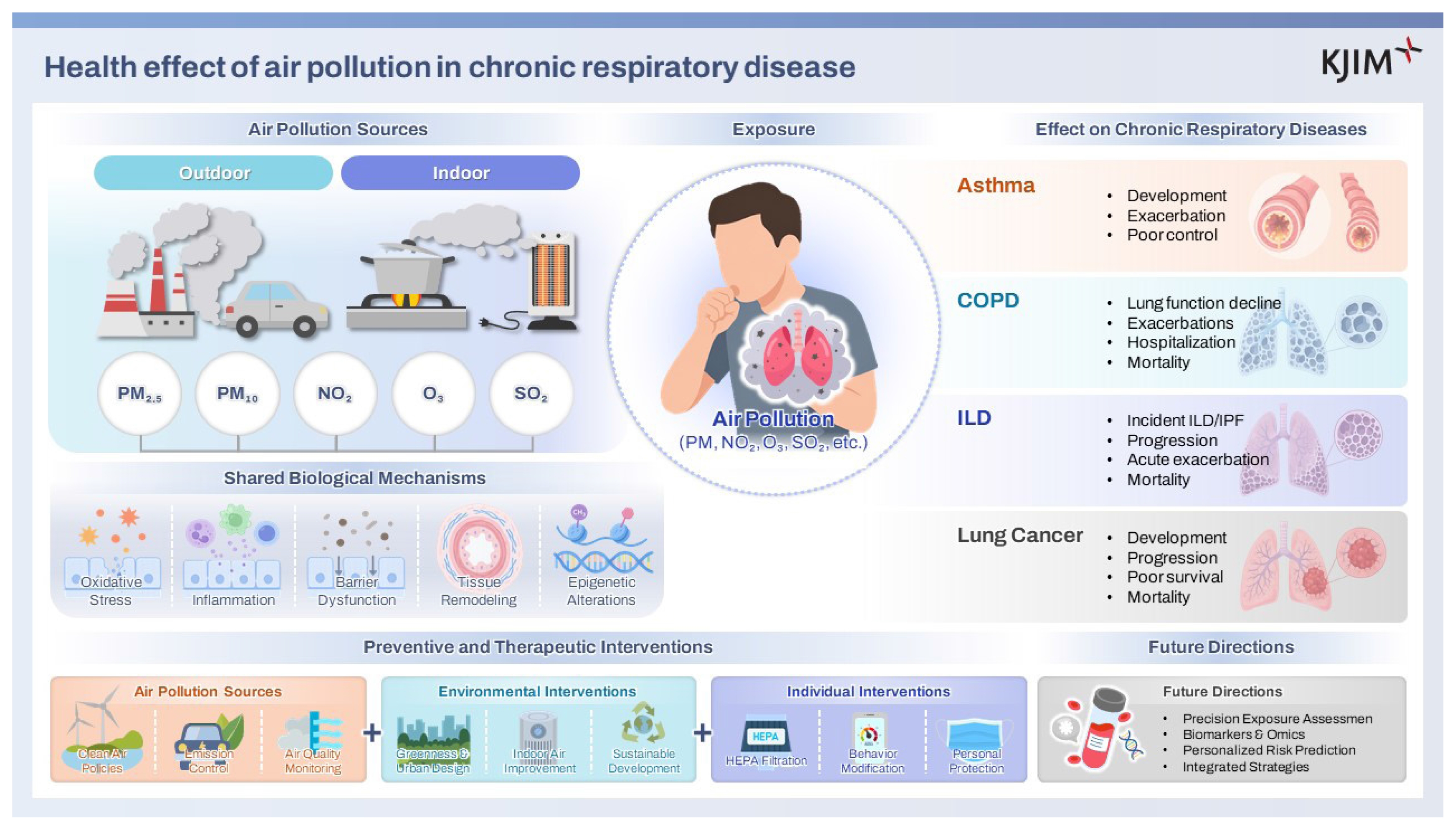
Exposure to both outdoor and indoor air pollution poses significant global public health challenges at all life stages. As the respiratory system serves as the primary entry route for inhaled pollutants, extensive evidence has demonstrated the detrimental effects of various air pollutants on respiratory health. Air pollution is a well-established risk factor for the development, exacerbation, and mortality of chronic respiratory diseases (CRDs), including airway diseases such as asthma, chronic obstructive pulmonary disease, interstitial lung disease, and lung cancer. This review summarizes the epidemiological evidence linking air pollution to the incidence and progression of CRDs and examines the impact of air quality control interventions. With the growing recognition that air pollution is a potentially preventable risk factor contributing to high morbidity and mortality, increasing attention has been directed toward protective strategies. We discuss the recent evidence on non-pharmacological interventions aimed at reducing air pollution exposure, both at the individual and social levels, and emphasize the ongoing need for integrated efforts to improve air quality and respiratory health.
INTRODUCTION
Air pollution refers to the contamination of the indoor or outdoor atmosphere by chemical, physical, or biological agents that alter its natural composition. Common air pollutants with accumulating evidence of adverse health effects include particulate matter (PM), ozone (O3), nitrogen dioxide (NO2), carbon monoxide (CO), and sulfur dioxide (SO2) [1]. These pollutants originate from a broad range of sources, including household fuel combustion, industrial processes, vehicle emissions, power generation, open waste burning, and agricultural activities.
Air pollution is the most significant environmental risk factor to human health. According to the Global Burden of Disease 2019 report [2], ambient and household air pollution was ranked as the fourth leading cause of mortality worldwide, following hypertension, tobacco use, and dietary risks. Furthermore, the World Health Organization (WHO) estimates that 12.6 million deaths are attributable to environmental determinants annually, with air pollution contributing substantially to this burden [3]. Moreover, epidemiological evidence suggests that exposure to air pollutants is associated with increased incidence and exacerbation of respiratory diseases [4–6]. Chronic respiratory diseases (CRDs), including chronic obstructive pulmonary disease (COPD), asthma, lung cancer, and interstitial lung disease (ILD), are among the leading causes of global morbidity and mortality and impose substantial public health and socioeconomic burdens [7]. In 2019, CRDs accounted for approximately 4.0 million deaths and affected 454.6 million individuals worldwide [7].
The respiratory tract is the primary entry point for ambient air pollutants. Importantly, the site of particle deposition depends largely on particle size: coarse particles (PM10, ≤ 10 μm in diameter) can penetrate the bronchi, while fine particles (PM2.5, ≤ 2.5 μm in diameter) are capable of reaching the alveoli and inducing local and systemic inflammatory responses. Consequently, both outdoor and indoor air pollutants are major environmental risk factors for CRDs and have emerged as the second leading cause of lung cancer-related mortality [8]. Recognizing this, the WHO has classified air pollution as a Group 1 carcinogen, and the International Agency for Research on Cancer has underscored its potential carcinogenic potential in humans [9]. This review aims to comprehensively summarize the current evidence on the impact of ambient and household air pollution on the development, progression, and outcomes of CRDs, with a focus on major CRD entities.
SHARED BIOLOGICAL MECHANISMS LINKING AIR POLLUTION TO CRDs
The respiratory tract serves as the primary entry route for inhaled air pollutants and contributes to the development and progression of CRDs through multiple biological mechanisms. Although these pathways are broadly shared across different conditions, their relative contributions and dominant target cell populations vary by disease type. This section briefly summarizes the major shared mechanisms, which are schematically illustrated in Fig. 1.
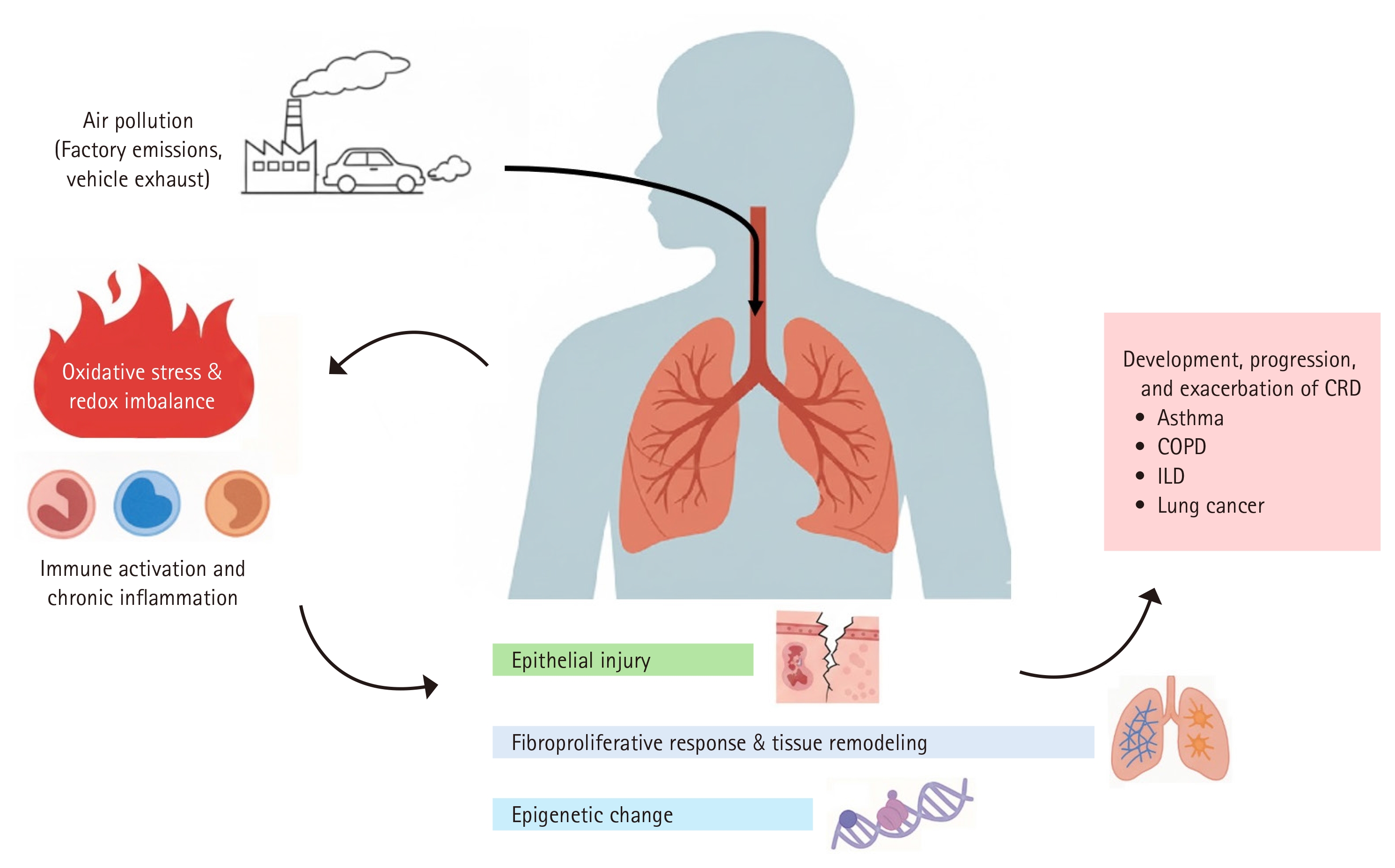
Common mechanisms underlying the impact of air pollution on CRDs. CRD, chronic respiratory disease; COPD, chronic obstructive pulmonary disease; ILD, interstitial lung disease.
Oxidative stress and redox imbalance
Air pollutants, particularly PM, O3, and NO2, induce excessive reactive oxygen species generation either directly or through inflammatory cell activation [10,11]. Persistent oxidative stress occurs when endogenous antioxidant defense systems, including glutathione, superoxide dismutase, and nuclear factor erythroid 2-related factor 2–mediated pathways, are overwhelmed. This leads to epithelial injury, mitochondrial dysfunction, and impaired cellular repair mechanisms [12]. Redox imbalance serves as a unifying upstream trigger of asthma, COPD, and fibrotic interstitial ILDs.
Innate immune activation and chronic inflammation
Air pollutants activate pattern recognition receptors, including Toll-like receptors and inflammasomes, which serve as the body’s immune detection system [11,13,14]. Continuous stimulation of these sensors sustains innate immune responses, driving the persistent release of pro-inflammatory cytokines (e.g., interleukin [IL]-1β, IL-6, tumor necrosis factor-α) and chemokines that recruit neutrophils, monocytes, and lymphocytes. Consequently, the lung tissue becomes trapped in a state of chronic, low-grade inflammation that fails to resolve. This inflammatory milieu amplifies tissue injury and lowers the threshold for disease exacerbation, rendering the airways hyperresponsive to minor triggers.
Epithelial injury, barrier dysfunction, and abnormal repair
The airways and alveolar epithelium constitute the primary interfaces with inhaled pollutants. Chronic pollutant exposure compromises epithelial barrier integrity through tight junction disruption, mucociliary clearance impairment, and the induction of epithelial cell apoptosis or senescence [15,16]. Critically, pollutant-mediated epithelial injury dysregulates repair mechanisms, characterized by inappropriate activation of epithelial–mesenchymal transition, altered progenitor cell differentiation, and defective re-epithelialization [13,15]. These aberrant repair processes represent a unifying pathogenic feature: in asthma and COPD, they drive airway remodeling and structural alterations; in ILD, they contribute to progressive fibrotic remodeling; and in ILD and lung cancer, they establish a permissive microenvironment for neoplastic transformation.
Tissue remodeling and fibroproliferative responses
Chronic inflammatory signaling induced by air pollutants upregulates proteases (e.g., matrix metalloproteinase [MMP]-9, MMP-12) and profibrotic mediators (e.g., transforming growth factor [TGF]-β1), which together disrupt extracellular matrix homeostasis [17,18]. This promotes matrix degradation in emphysematous regions while simultaneously driving fibroblast activation and excessive matrix deposition in fibrotic areas. Beyond inflammation, pollutants directly affect structural cells—including fibroblasts, airway smooth muscle cells, and endothelial cells—leading to altered matrix turnover, increased airway wall thickness, small airway narrowing or obliteration, and vascular dysfunction [13,19]. Through these fibro-proliferative processes, chronic exposure translates into irreversible structural changes that manifest across a spectrum ranging from obstructive disease to progressive fibrotic ILDs.
Epigenetic reprogramming and persistent susceptibility
Exposure to air pollution induces epigenetic modifications, including DNA methylation changes, histone modifications, and non-coding RNA expression in pathways governing inflammation, oxidative stress, cell survival, and immune regulation [20–23]. These epigenetic alterations stabilize aberrant inflammatory and profibrotic programs, potentially linking early life or chronic exposure to a long-term risk of disease and the progression of CRDs, even when short-term exposure levels fluctuate.
EPIDEMIOLOGIC EVIDENCE OF THE CLINICAL IMPACTS OF AIR POLLUTION ON CRDs
Airway disease
Development and lung function decline
Accumulating evidence suggests that exposure to high levels of air pollution during prenatal and early childhood restricts lung growth and increases the risk of asthma in children [24–27]. Moreover, sustained exposure to ambient pollutants is associated with an accelerated decline in lung function and an elevated risk of chronic airway diseases in both children and adults [27–29]. The key evidence regarding air pollution and airway diseases is summarized in Table 1.
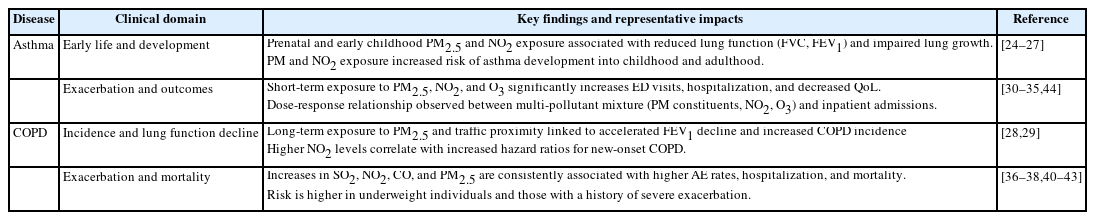
Effects of air pollution on asthma and COPD
In a prospective cohort study of 176 pregnant women, personal exposure to PM2.5 was individually measured over a 48-hour period during the second trimester, and respiratory outcomes in their children were followed for five years [24]. Higher maternal PM2.5 exposure levels (> 52.6 μg/m3) were significantly associated with reduced lung function at age 5, with mean decreases of 92.9 mL in forced vital capacity (FVC; p = 0.008), 87.7 mL in forced expiratory volume in 1 second (FEV1; p = 0.008), and 72.7 mL in forced expiratory volume of half a second (FEV0.5; p = 0.026). These findings suggest that prenatal exposure to elevated PM2.5 adversely affects fetal lung development, leading to impaired lung growth in early childhood.
Consistently, another population-based study of 736 full-term children used a validated satellite-based spatiotemporal model to estimate daily maternal PM2.5 exposure during pregnancy and found that increased exposure between gestational weeks 16 and 23 was significantly associated with a higher risk of early-onset asthma before age 6, with more pronounced effects observed in boys [25]. Similarly, in the Dutch PIAMA birth cohort comprising 3,687 participants followed up until the age of 20 years, early-life exposure to air pollution was associated with a persistently higher risk of asthma development from childhood through early adulthood. Notably, each interquartile range increase in pollutant concentration at the residential address at birth was associated with adjusted odds ratios (ORs) ranging from 1.09 (95% confidence interval [CI] 1.01–1.18) for PM10 to 1.20 (95% CI 1.10–1.32) for NO2. These findings indicate that exposure to traffic-related air pollutants early in life confers long-term susceptibility to asthma that extends into adulthood [27].
In the Children’s Health study, a cohort of 1678 fourth-grade children was followed up for 4 years to evaluate the effects of air pollution on lung function [26]. Significant reductions in lung function growth rates were observed among children exposed to higher levels of acid vapor, NO2, PM2.5, and elemental carbon. These results support the notion that long-term exposure to air pollution impairs normal lung growth and development in children.
In adult populations, long-term exposure to ambient air pollution is consistently associated with reduced lung function and accelerated functional decline. In the Framingham Offspring and Third Generation cohorts [29], each 2 μg/m3 increase in PM2.5 concentration was associated with a 13.5 mL lower FEV1 and a 2.1 mL/year faster decline in FEV1, while living within 100 meters of a major roadway was linked to an additional 23.2 mL reduction in FEV1. Similar associations were observed for FVC, whereas FEV1/FVC ratios were largely unaffected. These findings indicate that even relatively low levels of long-term exposure to traffic-related and fine particulate air pollution contribute to the chronic loss of lung function in adults. Consistent with these findings, in a large prospective cohort of 57,053 adults from the Danish Diet, Cancer, and Health Study, long-term exposure to traffic-related air pollution was found to be significantly associated with an increased risk of developing COPD [28]. In the 35-year follow-up period, each interquartile range increase of 5.8 μg/m3 in mean NO2 level was associated with an 8% higher risk of COPD (hazard ratio [HR] 1.08, 95% CI 1.02–1.14).
Acute exacerbations and hospitalization
The detrimental effects of air pollutant exposure on asthma are well established, with numerous studies demonstrating significant increases in asthma-related emergency department visits and hospitalizations [30,31]. More recently, an analysis of inpatient data from 11 states in the United states (U.S.) collected between 2002 and 2016 evaluated the cumulative effect of 15 particulate components, NO2, and O3 on asthma hospitalizations [32]. Each decile increase in the pollutant mixture was associated with a 10.6% (95% CI 10.0–11.2%) and 8.0% (95% CI 7.7–8.4%) rise in annual asthma hospitalizations among children (0–18 yr) and adults (19–64 yr), respectively. Nickel, vanadium, sulfate, nitrate, bromine, and ammonium were the major contributors to the observed associations, indicating that long-term exposure to complex pollutant mixtures substantially increases asthma morbidity across age groups. Beyond acute hospitalizations, exposure to air pollutants has long been consistently linked to asthma exacerbations and other adverse asthma outcomes, such as impaired asthma control, reduced quality of life (QoL), and greater healthcare resource utilization [33–35].
Similar to asthma, accumulating evidence has indicated that air pollution exacerbates COPD. Meta-analyses have shown that short-term increases in ambient air pollutants are significantly associated with a higher risk of COPD exacerbation and hospital admission. In 59 studies [36], each 10 μg/m3 rise in pollutant concentration increased exacerbation risk, particularly for SO2 (relative risk [RR] = 1.012, 95% CI 1.001–1.023) and NO2 (RR = 1.019, 95% CI 1.014–1.024), while another meta-analysis of 46 studies reported a 2% increase in COPD-related admissions per 1 mg/m3 rise in CO [37]. Additionally, a meta-analysis of 12 studies reported that each 10 μg/m3 increase in daily PM2.5 concentration (lag 0–7 days) was associated with a 3.1% (95% CI 1.6–4.6%) rise in COPD hospitalizations and a 2.5% (95% CI 1.5–3.5%) increase in COPD mortality [38]. These findings underscore the fact that even low-level pollution exposure substantially contributes to COPD exacerbation and related deaths. Recent observational studies further support these findings, showing that short-term exposure to PM2.5 and PM10 significantly increases the risk of COPD exacerbations, particularly among younger patients (< 65 yr), those with severe disease, individuals with early-onset COPD diagnosed between 20 and 50 years of age, and during cooler seasons, thereby highlighting the presence of susceptible subpopulations [39].
Mortality
Exposure to air pollution has been linked to an increased risk of both short- and long-term mortality from airway diseases. In COPD, meta-analyses have shown that each 10 μg/m3 increase in PM2.5 is associated with approximately a 1–2% rise in mortality [40]. The effect appears to be greater for smoke-related PM2.5 among elderly people, in whom a 1 μg/m3 increase in PM2.5 has been associated with a 9.2% increase in COPD mortality [41]. Cohort studies also indicated that long-term exposure to traffic-related PM and wood smoke is associated with increased mortality in patients with COPD [42], with pronounced effects among underweight individuals and those with prior severe exacerbation [43].
A large case-crossover analysis found that short-term exposure to PM2.5, NO2, and O3 was associated with approximately 7–11% higher odds of asthma-related death across the interquartile range of pollutant concentrations [44]. Furthermore, a recent systematic review and meta-analysis reported that long-term exposure to PM2.5 increases the risk of childhood and adult asthma—including prevalence, incidence, and mortality—by 21.4% and 7.1% for every 10 μg/m3 increase. This finding highlights the substantial contribution of chronic air pollution exposure to the cumulative burden of severe and fatal asthma throughout life [31].
ILD
Development
ILDs comprise a heterogeneous group of disorders characterized by abnormal collagen deposition, interstitial proliferation, inflammatory cell infiltration, and, in some cases, pulmonary fibrosis [45]. ILDs are classified according to their etiology and morphological patterns identified on lung biopsy or high-resolution computed tomography. Some forms, such as hypersensitivity pneumonitis, asbestosis, and silicosis, result from environmental exposure, whereas idiopathic interstitial pneumonia lacks an identifiable cause but may be influenced by environmental factors, including air pollution. The major evidence linking air pollution and ILDs is summarized in Table 2.
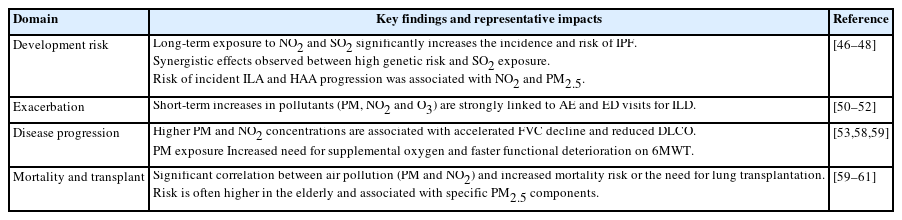
Effects of air pollution on ILD
Contin et al. [46] first reported an association between ambient air pollution and idiopathic pulmonary fibrosis (IPF) incidence in Italy, showing that each 10 μg/m3 increase in NO2 concentration was linked to a 7.9–8.4% rise in IPF incidence, particularly during the cold season. In the United Kingdom (UK) Biobank cohort, among 2,562 IPF cases, SO2 concentration demonstrated a linear association with IPF risk, with each 1 μg/m3 increment corresponding to an HR of 1.67 (95% CI 1.58–1.76) [47]. Similarly, data from the Multi-Ethnic Study of Atherosclerosis indicated that subclinical interstitial lung abnormalities and high-attenuation areas on chest CT are associated with air pollution exposure [48]. The risk of developing interstitial lung abnormalities increased 1.77-fold per 40 ppb rise in NOx (95% CI 1.06–2.95, p = 0.03), and high-attenuation areas tended to increase annually by 0.43% for each 5 μg/m3 increase in PM2.5 and by 0.45% for each 10 ppb increase in NO2.
Acute exacerbations and lung cancer development
IPF typically follows a chronic progressive course, although its clinical trajectory remains unpredictable. While most patients experience a gradual decline in lung function, a subset develop sudden and unexpected worsening, known as acute exacerbations [45,49]. Epidemiological studies from various countries have investigated the relationship between air pollutant exposure and the risk of acute exacerbations in patients with IPF.
In a 2014 South Korean IPF cohort, elevated ambient concentrations of O3 and NO2 measured within 6 weeks prior to acute exacerbation onset were significantly associated with an increased acute exacerbation risk [50]. Similarly, in Santiago, Chile, higher average concentrations of CO, NO2, SO2, PM10, and PM2.5 across multiple regions were significantly correlated with hospital admission for IPF [51]. In a study of 152 patients with surgically diagnosed IPF, increased exposure to NO2 and PM2.5 within 30 days before acute exacerbation was strongly associated with its occurrence, with ORs of 1.46 (95% CI 1.11–1.93) and 2.56 (95% CI 1.27–5.15), respectively, per 10-unit increase [52]. Likewise, in a French cohort of 1,982 IPF patients, higher mean O3 levels during the 6 weeks preceding acute exacerbation onset were associated with a significantly increased risk (HR 1.47, 95% CI 1.13–1.92 per 10 μg/m3) [53]. Collectively, these findings suggest that short-term exposure to ambient air pollutants may trigger acute exacerbations in patients with IPF.
The prevalence of lung cancer in patients with IPF is approximately six to eight times higher than that in the general population, which is attributable to IPF itself as a risk factor for the development of lung cancer and shared risk factors, such as older age, male sex, and smoking exposure [54–56]. Among 1,085 Korean IPF patients, high NO2 levels (≥ 21 ppb) significantly increased the risk of lung cancer by 2.0-fold within a median follow-up of 4.3 years (HR 2.023, 95% CI 1.011–4.049, p = 0.047). Although the pathogenetic link between IPF and lung cancer remains unclear, exposure to traffic air pollution can accelerate the development of lung cancer through repetitive epithelial injury, chronic inflammation, genetic alterations (e.g., decreased DNA methylation and increased methylation of a series of tumor suppressor genes), and lung tissue injury and remodeling [56,57].
Disease progression and mortality
Several longitudinal and cohort studies have demonstrated that exposure to ambient air pollutants contributes to disease progression and mortality in ILD, particularly in IPF. In a longitudinal study of 135 IPF patients, each 5 μg/m3 increase in PM10 was associated with a 46 mL/year decline in FVC (95% CI 12–81, p = 0.008), while a similar increase in PM2.5 was linked to a 1.15 L/year rise in supplemental oxygen requirement to maintain oxygen saturation above 88% during the six-minute walk test (95% CI 0.03–2.26, p = 0.044) [53]. In a Korean cohort of 946 IPF patients, 58.8% experienced disease progression, defined as a ≥ 10% relative decline in FVC, with each 10 ppb increase in NO2 associated with a 10.5% higher risk of progression (HR 1.105, 95% CI 1.000–1.219) [58]. Similarly, among 1,424 patients with fibrotic ILDs in the U.S., a 1 μg/m3 rise in 5-year mean PM2.5 exposure corresponded to an additional annual decline of 0.4% in FVC and 0.28% in diffusing capacity for CO [59].
Long-term exposure to pollutants has also been linked to mortality in patients with ILDs. In 192 French IPF patients, cumulative exposure to PM10 and PM2.5 was associated with significantly increased mortality (PM10: HR 2.01, 95% CI, 1.07–3.77; PM2.5: HR 7.93, 95% CI 2.93–21.33 per 10 μg/m3) [60]. In a Korean IPF cohort of 1114 patients followed up for a median of 3.8 years, each 10 ppb increase in NO2 was associated with a 17% higher mortality risk (HR 1.305, 95% CI 1.072–1.598), particularly in elderly males, whereas PM10 showed no significant association [61]. Moreover, in a large international cohort of 6,683 patients with non-IPF fibrotic ILDs (Simmons, 1,424; Pulmonary Fibrosis Foundation, 1,870; and Canadian Registry for Pulmonary Fibrosis, 3,389), a 1 μg/m3 increase in PM2.5 was associated with a 9% higher mortality risk (HR 1.09, 95% CI 1.05–1.13), with sulfate, ammonium, and black carbon components contributing most strongly to this association [59].
Lung cancer
Development
Air pollution has long been associated with respiratory diseases and is one of the leading causes of lung cancer after cigarette smoking [62,63]. Many epidemiological studies have revealed an association between air pollution, particularly exposure to PM, and lung cancer. An estimated 14% of all lung cancer cases in 2017 were attributed to outdoor air pollution with high levels of PM [62]. Notably, PM2.5 is associated with an increased risk of lung cancer independent of smoking history [64,65]. The key findings regarding the effects of major air pollutants on lung cancer are summarized in Table 3.

Effects of air pollution on lung cancer
A large prospective analysis of 455,974 participants from the UK Biobank demonstrated that long-term exposure to air pollutants significantly increased lung cancer risk [66]. Each 5 μg/m3 rise in PM2.5 and 10 μg/m3 rise in PM10 was associated with HRs of 1.63 (95% CI 1.33–2.01) and 1.53 (95% CI 1.20–1.96), respectively, while NO2 and NOx also showed positive associations. Importantly, individuals with both high genetic susceptibility and high pollutant exposure exhibited the greatest risk, with HRs ranging from 1.67 to 1.77, highlighting an additive interaction between air pollution and genetic predisposition in lung cancer development. Similarly, evidence from the Adventist Health and Smog Study-2 cohort, consisting predominantly of never-smokers (81%), further supports the independent role of air pollution in lung cancer development [67]. Among 80,285 participants followed for an average of 7.5 years, each 10 μg/m3 increase in ambient PM2.5 concentration was associated with a 43% higher risk of incident lung cancer (HR 1.43, 95% CI 1.11–1.84). The association was even stronger among individuals who spent more than one hour outdoors daily or had lived in the same residence for over five years, indicating that prolonged and consistent exposure amplified the carcinogenic effects of PM2.5 even in non-smoking populations. In a population-based case-control study of 908 lung cancer patients and matched controls in Korea, long-term exposure to ambient PM10 and NO2 was associated with increased lung cancer risk, with adjusted ORs of 1.09 (95% CI 0.96–1.23) and 1.10 (95% CI 1.00–1.22) per 10-unit increase, respectively [68]. These associations were particularly evident among never-smokers and were stronger for squamous cell and small-cell carcinomas than for adenocarcinomas.
Mechanistic links between air pollution and lung cancer progression
Recent evidence suggests that air pollution, particularly exposure to PM2.5, may influence not only lung cancer development but also tumor behavior through multiple biological mechanisms. However, direct clinical evidence linking air pollution exposure to lung cancer progression during treatment remains limited. One clinical study reported that long-term exposure to specific PM2.5 constituents, particularly black carbon and organic matter, was associated with a higher risk of non-small cell lung cancer progression after programmed cell death protein-1/PD-ligand 1 inhibitor treatment (HR 2.42 and 2.41, respectively), whereas overall PM2.5 mass was not. Short-term O3 exposure was also associated with increased progression risk (HR 1.64, 95% CI 1.08–2.50), with evidence of dose-response relationships [69].
Beyond these emerging clinical observations, accumulating evidence has highlighted several mechanistic pathways through which air pollution may promote carcinogenesis and tumor progression. A large Korean cohort study involving 60,581 adults demonstrated that long-term exposure to air pollutants was significantly associated with elevated systemic inflammation, as reflected by increased high-sensitivity C-reactive protein (hs-CRP) levels [70]. Each interquartile range increase in PM10, PM2.5, SO2, and NO2 was associated with 3.75%, 3.68%, 1.79%, and 3.31% increases in hs-CRP, respectively. These findings suggest that chronic exposure to ambient air pollution may contribute to the systemic inflammatory processes that promote carcinogenesis.
Air pollution–induced inflammation involves the release of cytokines, chemokines, and growth factors that coordinate immune responses and promote tumor-supportive microenvironments [71]. Persistent inflammation can lead to DNA damage, activation of oncogenic signaling, inhibition of apoptosis, immune cell recruitment, and angiogenesis. In addition, air pollution–related inflammation can induce the excessive production of reactive oxygen species and reactive nitrogen species, further amplifying tumor-promoting conditions. Sustained inflammatory signaling may also activate the nuclear factor kappa B pathway in cancer cells, promoting epithelial–mesenchymal transition and enhancing tumor invasion and metastasis [72]. Furthermore, long-term PM exposure upregulates vascular endothelial growth factor A via mitogen-activated protein kinase signaling, thereby stimulating angiogenesis and tumor growth [73].
Recent studies have suggested a potential interaction between air pollution and oncogenic driver mutations. Elevated PM2.5 concentrations have been associated with higher rates of epidermal growth factor receptor (EGFR)-mutant lung adenocarcinoma, with increases in incidence per 1 μg/m3 rise in PM2.5, with effect estimates of 0.63 in England (p = 0.0028), 0.71 in South Korea (p = 0.0091), and 1.82 in Taiwan (p = 4.01 × 10⁻⁶) [74]. Experimental models further revealed that PM2.5 exposure can recruit macrophages to the lungs and induce IL-1β release, promoting a progenitor-like state in EGFR-mutant alveolar epithelial cells and accelerating tumorigenesis. Long-term PM2.5 exposure also sustains aberrant EGFR activation, enhances proliferation, and promotes tumor growth in adenocarcinoma cells with L858R or T790M mutations, effects not seen in wild-type EGFR cells [75]. Moreover, PM2.5-induced aryl hydrocarbon receptor–mediated upregulation of transmembrane serine protease 2 and IL-18 may further contribute to tumor progression and therapeutic resistance in EGFR-mutant lung cancer.
Mortality
Studies have shown that air pollution influences both lung cancer incidence and mortality at the population level, largely reflecting the increased occurrence of lung cancer in exposed populations. A pooled analysis of four European cohorts demonstrated that long-term exposure to PM2.5 and NO2 significantly increases both lung cancer incidence (HR 1.14 and 1.10 per incremental exposure, respectively) and mortality (HR 1.12 and 1.09), with positive associations observed even at relatively low pollution levels [76]. Evidence from the U.S. Cancer Prevention Study II, which followed 188,699 lifelong never-smokers for 26 years, further reinforces this association [77]. In that study, each 10 μg/m3 increase in PM2.5 concentration was linked to a 15–27% higher risk of lung cancer death, independent of smoking history, with stronger associations observed among individuals with preexisting chronic lung disease. Consistent with these findings, the 2019 Global Burden of Disease report estimated that household exposure to PM2.5 accounted for approximately 80,000 deaths and 1.94 million disability-adjusted life-years from lung cancer worldwide in 2019 [78]. Notably, although the global burden attributable to household PM2.5 has declined since 1990, it remains disproportionately high in low- and middle-income regions, particularly in sub-Saharan Africa, and is more pronounced in men and the elderly.
In addition to these population-level effects, emerging evidence suggests that exposure to air pollution after diagnosis may influence the survival of patients with established lung cancer. Among the 73,711 participants in the California cohort of the U.S. Cancer Prevention Study, long-term exposure to NO2 was significantly associated with increased lung cancer mortality, with a RR of 1.111 (95% CI 1.020–1.210) [79]. Similarly, a large population-based cohort of 352,053 newly diagnosed lung cancer patients in a localized state in California demonstrated that post-diagnosis exposure to air pollutants adversely affected survival, with each standard deviation increase in NO2, O3, PM10, and PM2.5 being associated with elevated mortality risks (HRs 1.30, 1.04, 1.26, and 1.38, respectively), with the strongest association observed in early-stage adenocarcinoma [80]. This finding suggests that urban air pollution, particularly traffic-related emissions, may adversely affect survival even after a lung cancer diagnosis.
COMPARATIVE INTERPRETATION OF AIR QUALITY STANDARDS
As air pollutants pose significant health risks, most countries monitor air quality and establish maximum acceptable concentrations of key pollutants. Table 4 compares the global air quality standards with the domestic standards in Korea.
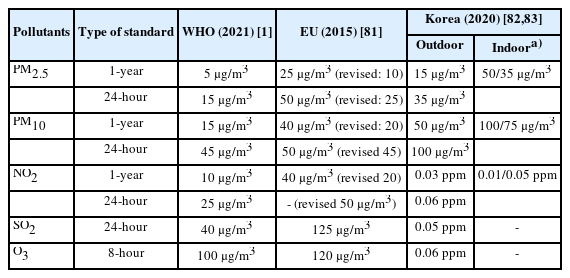
Outdoor and indoor air quality standards according to the WHO
The 2021 WHO Global Air Quality Guidelines proposed markedly stricter limits (e.g., PM2.5: 5 μg/m3; PM10: 15 μg/m3; NO2: 10 μg/m3; O3: 60 μg/m3), reflecting evidence of health effects at very low concentrations [1]. These values are non-binding but represent the most health-protective reference globally. The European Union (EU) Ambient Air Quality Directive (2008/50/EC) currently applies less stringent thresholds (PM2.5: 25 μg/m3; PM10: 40 μg/m3; NO2: 40 μg/m3; O3: 120 μg/m3) [81]. However, a 2024 revision aims to tighten limits by 2030 (e.g., PM2.5: 10 μg/m3; NO2: 20 μg/m3) to align with WHO recommendations. In contrast, Korea’s National Ambient Air Quality Standards remain relatively high, particularly for fine PM (PM2.5: 15 μg/m3; PM10: 50 μg/m3; NO2: 0.03 ppm; O3: 0.06 ppm), reflecting policy feasibility rather than health-based evidence [82,83]. In Korea, indoor air quality standards are set separately for general and sensitive facilities (e.g., medical institutions, elderly care centers, and daycare centers), with stricter standards for sensitive facilities. However, these standards permit very high levels of exposure. Overall, the WHO framework establishes science-based targets aimed at minimizing population-level health risks, whereas the EU system is progressively evolving toward these benchmarks through staged regulatory tightening. In contrast, Korea’s air quality thresholds remain substantially higher and are less protective from a health risk perspective.
At the global level, real-world pollution levels in many regions continue to exceed even these regulatory standards. According to the Health Effects Institute, the annual average PM2.5 concentration in Delhi, India (100 μg/m3) and NO2 level in Shanghai, China (41.6 μg/m3) far exceed the WHO air quality guidelines by approximately 20-fold and fourfold, respectively, highlighting the severe pollution burden in major cities of low- and middle-income countries [84].
PREVENTIVE AND THERAPEUTIC IMPLICATIONS OF AIR QUALITY CONTROL
Benefits of clean air policies on respiratory health
Since the Great Smog in London in December 1952, which caused more than 4,000 deaths, Western societies have made substantial efforts to improve air quality through the implementation of the Clean Air Act and related environmental regulations. These initiatives have led to marked reductions in air pollution across many regions, including major cities along the U.S. West Coast, where average PM2.5 concentration decreased from approximately 20–35 μg/m3 in the early 1990s to about 10–15 μg/m3 by 2010 [85]. The Children’s Health study provided compelling evidence of the health benefits of this improvement, demonstrating that long-term reductions in ambient NO2 and PM were associated with substantial increases in lung function growth among children aged 11 to 15 years [85]. Over the 13-year observation period, as air pollution levels decreased, both FEV1 and FVC significantly improved, and the proportion of children with clinically low FEV1 (< 80% predicted) decreased from 7.9% to 3.6%. Collectively, these findings indicate that sustained improvements in air quality are associated with enhanced lung function development in children.
In adult populations, improvements in air quality have also been associated with measurable benefits in lung function. Findings from the Swiss Cohort Study on Air Pollution and Lung Disease in Adults demonstrated that adults benefited from cleaner air [86]. In this prospective study of 9651 participants followed for 11 years, a 10 μg/m3 reduction in PM10 exposure was associated with a 9% slower annual decline in FEV1 and 16% slower decline in forced expiratory flow between 25% and 75% of the vital capacity (FEF25–75) percent predicted, reflecting improved small airway function. These results indicate that long-term reductions in PM can attenuate age-related decline in lung function not only in children but also in adults.
Associations between residential greenness and CRDs
Residential greenness, including parks, gardens, and forests, confers multiple health benefits to urban populations. Exposure to green spaces is generally regarded as health-promoting, as it encourages physical activity and social interactions, alleviates psychological stress, and reduces exposure to air pollution, noise, and excessive heat [87,88]. Moreover, greater exposure to greenness has been associated with lower risks of cardiovascular diseases, obesity, mortality, and mental health disorders [87–89]. Large-scale cohort studies have also investigated the impact of greenness on CRDs, providing growing evidence of its potential role in respiratory health.
In a large UK Biobank cohort of 469,348 participants, higher residential greenness, measured using the normalized difference vegetation index (NDVI) within 300–1,500 m, was significantly associated with a reduced incidence of IPF over a median follow-up of 11.9 years [90]. The protective association was stronger among individuals with intermediate or high genetic susceptibility to IPF, based on 13 IPF-related single-nucleotide polymorphisms. Mediation analyses revealed that reductions in PM2.5 and NO2 exposure accounted for approximately one-third to two-fifths of the observed protective effect, suggesting that greenness may mitigate IPF risk partly by lowering ambient air pollution.
Similarly, in the same UK Biobank cohort, each interquartile increase in greenness within a 500 m buffer, measured by both NDVI and the enhanced vegetation index, was associated with an 8–9% reduction in lung cancer risk [91]. This protective effect was largely mediated by decreased exposure to PM2.5 and increased physical activity, indicating that enhancing urban greenness may also help mitigate air pollution–related cancer risks.
Recent large-scale cohort studies have shown that greater residential greenness is associated with a lower risk of asthma [92]. In the UK Biobank, each interquartile increase in NDVI within 300 m of residence was linked to a 3.5% reduction in asthma incidence (HR 0.965, 95% CI 0.949–0.982), with stronger effects observed in non-smokers and genetically susceptible individuals. Mediation analyses indicated that approximately 40% of this protective effect was attributable to reductions in PM2.5 exposure. Consistent findings from the Chinese Biomarkers for the Prediction of Respiratory Disease Outcomes cohort further demonstrated that higher greenness was associated with a 35% lower risk of severe asthma among non-smokers (OR 0.645, 95% CI 0.441–0.943, p = 0.005) and significant improvements in clinical outcomes, including reduced sputum eosinophil counts (p = 0.038), fewer asthma exacerbations (p = 0.027), and better asthma control (Asthma Control Questionnaire 5 [ACQ5], p = 0.023) and QoL (Asthma Quality of Life Questionnaire [AQLQ], p = 0.048). These results suggest that enhancing urban greenness may be an effective strategy to mitigate air pollution–related respiratory diseases. However, a recent review that examined the relationship between greenness exposure and respiratory health outcomes indicated that the effects of greenness exposure on COPD remain unclear [93]. Similarly, in the Respiratory Health in Northern Europe study involving 5,355 adults, residential greenness was not associated with the incidence of chronic bronchitis or COPD [94].
Effects of personal lifestyle interventions on CRDs
Lifestyle habits such as wearing masks and using air purifiers have been proposed as individual interventions to mitigate the effects of air pollution. The use of masks has notably increased since the coronavirus pandemic, and masks have become one of the most common methods for dealing with fine dust. Despite their widespread use, limited evidence supports their effectiveness. In addition, there are concerns that wearing a mask may exacerbate breathing difficulties in patients with CRDs owing to increased breathing resistance and larger dead space [95]. However, studies conducted thus far have shown no definitive evidence that wearing a mask for short periods negatively affects hemodynamic indices such as blood pressure and heart rate [96]. In parallel, several studies have been conducted on the use of air purifiers to provide data on their potential benefits.
High-efficiency particulate air (HEPA) filtration significantly reduces the indoor concentration of traffic-related airborne particles in the homes of children with asthma [97]. In children with poorly controlled asthma, asthma control (ACQ score: 1.3 to 0.9, p = 0.003) and QoL (AQLQ score: 4.9 to 5.5, p = 0.02) improved after using a HEPA air cleaner. These findings demonstrate that HEPA filtration can enhance the clinical outcomes and QoL in children with uncontrolled asthma. Similarly, PM2.5 filtration significantly reduces indoor PM2.5 concentrations by 63.4%, leading to improvements in airway mechanics, including a 24.4% reduction in total airway resistance and a 43.5% reduction in small airway resistance [98]. In addition, fractional exhaled nitric oxide decreased by 27.6% and peak expiratory flow improved by 1.6%, reflecting reduced inflammation and enhanced lung function. These changes were particularly significant in children without eosinophilic airway inflammation, indicating that the filtration of PM2.5 may improve airway function and reduce inflammation in asthmatic children.
In a randomized double-blind trial of 116 former smokers with moderate-to-severe COPD, the use of active portable HEPA cleaners for six months reduced respiratory morbidity compared with sham devices [99]. Although changes in total St. George’s Respiratory Questionnaire (SGRQ) scores were not statistically significant, the active filter group showed greater improvement in SGRQ symptom subscales (β = −2.77, 95% CI −5.0 to −0.37), fewer moderate exacerbations (incidence rate ratio [IRR] = 0.32, 95% CI 0.12–0.91), and reduced rescue medication use (IRR = 0.54, 95% CI 0.33–0.86). Per-protocol analyses confirmed significant benefits in the overall SGRQ, symptom burden, and six-minute walk distance, particularly among participants who spent more time indoors. These effects were more pronounced in participants who used it more than 80% of the time.
The behavioral intervention significantly improved clinical outcomes in COPD patients, with a −5.9 reduction in SGRQ scores (−3.4 vs. 2.5, p = 0.049) and a −3.8 reduction in COPD assessment test (CAT) scores (−1.2 vs. 2.7, p = 0.001) [100]. The intervention comprised five activities: (1) operating indoor air filters and regularly replacing them, (2) regularly checking air quality forecasts, (3) practicing regular home ventilation by opening windows, (4) refraining from going outdoors when air pollution levels were high, and (5) adhering to inhaler treatments. Participants with better adherence to the intervention demonstrated greater improvements in CAT scores and lower PM2.5 levels. Additionally, regular checking of air quality forecasts was significantly associated with improved CAT scores, highlighting the effectiveness of individual-level behavioral interventions in reducing PM2.5 exposure and enhancing health outcomes.
FUTURE PERSPECTIVES
Non-pharmacological interventions targeting air pollution exposure represent a promising approach for mitigating disease progression and reducing mortality in patients with CRDs. However, the effectiveness and standardization of behavioral strategies to minimize exposure remain poorly defined, highlighting the need for further research and consensus in this area. Beyond individual-level interventions, public health strategies are essential, including the reevaluation of air quality standards and policy-driven transitions toward clean and sustainable energy sources. Geographic, residential, and cultural disparities contribute to heterogeneity in pollutant exposure, limiting the accurate assessment of individual exposure levels; therefore, improved precision in exposure evaluation and the development of quantitative biomarkers are needed. Finally, personalized risk-prediction models and tailored approaches that account for individual susceptibility, risk factors, and environmental or social determinants of exposure should be established to optimize prevention and management strategies for diverse populations.
CONCLUSION
The evidence summarized in this review demonstrates a consistent association between air pollution exposure and adverse health outcomes across CRDs, including increased incidence, accelerated lung function decline, more frequent exacerbations, and higher mortality. These associations are evident in airway diseases, ILDs, and lung cancer, emphasizing the urgent need for interventions aimed at reducing exposure to air pollution in at-risk populations. Improving air quality and minimizing exposure may substantially reduce the risk of lung-related complications. Furthermore, raising awareness to protect both environmental and public health, along with implementing multifaceted and personalized strategies for risk prediction and prevention, are essential for mitigating the disease burden attributable to air pollution.
Notes
CRedit authorship contributions
Yong Suk Jo: conceptualization, methodology, investigation, writing - original draft, writing - review & editing, visualization; Jin Woo Song: conceptualization, methodology, investigation, data curation, writing - review & editing, supervision, project administration, funding acquisition
Conflicts of Interest
The authors disclose no conflicts.
Funding
This study was supported by a grant from the Bio & Medical Technology Development Program (NRF-2022M3A9E4082647) of the National Research Foundation of Korea, funded by the Ministry of Science and ICT, Republic of Korea. This study was supported by the National Institute of Health Research Project (2024ER090500) and the Korea Environment Industry & Technology Institute through the Core Technology Development Project for Environmental Diseases Prevention and Management Program, funded by the Korea Ministry of Environment (RS-2022-KE002197), Republic of Korea.