


INTRODUCTION
Traditionally, the term ‘syndrome’ has been used to describe a collection of clinical manifestations lacking a clearly defined underlying mechanism, whereas ‘disease’ denotes a biologically coherent entity with well-established pathogenic pathways. The reclassification of Sjögren syndrome (SS; also known as sicca syndrome; ICD-10 code M35.0) to Sjögren disease (SjD) reflects the growing recognition of its defined pathobiological basis [1].
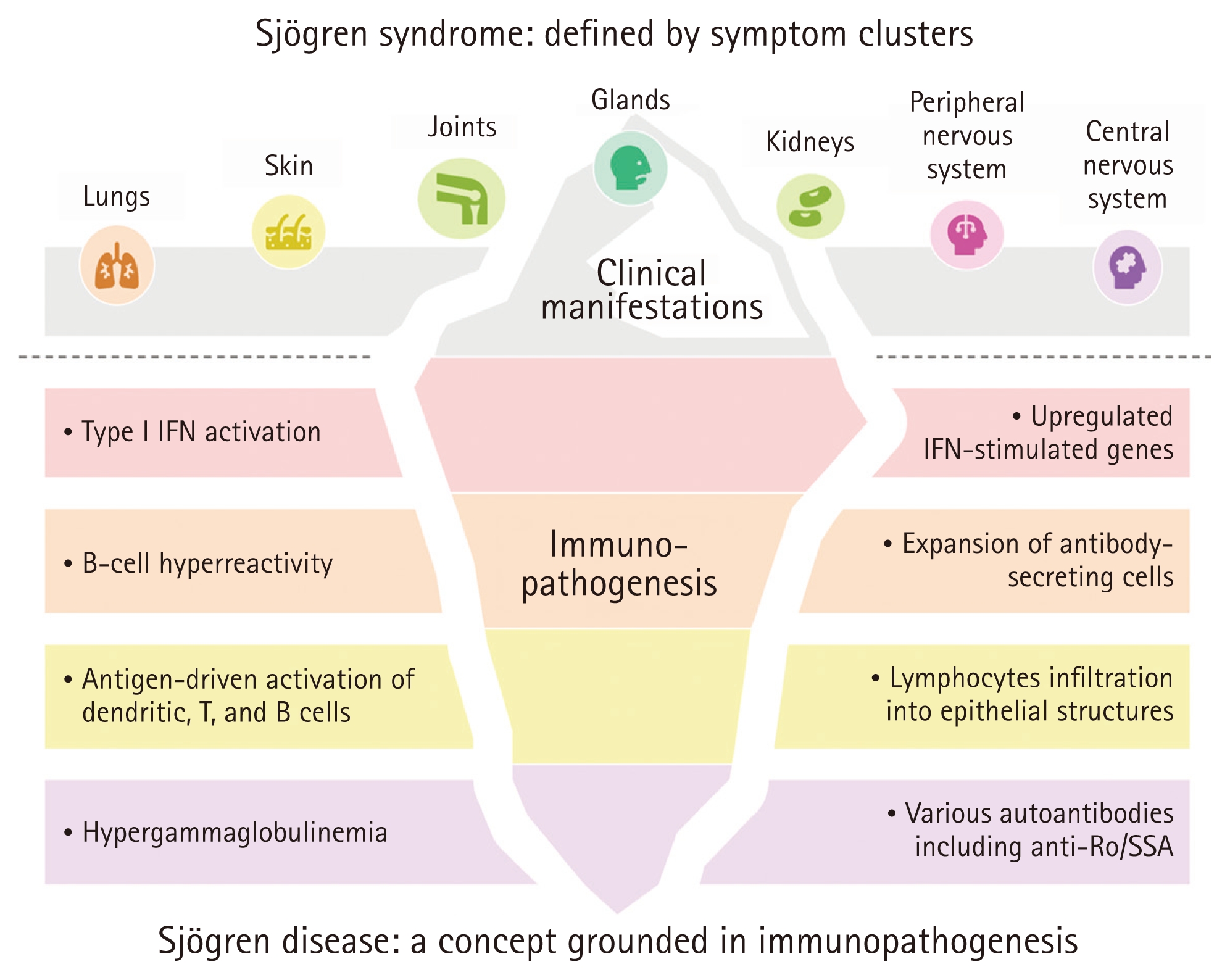
Well-established pathogenic features–such as systemic and local type I interferon (IFN) activation, B-cell hyperactivity with expansion of CD27+ memory B cells and long-lived plasma cells in glands, focal lymphocytic infiltration, ectopic germinal centers with local autoantibody production in exocrine glands–support its classification as a disease rather than a syndrome (Fig. 1) [2]. Concurrently, accumulating evidence has expanded the clinical spectrum of SjD beyond glandular involvement to include extra-glandular and systemic manifestations, aligning it more closely with other systemic rheumatic diseases such as systemic lupus erythematosus (SLE) and rheumatoid arthritis (RA).
This shift in terminology carries significant implications. It reflects biological plausibility, improves medical recognition, facilitates access to care, supports health and research policies, and promotes clinical trials for emerging therapies [3–5]. It also underscores the importance of avoiding overdiagnosis in individuals with isolated sicca symptoms lacking immunological evidence.
In parallel, the conventional dichotomy of “primary” versus “secondary” SS is being reconsidered. SjD may coexist with other autoimmune diseases such as RA or SLE, regardless of temporal sequence, as part of polyautoimmunity [6]. Many such patients exhibit immunological and clinical features of SjD [4]. The term “associated SjD” has emerged as a more practical and inclusive alternative, avoiding the implication that SjD is secondary or less important [7,8].
This article reviews the historical and conceptual evolution of SS classification criteria and discusses the pitfalls and uncertainties encountered in routine clinical practice when diagnosing SjD.
EVOLUTION OF CLASSIFICATION CRITERIA
Professor Henrik Sjögren first proposed, in his 1933 doctoral thesis, that keratoconjunctivitis sicca (KCS) might reflect a systemic disease. He studied 19 women with KCS; all had xerostomia, and 13 (68%) had chronic arthritis/arthralgia. Moreover, he employed slit-lamp examination using Rose Bengal dye to assess dry eye, laying the foundation for modern ocular surface staining techniques. In addition, he performed histopathologic examinations of salivary glands and identified lymphocytic infiltration [9].
Over time, classification criteria for SS have evolved with growing insights into its clinical and immunological pathogenesis. Early U.S. National Institutes of Health (NIH) studies defined cases based on the presence of two of the following three features: KCS, xerostomia, and RA or another connective tissue disease (CTD) [10]. By the time of the 2016 American College of Rheumatology (ACR)/European League Against Rheumatism (EULAR) criteria [11], more than 11 sets of criteria had been proposed, including the San Francisco, Copenhagen, Japanese, Greek, San Diego, preliminary European, and American-European Consensus Group (AECG) criteria [12]. Earlier criteria emphasized subjective or objective dryness, with limited consideration of systemic features. In addition, some criteria used less stringent thresholds for exocrine dysfunction compared with current standards (e.g., Schirmer’s test < 10 mm/5 min or the number [not density] of periductal lymphocytic focus ≥ 1).
In the San Diego criteria, autoantibodies related to SS (at least one of rheumatoid factor [RF] ≥ 1:160; antinuclear antibody [ANA] ≥ 1:160; or positive anti-Ro or anti-La antibodies) were first incorporated [13]. In contrast to the preliminary European criteria, where SS is defined by the presence of at least two of salivary, lacrimal, and systemic components, the AECG criteria mandate one or more of the following: anti-Ro or anti-La positivity, or focal lymphocytic sialadenitis (FLS) with a focus score (FS) ≥ 1/4 mm2 [14,15]. The two European criteria were the first to propose exclusion lists for SS-mimicking conditions. Even if dryness symptoms are not present, classification is possible if three out of four objective criteria are fulfilled in the AECG criteria [15]. Therefore, the AECG criteria improved specificity and enabled classification of individuals with early or mild SS. Additionally, the AECG criteria distinguish between primary and secondary SS; in secondary SS, anti-Ro and anti-La are not counted. The 2012 ACR criteria are based on three objective measures: ocular staining score (OSS), FLS with an FS ≥ 1/4 mm2, and serologic markers (anti-Ro, anti-La, or the presence of RF and ANA) [16]. The 2016 ACR/EULAR classification criteria unified previous systems into a weighted score-based model [11]. It consists of five highly specific items: anti-Ro antibody (3 points), minor salivary gland biopsy (MSGB) showing FLS with FS ≥ 1/4 mm2 (3 points), OSS ≥ 5 (1 point), Schirmer’s test ≤ 5 mm/5 min (1 point), and unstimulated whole salivary flow (USWSF) ≤ 0.1 mL/min (1 point). Classification requires a total score of ≥ 4, with anti-Ro or MSGB positivity as essential items. The current criteria define two entry pathways: ocular or oral dryness symptoms, and clinical suspicion based on the EULAR Sjögren’s syndrome disease activity index (ESSDAI), which requires at least one positive domain [11,17]. ESSDAI was developed to assess objective systemic disease activity across 12 organ-based domains [17,18]. The 2012 ACR and 2016 ACR/EULAR classification criteria are applicable to individuals with non-sicca phenotypes, regardless of whether they have “primary” or “secondary” SS, although they were originally derived from cohorts of primary SS patients [11,16]. Table 1 summarizes and compares the three most recent and widely used sets of criteria.
CLASSIFICATION CRITERIA IN CLINICAL PRACTICE: COMMON PITFALLS
Classification criteria are intended to ensure research uniformity and are not meant for diagnosing individual patients. However, in the absence of an established diagnostic definition for SjD, clinicians often rely on classification criteria to guide clinical diagnosis. This leads to spectrum bias, as most validation cohorts used to develop these criteria include patients with established disease, whereas clinical settings often involve early or atypical presentations [19,20]. Comparative studies of the 2002 AECG, 2012 ACR, and 2016 ACR/EULAR classification criteria show that they do not identify the same populations. Notably, the 2016 ACR/EULAR criteria demonstrate higher sensitivity and lower specificity–i.e., a higher false-positive rate–for SjD diagnosis in Korean and Japanese studies [21,22]. Therefore, in clinical practice, it is essential to apply classification criteria only after identifying patients with a high pretest probability based on clinical features and laboratory findings. This approach improves posttest probability and minimizes the risk of both underdiagnosis and overdiagnosis.
SICCA SYMPTOMS: COMMON BUT NONSPECIFIC
Dry eye and dry mouth are very common in the general population, and sicca symptoms are not specific to SjD. Overall, SjD is estimated to be present in around 10% of individuals evaluated for dry mouth or dry eye symptoms [23,24]. In a Korean cohort recruited from individuals undergoing general health examinations, the prevalence of xerostomia was 33%, with higher rates observed in older adults and those taking multiple medications, particularly postmenopausal women [25]. Moreover, dry mouth is associated with various conditions such as mouth breathing, use of drugs with anticholinergic effects, neuropathic pain syndromes including burning mouth syndrome, anxiety, and depression, underscoring the need for careful differential diagnosis. Additionally, dry mouth is more prevalent in females, as observed in SjD. This female predominance may be due to biological factors such as smaller salivary gland volume and the influence of sex hormone in females [26,27].
Similarly, in Korean adults, the prevalence of dry eye ranges from 14% in the general population to 33% among the elderly [28,29]. The most common subtype of dry eye is the evaporative type, primarily associated with Meibomian gland dysfunction [23]. According to the Dry Eye Clinical Survey-Korea study, the prevalence of evaporative versus aqueous-deficient dry eye is 60% and 40%, respectively [30].
Importantly, subjective dryness does not reliably correlate with objective measures of exocrine gland dysfunction. For example, in a large study of apparently healthy individuals without xerostomia, USWSF rates ranged from 0.008 to 1.85 mL/min [31]. Saliva film thickness on the oral mucosa is known to correlate with xerostomia independently of USWSF and depends on residual saliva volume after swallowing, evaporation, or diffusion through the oral epithelium [32]. A Chinese population-based study found that 22% of individuals with abnormal ophthalmic signs reported dry eye symptoms, whereas 39% of those with dry eye had no ocular signs [33]. In the Sjögren’s International Collaborative Clinical Alliance (SICCA) registry, which enrolled individuals with sicca symptoms, more than 50% did not meet the classification criteria for SS [34].
Because several conditions can mimic the clinical and laboratory features of SjD, the current classification criteria include a list of exclusion conditions, such as a history of head and neck radiation therapy, active hepatitis C virus (HCV) infection, acquired immune deficiency syndrome (AIDS), sarcoidosis, amyloidosis, graft-versus-host disease (GVHD), and IgG4-related disease [11]. Active HCV infection, in particular, can present with sicca symptoms, positive ANA, RF or cryoglobulins, and even anti-Ro/Sjögren’s syndrome A antigen (SSA) antibodies, leading to potential misclassification [35]. IgG4-related disease can present with lacrimal and salivary gland enlargement and dysfunction; however, its histopathologic features, including storiform fibrosis, obliterative phlebitis, and diffuse plasma cell infiltration with increased in IgG4+ cells, are distinct from those of SjD [36]. These mimicking conditions must be carefully excluded before initiating the diagnostic approach to SjD or confirming the diagnosis.
EXTRAGLANDULAR MANIFESTATIONS: RAISING CLINICAL SUSPICION
The 2016 ACR/EULAR classification criteria for SS can be applied even in the absence of sicca symptoms if an extraglandular manifestation–defined as at least one domain with a positive item on the ESSDAI–is considered attributable to SjD. The shift reflects the recognition of SjD as a systemic disease in which extraglandular manifestations may precede or predominate over classical exocrine involvement. According to data from the international, multi-ethnic Big Data Sjögren Project Consortium registry, the most common systemic features involve the articular (41%), hematological (22%), and pulmonary (12%) domains, apart from the biological domain (50%) [37]. The prevalences of other domains are approximately 10% or less: lymphadenopathy (11%), cutaneous and constitutional (10%), peripheral nervous system (6%), renal (5%), muscular (3%), central nervous system (2%) domains. Among non-ESSDAI-defined features, Raynaud phenomenon (15%) is the most frequently reported [37].
Arthritis in SjD typically presents as symmetric, non-deforming, and non-erosive synovitis, most commonly affecting small joints such as the metacarpophalangeal (MCP), proximal interphalangeal, and wrist joints [38,39]. While this pattern resembles early RA, joint involvement in SjD may be characterized by a low-grade synovial inflammatory process. Ultrasound studies have demonstrated subclinical synovitis in MCP joints in approximately 40% of SjD patients, even in the absence of clinical joint swelling [40]. RF is positive in approximately 50% of SjD patients [37]. Anti-cyclic citrullinated peptide antibodies (anti-CCP), a hallmark of RA, are found in up to 10% of SjD patients [41,42]. In SjD, the presence of RF or anti-CCP is associated with a higher frequency of articular involvement. In addition, longitudinal studies show that up to 50% of anti-CCP-positive SjD patients may eventually meet RA classification criteria [43].
Common hematologic abnormalities in SjD include mild to moderate anemia, leukopenia (lymphopenia or neutropenia), and thrombocytopenia, resulting from chronic immune-mediated bone marrow suppression or peripheral destruction. Cytopenia is reported in up to 30% of patients and may be the initial manifestation; thus, SjD should be considered in the differential diagnosis of apparently idiopathic cytopenia [24]. Leukopenia is observed in approximately 15% of SjD patients and may correlate with systemic disease activity [44]. Although less common, autoimmune hemolytic anemia and immune thrombocytopenia may occur. In such cases, the presence of ANA and anti-Ro/La antibodies may lead to misclassification as SLE rather than SjD. Notably, hematological abnormalities, especially CD4+ T-lymphocytopenia, may be associated with an increased risk of B-cell lymphoma [44].
Pulmonary involvement is a well-recognized extraglandular manifestation and is associated with increased mortality [41,45]. In the ESSDAI, the pulmonary domain includes persistent cough or bronchial involvement and interstitial lung disease (ILD). Pulmonary function tests frequently show a restrictive pattern with reduced diffusion capacity for carbon monoxide. The reported prevalence of clinically significant pulmonary involvement is approximately 10–25% [46], although this may be underestimated, as respiratory symptoms can be subtle or absent in early disease. Airway disease in SjD includes tracheobronchial sicca, bronchiectasis, and chronic bronchiolitis. Tracheobronchial sicca, often presenting as a chronic, dry, non-productive cough, may mimic airway hyperresponsiveness [47]. The prevalence of ILD in SjD increases over time, from 10% in the first year to 20% after 5 years and up to 47% after 15 years [45]. Among ILD subtypes, nonspecific interstitial pneumonia is the most frequently observed, followed by usual interstitial pneumonia and, less commonly, lymphocytic interstitial pneumonia [46].
EXOCRINE DYSFUNCTION ASSESSMENT: A GATEWAY TO DIAGNOSIS
Hyposalivation has been defined as an USWSF ≤ 0.1 mL/ min [48]. This threshold was originally proposed to define salivary hypofunction in general, not specifically for SjD. Furthermore, applying a fixed cut-off value to all individuals may be overly simplistic. A recent analysis suggests that age- and sex-specific thresholds should be considered, as USWSF naturally declines with age and is significantly lower in women. The study proposed USWSF ≤ 0.2 mL/min as a more appropriate threshold [27].
Although salivary gland scintigraphy has historically been used to evaluate salivary gland function, it is no longer recommended as a diagnostic tool for SjD due to the lack of a standardized protocol [49]. Moreover, scintigraphy findings correlate poorly with histological severity and serologic status, further limiting their diagnostic utility [50].
In contrast, salivary gland ultrasonography (SGUS) has emerged as a promising diagnostic modality for SjD due to its noninvasive nature and increasing standardization. The Outcome Measures in Rheumatology (OMERACT) semi-quantitative scoring system assesses echogenicity, homogeneity, and glandular architecture in both the parotid and submandibular glands [51]. OMERACT SGUS scores have shown correlations with USWSF rates and minor salivary gland histopathology, supporting SGUS as a complementary diagnostic tool [52,53]. SGUS is particularly useful in anti-Ro-negative patients, in whom histopathologic confirmation is essential for the diagnosis of SjD [54]. However, SGUS cannot fully replace MSGB for definitive diagnosis [55]. Its ability to differentiate SjD from other inflammatory salivary gland diseases, including sarcoidosis and HCV-related sialadenitis, remains controversial [56,57]. Therefore, SGUS findings should be interpreted in the context of clinical information and not used in isolation when establishing a diagnosis.
Tear break-up time, commonly used to evaluate dry eye, has limited discriminatory value for SjD, as it reflects tear film instability and evaporative tear loss. In contrast, Schirmer’s test assesses aqueous tear production from the lacrimal glands. However, Schirmer’s test has low reproducibility and high variability across repeated measurements, particularly in patients with values near the diagnostic threshold [58,59]. Consequently, when tear deficiency is not marked, Schirmer’s test may contribute to diagnostic uncertainty under the 2016 ACR/EULAR criteria.
The OSS reflects ocular surface epithelial damage in dry eye disease rather than directly measuring glandular hypofunction. In the 2016 ACR/EULAR criteria, equal weight is assigned to Schirmer’s test and OSS. However, since SjD patients typically show more pronounced hypofunction and epithelial damage than non-SjD patients, OSS demonstrates greater specificity than Schirmer’s test. In the SICCA registry, among patients ultimately classified as non-SjD, 32% had Schirmer’s test ≤ 5 mm/5 min, whereas approximately 12% had OSS ≥ 5 [34]. Furthermore, intense staining in the nasal or temporal conjunctiva is more specific to SjD than corneal staining [60,61]. Despite its specificity, OSS is subject to inter-rater variability. A multicenter study reported that such variability led to false-negative or false-positive classification in approximately 5–13% of cases [62]. These findings highlight the need for standardized assessment protocols and consistent rater training [63].
SEROLOGIC MARKERS: ANTI-Ro ANTIBODIES AND CLINICAL SIGNIFICANCE
Anti-Ro antibodies are a hallmark of autoimmune pathogenesis and represent a pivotal serological biomarker in current classification criteria. Although their presence provides important diagnostic clues in SjD, interpretation should be integrated with the clinical context.
Anti-Ro antibodies include two distinct specificities: anti-Ro60 (targeting TROVE2, an RNA-binding protein) and anti-Ro52 (targeting TRIM21, an IFN-inducible E3 ubiquitin ligase). While TROVE2 is not classified as IFN-inducible, both proteins participate in IFN-mediated inflammatory pathways. TRIM21-deficient mice show exaggerated inflammatory responses, indicating its role as a negative regulator of interleukin-23–IFN signaling [64]. TROVE2-deficient mice develop a lupus-like syndrome, supporting its protective role in the clearance of autoimmunity-inducible nucleic acids [65]. Reflecting their immunologic relevance, anti-Ro antibodies are frequently observed in systemic rheumatic diseases characterized by a high IFN signature, including SLE, SjD, systemic sclerosis (SSc), and idiopathic inflammatory myopathies [66].
Unlike anti-dsDNA antibodies, which are secreted by plasmablasts and fluctuate with disease activity, antibodies against RNA-binding proteins, such as anti-Ro, anti-Sm, and anti-RNP, are primarily produced by long-lived plasma cells [67–69]. Anti-Ro antibodies secreted from long-lived plasma cells do not correlate with disease activity and can be present for decades prior to the clinical onset of SjD [70]. Moreover, anti-Ro antibodies are detected in individuals without autoimmune disease: approximately 10% of ANA-positive individuals are anti-Ro-positive by enzyme immunoassay or line immunoblot [71,72]. Therefore, anti-Ro positivity is not unique to SjD, and low-level or transient positivity may lack clinical significance.
In current classification criteria for SjD, “anti-Ro” is described as a single serological marker, without distinguishing between anti-Ro60 and anti-Ro52. Historically, SSA was considered a single protein. Although Ro60 (TROVE2) and Ro52 (TRIM21) are genetically and functionally distinct, combined testing for anti-Ro antibodies has continued due to cost-effectiveness and technical simplicity. However, emerging evidence indicates that anti-Ro60 and anti-Ro52 differ in their clinical relevance and disease associations. Anti-Ro60 is closely associated with SLE and SjD, whereas Ro52 is more broadly detected across systemic and organ-specific autoimmune disorders [73–75]. In a French study, dual positivity for anti-Ro60 and anti-Ro52 shows the highest odds ratio (OR = 4.2) for SjD, especially when combined with anti-La positivity [74]. Conversely, isolated anti-Ro52 positivity is more frequently observed in inflammatory myopathies and non-autoimmune conditions, including infections and malignancies [74,75]. Additionally, distinct anti-Ro profiles are associated with different clinical phenotypes and prognosis in SjD. Dual anti-Ro60/Ro52 positivity is associated with more severe glandular dysfunction and B-cell hyperactivity compared with anti-Ro60 alone [76]. Anti-Ro52 is also associated with poor outcomes in CTD-associated ILD. An Australian study further reports that isolated anti-Ro52 is linked to higher disease activity and an increased prevalence of cryoglobulinemia, although its clinical implications remain debated [77]. Accordingly, separate evaluation of anti-Ro60, anti-Ro52, and anti-La antibodies is increasingly recommended, particularly in diagnostically ambiguous cases.
SALIVARY GLAND HISTOPATHOLOGY: CONTEXTUAL INTERPRETATION
MSGB has been a key tool for evaluating SjD-related histopathology since the 1960s and provides prognostic information, particularly regarding the risk of lymphoma. Although MSGB is invasive, the procedure is generally considered safe; neurological complications occur in 1–6% of cases, but most resolve spontaneously [69].
The hallmark finding is FLS, defined by a FS ≥ 1/4 mm2 in current classification criteria. A focus is defined as an aggregate of ≥ 50 mononuclear cells located within preserved glandular lobules. This threshold yields a diagnostic sensitivity of 80–92% and specificity of 88–97% for SjD [55]. To ensure biopsy adequacy, current guidelines recommend obtaining 4–5 minor salivary glands, with at least 8–10 mm2 of evaluable tissue containing well-preserved lobular architecture and minimal fibrosis [78]. Insufficient specimens may overestimate the calculated FS. Nonspecific chronic sialadenitis (NSCS) and sclerosing chronic sialadenitis (SCS) can mimic FLS but are typically characterized by interstitial fibrosis, ductal dilation, and fatty replacement [79]. These patterns should be carefully distinguished from FLS. Importantly, FLS is not pathognomonic for SjD. Up to 20% of healthy individuals, especially older adults, may demonstrate FS ≥ 1/4 mm2, likely due to subclinical inflammation, trauma (e.g., lip biting), or prior infection [80,81].
The current FS system does not reflect the size of foci or lymphocyte subsets. The composition of infiltrates evolves with disease stage. Early or mild disease is T-cell predominant, whereas more advanced disease exhibits B-cell–dominant infiltrates, which are associated with an increased risk of lymphoma [82]. A Dutch study demonstrates that the presence of B-cell–associated features (≥ 2 of IgG-predominant plasma cell shift, germinal center–like structures, and lymphoepithelial lesions) achieves 100% specificity, even in patients with FS < 1/4 mm2 [83]. These findings suggest that B-cell-oriented features can enhance the diagnostic value of MSGB. Furthermore, parotid gland biopsy may offer superior diagnostic yield, as it more frequently reveals B-cell-associated histologic features compared with matched MSGB specimens [84].
Preanalytical factors may also influence histopathology. Current smoking has been reported to reduce lymphocytic infiltration [85]. Glucocorticoids and cytotoxic immunosuppressive agents may also suppress glandular inflammation [86,87]. Multi-level sectioning of MSGB specimens may enhance diagnostic yield in borderline cases [88].
MSGB interpretation is subject to interobserver variability. A multicenter study reports a median inter-rater κ value of 0.57 (range 0.44–0.92) for identifying FLS, and 16% of MSGB cases required histologic revision following blinded expert review in a UK study [89,90]. Moreover, MSGB findings may change over time. In the SICCA cohort, up to 25% of patients with an initial FS < 1/4 mm2 later develop FS ≥ 1/4 mm2 upon repeat biopsy after 2–3 years, and ultimately, 8% are reclassified as SjD [87]
Temporal and interobserver variability highlight the need for standardized histopathological protocols and expert pathology review to ensure reliable diagnosis. In summary, while a FS ≥ 1/4 mm2 in MSGB remains a cornerstone of SjD diagnosis, its interpretation must consider clinical context, sample quality, infiltrate composition, and mimickers such as NSCS/SCS.
ASSOCIATED SjD: RECOGNITION AND DIAGNOSIS
The traditional distinction between primary and secondary SS has been increasingly challenged. Growing evidence shows substantial clinical and immunopathologic overlap between SjD and other autoimmune diseases. Although SjD can coexist with a variety of organ-specific or systemic autoimmune diseases [91], the term “secondary SS” has historically been limited to cases with concurrent non-SjD systemic rheumatic diseases. Notably, in the historical SS cohorts described by Henrik Sjögren and by the NIH, a considerable proportion of patients had coexisting autoimmune diseases, including RA. The term “secondary SS” was originally introduced through comparisons between patients with isolated sicca symptoms and those with coexisting RA [92]. Over time, this distinction expanded to include other rheumatic diseases and became embedded in SS classification criteria, despite limited supporting evidence [7]. As a result, the 2016 criteria no longer distinguish between primary and secondary forms. Additionally, experts have proposed the term “associated SS or SjD” to describe overlapping autoimmune status (polyautoimmunity) without implying causality or subordination [4,7].
Salivary glands, as part of the oral mucosal immune system, participate in both innate and adaptive immune responses. They are continuously exposed to diverse microorganisms and contain immune-active cells, including dendritic cells, macrophages, B and T cells, and epithelial cells [2,93]. Given this immunological complexity, it is not surprising that salivary glands are affected in a variety of inflammatory conditions, including viral infections, GVHD, and systemic rheumatic diseases beyond SjD. Furthermore, individuals with one autoimmune disease are more likely to develop another. Therefore, patients with RA, SLE, or SSc may develop clinically significant exocrine gland involvement and fulfill classification criteria for SjD. In such cases, the term “associated SjD” may be appropriate for both clinical and research purposes.
However, this concept still faces challenges in clinical practice. Physician awareness of and attention to SjD can influence differential diagnosis. In a multicenter study, among patients with sicca symptoms previously diagnosed with RA, 36% were reclassified as having primary SS and 20% as secondary SS upon re-evaluation. Likewise, among those previously diagnosed with SLE, 31% were reclassified as primary SS and 22% as secondary SS [94]. Despite overlapping clinical manifestations between SjD and other CTDs, and the modifying effects of anti-rheumatic drugs on MSGB histopathology, no consensus currently exists on when or in whom to evaluate coexisting SjD in patients with non-SjD CTDs. Exocrine dysfunction not attributable to other causes, or the presence of anti-Ro52/Ro60 dual positivity, may warrant further evaluation. Ambiguity also arises in disease activity assessment. The ESSDAI scoring system excludes manifestations attributed to other autoimmune diseases. For instance, autoimmune cytopenia, synovitis, subacute cutaneous lupus erythematosus, or ILD should not be scored when they are considered manifestations of SLE, RA, or SSc in patients with associated SjD [18]. However, it is often difficult to determine the relative contribution of SjD versus non-SjD conditions. This restriction implies a hierarchical relationship in which SjD is subordinate to coexisting rheumatic diseases. Such an approach is inconsistent with recent conceptual advances and may underestimate disease activity in patients with associated SjD. In summary, while the concept of associated SjD has gained broader acceptance, there remains a need for practical consensus to guide diagnosis and disease activity assessment in these patients.
CLINICAL DIAGNOSIS OF SjD: CHALLENGES AND CLUES
Despite refinements in classification criteria, diagnosing SjD in clinical practice remains difficult due to its heterogeneity. In associated SjD, clinical findings may overlap with or be masked by those of another CTD, leading to missed diagnoses unless clinical suspicion is high. In routine practice, several clinical and laboratory findings may suggest SjD and help determine whether to proceed with further diagnostic evaluation (Table 2, 3).
First, demographics offer early diagnostic clues. SjD predominantly affects women, particularly those over the age of 50. In men, dryness tends to be less pronounced, whereas extraglandular manifestations, including pulmonary involvement and lymphoma, are more common [95,96]. Juvenile-onset SjD is rare and typically presents with recurrent parotid swelling rather than dryness [97].
Second, as exocrine glands are the most commonly affected organs in SjD, clinicians often consider SjD when patients report oral or ocular dryness attributable to reduced body fluid production. In clinical practice, assessing oral mucosal wetness and performing Schirmer’s test are practical screening methods. Appropriate sites for assessing intraoral wetness include the mucosa near the orifices of the Wharton’s and Stensen’s ducts, located on the floor of the mouth beneath the tongue and lateral to the second upper molar, respectively [98]. Additionally, a history of recurrent unilateral or bilateral parotitis further increases the likelihood of SjD [38].
Third, distinguishing SjD from sicca syndromes in polymedicated patients presents another challenge. Medications such as antihypertensives, anticholinergics, diuretics, or immune checkpoint inhibitors for malignancies can negatively affect USWSF and Schirmer’s test [99–101]. Exocrine function tests should be deferred for a period equivalent to at least four times the half-life of the suspected drug whenever possible [15]. If the potentially offending drugs cannot be suspended, test results may not be reliable.
Fourth, routine laboratory findings may raise suspicion for SjD: elevated erythrocyte sedimentation rate with normal C-reactive protein levels, hypergammaglobulinemia or a low serum albumin-to-total protein ratio, and cytopenia. In the appropriate clinical context, the presence of hypocomplementemia may further support the diagnosis [38]. Even in suspected but unclassifiable cases, hypergammaglobulinemia and hypocomplementemia have been identified as risk factors for future SjD development [87]. Although uncommon, hypokalemia of undetermined etiology, persistently alkaline urine, or evidence of medullary nephrocalcinosis— reflecting distal renal tubular acidosis—may also suggest SjD [38]
Fifth, over-reliance on serological markers can be misleading, as autoantibodies may be present in the absence of clinically apparent disease and, conversely, disease may exist without detectable autoantibodies [94]. Although anti-Ro/SSA antibodies are highly specific, they are negative in 8–37% of SjD patients [102]. Seronegative SjD is often associated with older age, a higher subjective symptom burden, and a lower risk of lymphoma [38,102]. Unique B-cell hyperactivity in SjD may lead to the production of diverse autoantibodies or the emergence of distinct clinical subgroups, even in the absence of a corresponding CTD diagnosis [103]. Therefore, the presence of disease-specific autoantibodies without corresponding clinical disease may suggest underlying SjD. For example, anti-centromere antibodies are detected in 8–25% of East Asian SjD patients, even in the absence of SSc, and are associated with severe exocrine dysfunction and Raynaud’s phenomenon [104]. Anti-CCP positivity increases the likelihood of non-erosive arthropathy and the risk of RA progression, while anti-RNP positivity is associated with muscular and pulmonary involvement [43,105]. Anti-dsDNA positivity is observed in 8% of Korean SjD patients without SLE and may predict future SLE development [106]. Autoimmune thyroid disease (AITD) is the most frequently associated autoimmune disease in SjD. A meta-analysis shows an OR of 3.5 for AITD in primary SS patients [107]. A Korean clinic-based study reports overt hypothyroidism in 9% of SjD patients, while anti-thyroglobulin and anti-thyroid peroxidase antibodies are positive in 16% and 14%, respectively, among those without overt thyroid disease [108].
Sixth, although limb (muscular and articular) pain is common and fibromyalgia affects 15–35% of SjD patients [38], the ESSDAI muscular domain includes only objective myositis [18]. Peripheral or central neurologic manifestations, including polyneuropathy, optic neuritis, or multiple sclerosis-like features, may occur. However, widespread or intraoral neuropathic pain is negatively associated with SjD [109]. In such cases, alternative diagnoses should be prioritized.
Seventh, challenges include limited access to diagnostic tools and the invasiveness of MSGB. Inadequate diagnostic assessment may lead to overdiagnosis and overtreatment. Because SjD diagnosis requires a multidisciplinary approach, clinicians should refer complex cases to specialized institutions. As there are currently no approved disease-modifying therapies for SjD and many patients remain clinically stable for several years [110,111], careful follow-up at 6–12 month intervals may be appropriate in patients with low disease activity or without high-risk features [112]. Importantly, SjD carries an increased risk of hematologic malignancies, including lymphoma. A meta-analysis reports pooled standardized incidence ratios of 11.6 for hematological malignancies, 13.7 for non-Hodgkin lymphoma, 8.8 for Hodgkin lymphoma, 8.3 for multiple myeloma, and 2.6 for leukemia [113]. Patients with persistent parotid swelling or lymphadenopathy, low complement C4 levels, Raynaud’s phenomenon, RF or cryoglobulinemia, or monoclonal gammopathy should be referred promptly, even if they do not meet full classification criteria for SjD [55].
CONCLUSION
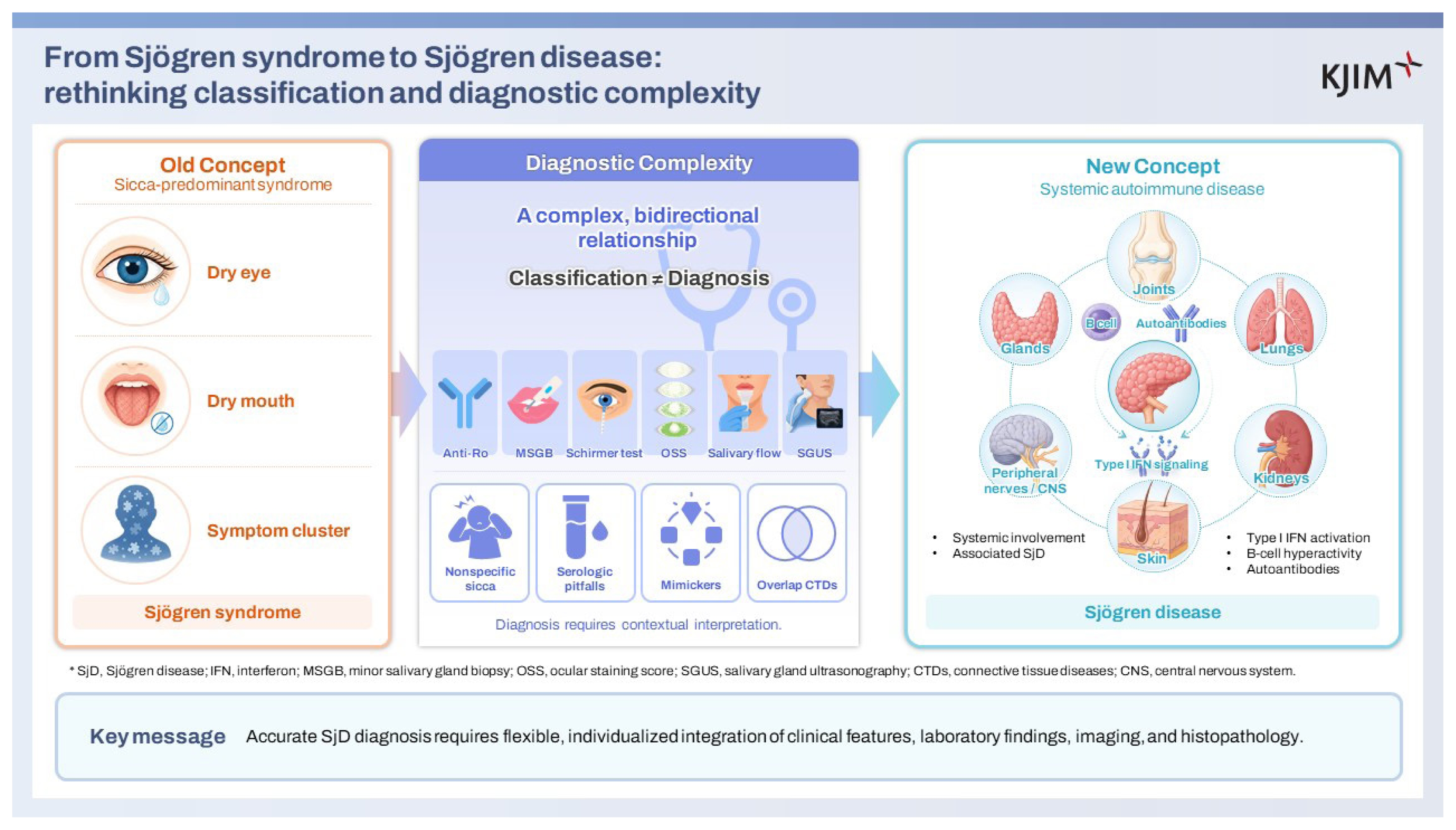
The conceptualization of SS has evolved from a sicca-predominant syndrome to a systemic autoimmune disease, accompanied by successive refinements in classification criteria over several decades. In parallel with advances in immunopathogenesis and the recognition of clinical heterogeneity, expert consensus has led to terminological changes–replacing SS with SjD and “secondary SS” with “associated SjD”. These developments have heightened clinical awareness of the importance of accurate diagnosis and systematic assessment of SjD in everyday practice.
Nevertheless, substantial challenges remain. The marked heterogeneity of SjD, frequent overlap with other autoimmune conditions, the need for a multidisciplinary approach, and limitations in diagnostic biomarkers complicate clinical diagnosis. Classification criteria are not intended for diagnostic use, and spectrum bias is inevitable. Therefore, clinicians must integrate demographic features, laboratory findings, imaging results, and histopathologic data within a flexible and individualized framework. A high index of suspicion is particularly warranted in seronegative or non-sicca presentations. To optimize real-world diagnosis and management of SjD, there is an urgent need for updated clinical consensus, especially regarding diagnostic strategies and disease activity assessment, in the context of ongoing terminological and conceptual shifts in the field.


 PDF Links
 PubReader
 ePub Link
 XML Download
 Full text via DOI
 Download Citation
 Print
Print