


INTRODUCTION
Interventional treatment of acute coronary syndrome (ACS) begins with securing appropriate vascular access and ends with achieving effective hemostasis at the puncture site. Patients with ACS are at increased bleeding risk due to the frequent use of potent antiplatelet agents, parenteral anticoagulation, or intravenous glycoprotein IIb/IIIa inhibitors. The 2023 European and 2025 American guidelines for the management of ACS recommend transradial access (TRA) over transfemoral access (TFA) to reduce bleeding, vascular complications, and mortality [1,2].
In cases of severe coronary calcification, complex and high-risk coronary intervention, or cardiogenic shock, TFA is often required because large-bore guiding catheters are necessary for left main disease, bifurcation lesion, rotational atherectomy or mechanical circulatory support. Therefore, determining the most appropriate vascular access is crucial in ACS, balancing guideline recommendations with real-world procedural demands. In the Korean Prospective Registry for Evaluating the Safety and Efficacy of Distal Radial Approach (KODRA) registry, 37.4% of patients presented with ACS. In this cohort, puncture failure was strongly associated with weak distal radial artery pulsation and limited operator experience (< 100 distal radial access [DRA] cases) [3]. Although the learning curve improves with increasing operator experience [4,5], weak arterial pulsation remains a major limitation for DRA, particularly in ACS patients.
While several randomized controlled trials (RCTs) and meta-analyses have established the safety and efficacy of DRA in elective or stable coronary procedures, clinical evidence regarding its use in ACS remains limited [6–9]. Therefore, we aimed to assess the feasibility and safety of DRA in ACS patients with good arterial pulsation using data from the KODRA registry.
METHODS
Study design and population
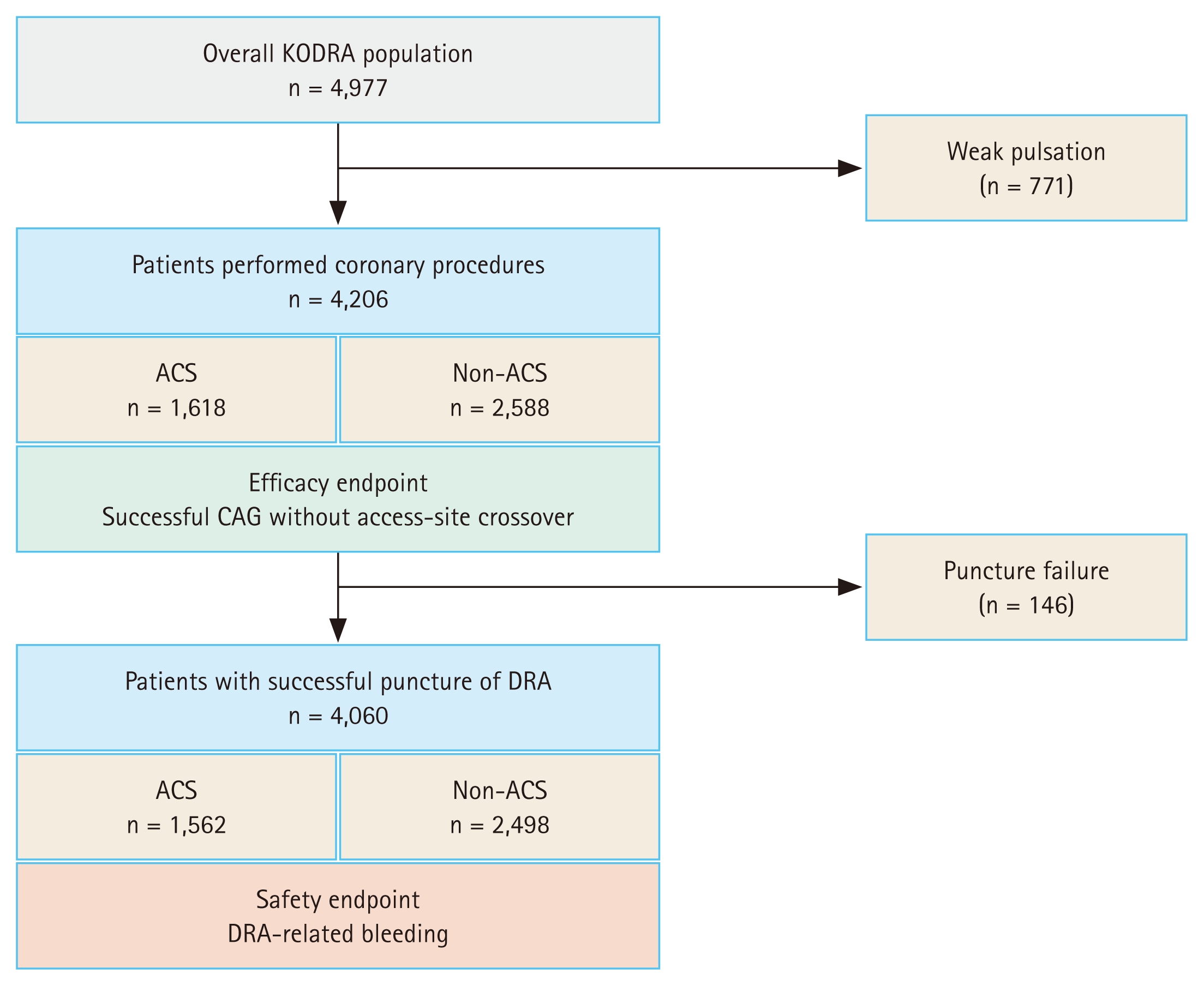
This study is a subgroup analysis derived from the KODRA registry. Patients aged ≥ 20 years who were scheduled for coronary procedures and exhibited good or very good arterial pulsation on physical examination were included. Patients with weak or nonpalpable arterial pulsation were excluded. Additional exclusion criteria comprised a positive modified Allen test, pregnancy or potential pregnancy, breastfeeding, and any other condition deemed unsuitable for participation by the investigator. Of the 4,977 patients enrolled at 14 hospitals between September 2019 to September 2021, a total of 4,206 patients met the inclusion criteria and were eligible for analysis (Fig. 1). The study protocol was approved by the Institutional Review Board of each hospital (approval number: CR319083) and all participants provided written informed consent (ClinicalTrials.gov identifier: NCT04080700).
Study procedures and protocol
The target puncture site was disinfected and locally anesthetized with lidocaine. Distal radial artery, located either within the anatomical snuffbox or on the dorsum of the hand, was punctured with a needle, followed by the insertion of a mini-guidewire and subsequent placement of an introducer sheath. Administration of antiplatelet agents, unfractionated heparin, and other anticoagulants were at the operator’s discretion. After completion of diagnostic coronary angiography (CAG) and percutaneous coronary intervention (PCI), hemostasis was achieved using one of four methods: adhesive tape fixation over packed gauze, wrapping with an elastic bandage, a dedicated compression device, or manual compression. The choice between three-way directional compression across the first intermetacarpal space and conventional two-way directional compression resembling radial compression was also at the operator’s discretion. The access-site was assessed by careful palpation before discharge and at the one-month follow-up visit.
Study endpoints and definitions
The primary efficacy endpoint was defined as successful CAG without access-site crossover. The primary safety endpoint was DRA-related bleeding. The secondary safety endpoint was radial artery occlusion (RAO) assessed before discharge and at one-month follow-up. The degree of arterial pulsation was assessed through careful palpation and categorized into four grades: very good, good, weak, and no pulsation. Puncture success was defined as successful arterial puncture followed by mini-guidewire insertion, and introducer sheath placement into the distal radial artery. Overall access-site crossover was defined as any change from the initially intended vascular access-site. In addition, access-site crossover after puncture success was defined as crossover occurring after successful puncture. Puncture time was measured from the skin contact with the needle to the insertion of the mini-guidewire. Access time was defined as the interval from subcutaneous lidocaine injection to the placement of introducer sheath. CAG time was measured as the duration from the insertion to the removal of the diagnostic catheter. Hemostasis time was defined as the time required to achieve complete hemostasis, measured from the application to the removal of the compression materials. Bleeding events were recorded according to the Bleeding Academic Research Consortium (BARC) criteria and modified Early Discharge After Transradial Stenting of Coronary Arteries (EASY) study hematoma classification [3,10]. Access-site complications included distal radial artery occlusion (DRAO), RAO, local tenderness, hand edema, numbness, arterial perforation, arterial dissection, hand dysfunction, pseudoaneurysm, and arteriovenous fistula. The clinical indication for coronary procedures was obtained through detailed records.
Statistical analysis
Continuous variables are presented as mean ± standard deviation or as median with interquartile range, as appropriate. Categorical variables are expressed as frequencies and percentages. Comparisons between the ACS and non-ACS groups were performed using the chi-square test, or Fisher’s exact test for categorical variables, and the independent t-test, or Wilcoxon rank-sum test for continuous variables, depending on data distribution. The associations between ACS and the primary efficacy and safety endpoints were evaluated using univariable logistic regression analysis. Variables with a p value < 0.05 in univariable analysis, including demographic characteristics, comorbidities, medications, and procedure-related factors, were subsequently included in the multivariable logistic regression analysis, using the enter method. A stratified subgroup analysis for the efficacy endpoint, including interaction testing, was conducted across the following predefined subgroups: age, sex, body surface area, hypertension, diabetes mellitus, chronic kidney disease, and operator experience (< 100 DRA cases). All tests were two-sided, and p values < 0.05 were considered statistically significant. Statistical analyses were performed using IBM SPSS Statistics for Windows, version 29.0 (IBM Corp., Armonk, NY, USA).
RESULTS
Baseline patient characteristics are summarized in Table 1. The mean age of the study population was 66.3 ± 11.9 years, and 2,929 patients (69.6%) were male. Patients in the ACS group were younger and more frequently male compared with the non-ACS group. The prevalence of hypertension, diabetes mellitus, chronic kidney disease and dyslipidemia was comparable between the two groups. Atrial fibrillation was more common in the non-ACS group, whereas current smoking, prior myocardial infarction, and previous PCI were more prevalent in the non-ACS group. Among the non-ACS group, the most frequent indications for coronary procedures were atypical symptoms (15.7%) and follow-up CAG (11.1%) (Table 1). Preloading with antiplatelet agents and the use of heparin were significantly more frequent in the ACS group.
Procedural characteristics are summarized in Table 2. The overall puncture success rate in the total study population was 96.5%, with no significant difference between the ACS and non-ACS groups (p = 0.977). The overall access-site crossover rates were 4.9% in the ACS group and 4.3% in the non-ACS group (p = 0.351). The incidences of access-site crossover after puncture success were 1.5% in the ACS group and 0.9% in the non-ACS group (p = 0.055). Operator with DRA experience < 100 cases were more frequently observed in the non-ACS group. Left DRA was chosen in 60.4% of cases, while femoral access for CAG was used in only 0.7%. Of the 4,172 patients (99.2%) who underwent CAG, the overall CAG success rate was 100%. The rate of PCI and the use of an introducer sheath ≥ 6 Fr were significantly higher in the ACS group. Compared with the non-ACS group, ACS group demonstrated similar puncture time, but had shorter access and CAG time, and required longer hemostasis time.
The efficacy endpoint, defined as successful CAG without access-site crossover, was comparable between the two groups (94.2% in the ACS group vs. 94.9% in the non-ACS group, p = 0.094) (Table 3). Regarding the safety endpoint, DRA-related bleeding occurred more frequently in the ACS group (4.3% vs. 2.6%, p = 0.002). All bleeding events were classified as BARC type 1 or type 2. According to the modified EASY hematoma classification, the majority were minor hematoma (EASY Ia). One case of EASY II and one case of EASY III occurred, both due to voluntary removal of the compressive material by uncooperative patients. Access-site complications before discharge were also more frequent in the ACS group (4.3% vs. 3.0%, p = 0.030), although most were clinically insignificant, including local tenderness or hand edema. The incidence of DRAO and RAO before discharge did not differ significantly between the two groups. However, at one-month follow-up, both DRAO and RAO were observed more frequently in the non-ACS group, though the incidence rates remained low (DRAO 1.1%, RAO 1.0%).
In univariable logistic regression analysis, ACS at presentation was not associated with the efficacy endpoint (odds ratio [OR] 0.871, 95% confidence interval [CI] 0.664–1.144) (Table 4). In contrast, body surface area, prior history of myocardial infarction, and operator experience of DRA < 100 cases were significantly associated with the efficacy endpoint. In the multivariable model, operator experience of DRA < 100 cases remained the only independent predictor of efficacy (OR 0.438, 95% CI 0.334–0.576). For the safety endpoint, ACS at presentation was not predictive (OR 0.817, 95% CI 0.538–1.240). However, smaller body surface area (OR 0.173, 95% CI 0.046–0.645), P2Y12 receptor inhibitor preloading (OR 2.128, 95% CI 1.138–3.976), and heparin dose ≥ 8,000 IU (OR 2.213, 95% CI 1.287–3.805) were significantly associated with DRA-related bleeding (Table 5).
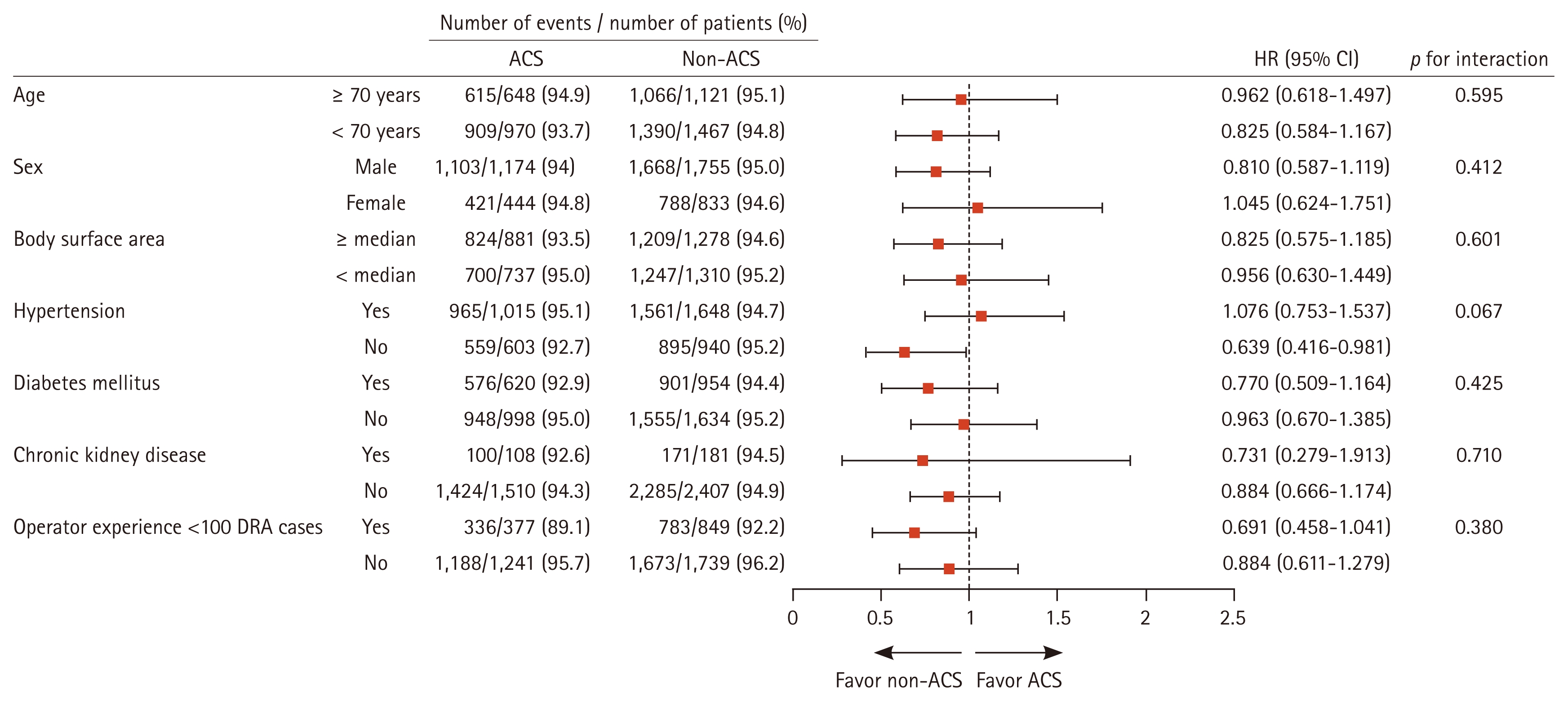
In the subgroup analysis for the efficacy endpoint, there were no significant interactions across clinically relevant subgroups, including age, sex, body surface area, hypertension, diabetes mellitus, chronic kidney disease, operator experience of DRA < 100 cases (Fig. 2).
DISCUSSION
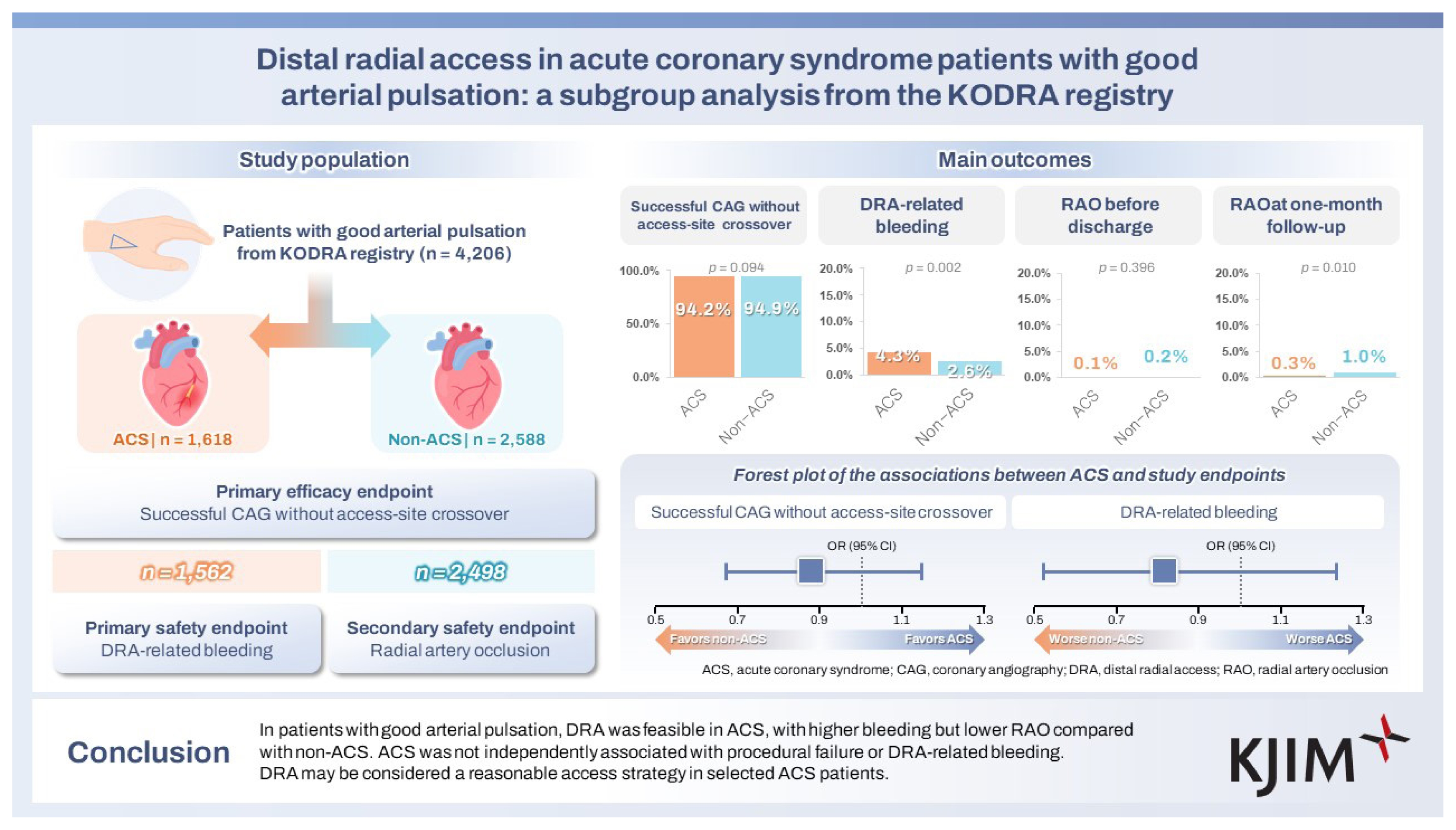
This study evaluated the feasibility and safety of DRA in patients with ACS and good distal radial pulsation. Several key findings were observed (Central illustration). First, the rate of successful CAG without access-site crossover in the ACS group was comparable to that in the non-ACS group, whereas the incidence of DRA-related bleeding was higher in the ACS group. Second, logistic regression analysis demonstrated that ACS presentation was not independently associated with either efficacy or safety endpoints. Third, puncture success and access-site crossover rates were similar between groups. Fourth, although the ACS group showed comparable puncture time and faster CAG time, a longer hemostasis time was required. Finally, the incidences of DRAO and RAO before discharge were very low and similar in both groups, but occurred more frequently at one-month follow-up in the non-ACS group.
Proper management of patients with ACS encompasses various aspects, including the choice of invasive strategy, management of cardiogenic shock, technical challenges during procedures, prevention of ACS-related complications, and optimization of antithrombotic regimen in patients at high bleeding risk. From a procedural perspective, the initial and crucial step is the selection of an optimal vascular access route to ensure favorable outcome. Based on robust evidence, the 2023 European Society of Cardiology (ESC) guidelines for the management of ACS recommend the use of TRA to reduce access-site related bleeding and vascular complications [1]. The recently published 2025 ACC/AHA/ACEP/NAEMSP/SCAI guidelines incorporated new data demonstrating that DRA and transulnar access provide outcomes comparable to TRA [2]. However, these guidelines also highlight that ultrasound-guided TFA should be considered in patients requiring mechanical circulatory support or in cases where TRA, transulnar access or DRA are not feasible. Within these contexts, our study specifically focused on patients with good distal radial pulsation, who are generally considered acceptable candidates for DRA even in ACS settings. The findings demonstrated that ACS presentation did not confer additional risks in terms of arterial puncture, access-site crossover, CAG success, puncture time, access time, or CAG time. The only observed difference was a higher incidence of minor DRA-related bleeding in ACS patients; however, this was not attributable to ACS itself but rather to factors such as smaller body surface area, preloading with P2Y12 receptor inhibitors, and performance of PCI.
Several studies have evaluated the feasibility of DRA in ACS setting. The RAPID III RCT (Distal Radial Access for Primary PCI in STEMI Patients to Prevent RAO) enrolled 260 patients in each group and demonstrated identical success rates of vascular access between DRA and TRA (94.6%) [11]. Importantly, DRA was associated with a significantly lower incidence of hematoma (modified EASY ≥ 2 hematoma: 0.8% vs. 3.5%, p = 0.033), while fluoroscopic time, radiation dose, and access-related complications were comparable. Moreover, DRA significantly reduced the incidence of RAO assessed by Doppler ultrasound at 24 hours after primary PCI (1.9% vs. 8.5%, p = 0.001). The recently published DRAMI trial (comparison of DRA and TRA for the successful puncture in patients with ST-elevation myocardial infarction) compared puncture success rates between DRA and TRA in 354 patients (176 vs. 178, respectively) [12]. The puncture success rate in the DRA group was high and numerically similar to that in the TRA group (94.3% vs. 96.1%, p = 0.442); however, DRA did not demonstrate non-inferiority to TFA in the intention-to-treat population. Other procedural outcomes, including CAG success, PCI success, access-site crossover, and bleeding complications, were comparable between groups, and RAO occurred in only one patient in the TRA group at one-month follow-up. In addition, the DR-STEMI trial (distal versus conventional TRA for coronary catheterization in patients with STEMI) has been designed as a prospective, multicenter, non-inferiority RCT to evaluate the time from arterial puncture to wire crossing in the infarct-related artery [13]. The results of this trial may provide further context and potentially challenge the negative findings of the DRAMI trial. Collectively, current evidence suggests that DRA in ACS is both feasible and safe, although certain limitations such as puncture success in the emergency setting remain under debate. Our study further complements these findings by focusing on patients with good distal radial pulsation, demonstrating that ACS presentation itself did not adversely affect procedural feasibility or safety. Nevertheless, because ACS patients commonly present with weak or absent arterial pulsation, particularly in cardiogenic shock or low perfusion state, these findings should not be generalized to such high-risk subgroups. Among 771 excluded patients with weak pulsation, puncture success was significantly lower in the ACS group (78.4% vs. 84.7%, p = 0.032; data not shown). These observations underscore the need for dedicated studies examining vascular conditions and access strategies to determine the feasibility of DRA in a broader ACS population.
The incidences of RAO before discharge and at one-month follow-up were remarkably low. The RAO rate before discharge (0.3%) was comparable to that (0.31%) reported in the DISCO-RADIAL trial (Distal vs Conventional Radial Access) [14]. Meta-analyses have reported approximately 2% RAO in DRA versus > 5% in TRA [6–8]. Interestingly, the single-center, open-label, 2 × 2 factorial RAPID trial (Strategies to Maintain Radial Artery Patency Following Diagnostic Coronary Angiography) reported markedly higher RAO rates in both DRA and TRA groups (20.3% vs. 21.2%, p = 0.810) and a higher access-site crossover rate in DRA (14.9% vs. 8.3%, p = 0.032) [15]. Importantly, procedural anticoagulation with unfractionated heparin or bivalirudin substantially reduced RAO incidence (7.3% vs. 33.9%, p < 0.001). In our study, RAO at one-month follow-up was higher in the non-ACS group (1.0% vs. 0.3%, p = 0.001), potentially reflecting lower use of antiplatelet therapy, less heparin, and fewer PCIs. Conversely, this may explain the lower bleeding events observed in the non-ACS group. Therefore, the lower RAO rate in the ACS group is more likely driven by differences in antithrombotic therapy rather than a physiological advantage conferred by DRA itself. Although the RAPID trial emphasized the importance of adequate anticoagulation, RAO rates showed substantial variability compared with expectations from the international consensus paper for the prevention of RAO [16]. These findings underscore that, while DRA may reduce RAO, outcomes are influenced by procedural factors, particularly anticoagulation and hemostasis protocols. Standardized procedural protocols and further RCTs are warranted to optimize clinical outcomes in the emerging DRA era.
Limitations
Several limitations should be acknowledged. First, patients were not randomized, as this analysis was based on registry data; confirmatory RCTs comparing with TRA are warranted to validate these findings. Second, only patients with good or very good distal radial pulsation on physical examination were included, limiting the generalizability of the results to patients with weak or non-palpable pulsation. Third, the decision-making processes for procedural strategies including antithrombotic medication, access-site selection, puncture technique, and hemostasis method, were left to the operator’s discretion, introducing potential variability that may have influenced the observed outcomes, particularly for the safety endpoint. Fourth, the proportion of less experienced operators (DRA < 100 cases) was relatively high in the non-ACS group. Given the impact of operator experience on efficacy and safety outcomes, the procedural learning curve may have obscured other potential covariables. Fifth, access-site evaluation was primarily based on physical examination rather than by Doppler ultrasonography. As a result, asymptomatic RAO may have been underestimated. Future studies incorporating routine Doppler ultrasonography are recommended to provide a more accurate evaluation of access-site patency. Finally, the wide spectrum of clinical presentation, including higher rates of PCI, and use of large-bore sheaths, may have confounded the observed bleeding outcomes, despite statistical adjustment.
Conclusions
In ACS patients with good arterial pulsation, DRA achieved comparable CAG success without access-site crossover, but with higher DRA-related bleeding and lower RAO. ACS itself was not an independent predictor of primary efficacy and safety outcomes. These findings support DRA as a feasible access strategy in selected ACS patients.
KEY MESSAGE
1. DRA demonstrated comparable success of CAG without access-site crossover, higher DRA-related bleeding, and lower RAO in patients with ACS and good arterial pulsation.
2. ACS was not associated with procedural failure or DRA-related bleeding.
3. These findings support DRA can be considered a reasonable access strategy in selected ACS patients.


 PDF Links
 PubReader
 ePub Link
 XML Download
 Full text via DOI
 Download Citation
 Print
Print