


INTRODUCTION
Chronic inflammation is central to the atherothrombotic process, contributing to plaque formation, progression, and destabilization, and ultimately plaque rupture, thereby precipitating clinical events such as acute myocardial infarction (AMI), stroke, and cardiovascular death [1–3]. Among various inflammatory biomarkers, high-sensitivity C-reactive protein (hs-CRP) is the most extensively studied and remains a widely employed indicator of systemic inflammation and cardiovascular risk [4]. Notably, in both primary and secondary prevention settings, elevated hs-CRP levels independently predicted future adverse cardiovascular events in patients with established atherosclerotic cardiovascular disease [5,6].
Despite advances in guideline-directed coronary revascularization and intensive secondary prevention, many patients with acute coronary syndrome (ACS) remain at high residual risk for recurrent ischemic events. This “residual inflammatory risk” (RIR) is increasingly recognized as a distinct clinical entity, separate from residual cholesterol risk, and represents a potentially modifiable target for adjunctive therapy [7,8]. The CANTOS, COLCOT, and LoDoCo2 trials have provided compelling evidence that anti-inflammatory therapies can decrease cardiovascular events independently of lipid lowering, further reinforcing the clinical relevance of inflammation in long-term risk modulation [9–11].
Although baseline hs-CRP levels measured during the acute phase of AMI correlate with outcomes [12,13], their ability to predict long-term outcomes remains uncertain. This may partly reflect the dynamic nature of hs-CRP, which is acutely elevated during myocardial injury and systemic stress, potentially limiting its utility as a stable biomarker of chronic inflammation [14,15]. Accordingly, repeated evaluation of inflammatory status offers a more dependable approach to characterize RIR phenotypes among patients with coronary artery disease (CAD), potentially improving risk stratification and guiding personalized therapeutic strategies [14,16].
However, the long-term comparative predictive performance of hs-CRP during the chronic phase after AMI remains inadequately characterized. Given the increasing interest in sustained inflammatory risk (SIR) and the potential value of late-phase biomarkers in refining long-term risk stratification, further research is warranted. This study, therefore, sought to evaluate and compare the prognostic value of baseline and 1-year hs-CRP levels for predicting MACE over a 3-year follow-up in patients with AMI undergoing percutaneous coronary intervention (PCI).
METHODS
Study design and data source
Data were obtained from two large, prospective, multicenter registries for AMI: the Korea Acute Myocardial Infarction Registry-National Institutes of Health (KAMIR-NIH) (between November 1, 2011 and December 31, 2015) and KAMIR-V (between January 1, 2016 and June 30, 2020) cohorts. The KAMIR series is a dedicated prospective registry that consecutively enrolled patients diagnosed with AMI at 20 and 33 tertiary university hospitals, respectively. Detailed study protocols have been published previously [17]. The two cohorts involved 20 and 33 medical institutions capable of performing PCI and coronary artery bypass grafting (CABG), respectively. Protocols for both registries were approved by the Ethics Committee or Institutional Review Board of each participating center.
Study population (Fig. 1)
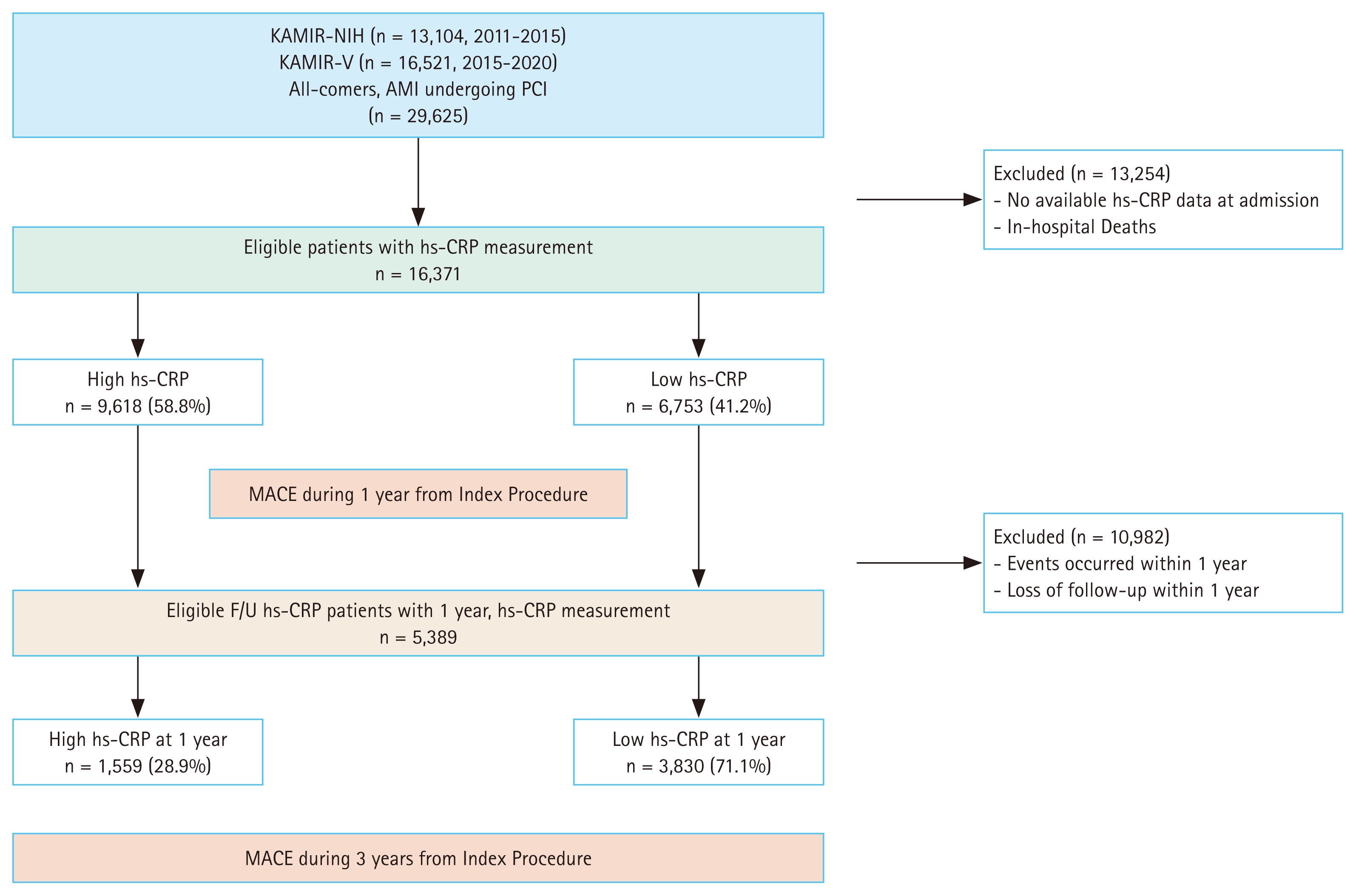
We merged two prospective nationwide registries, KAMIR-NIH and KAMIR-V, to enhance statistical power. In total, 29,625 patients were initially screened from the combined dataset. Patients were excluded if they did not have a final diagnosis of AMI, lacked valid hs-CRP measurements at admission, experienced in-hospital death, or were lost to follow-up.
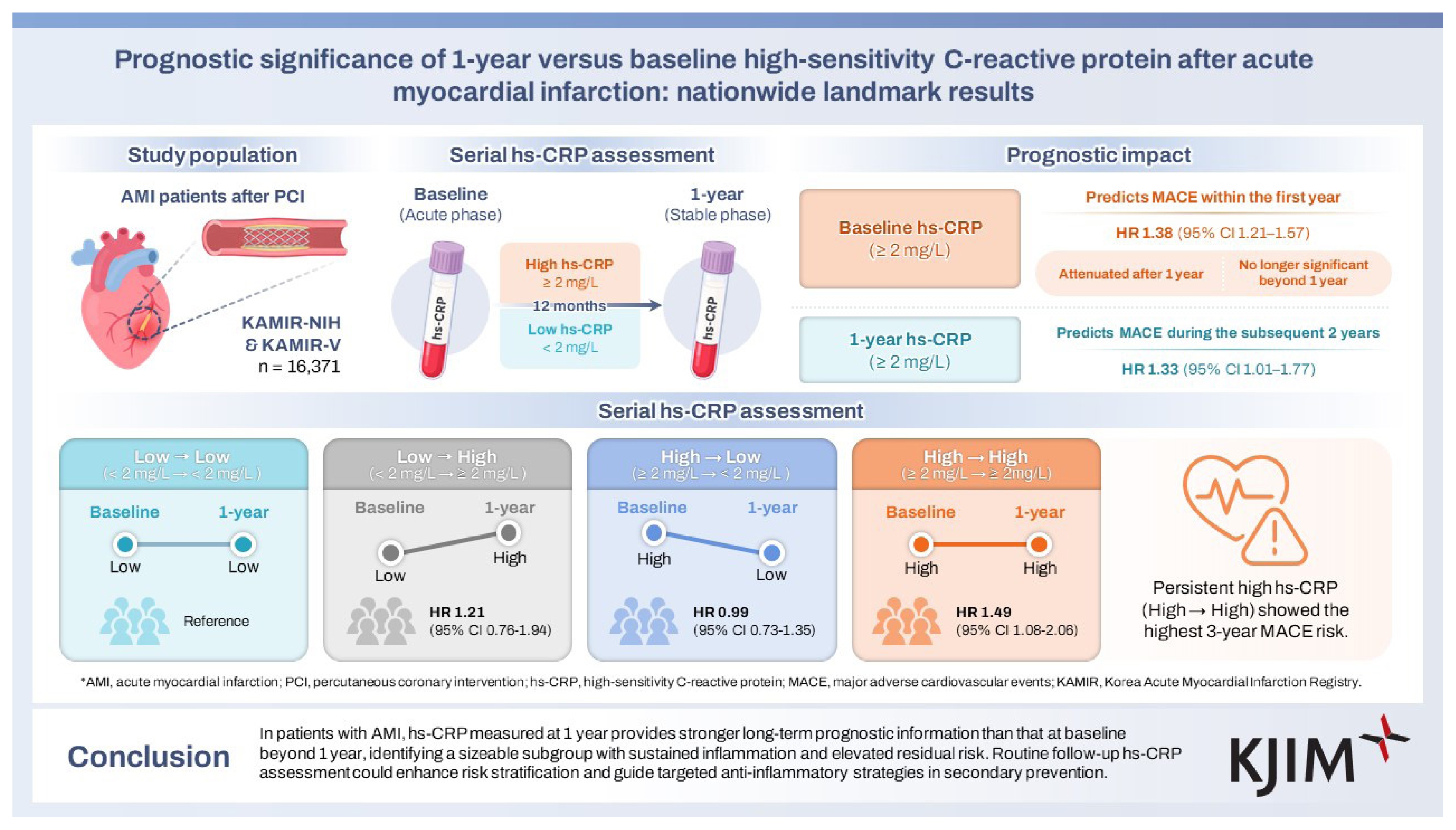
After applying these criteria, 16,371 patients were included in the primary analysis and stratified into high and low hs-CRP groups according to baseline hs-CRP levels. These patients were followed for clinical outcomes over a 3-year period.
Subsequently, a landmark analysis was conducted on 5,389 patients to assess the prognostic value of 1-year hs-CRP. In this process, 10,982 patients were excluded because they either experienced a cardiovascular event during the first year or lacked follow-up hs-CRP measurements. Although this selection resulted in a cohort with fewer comorbidities (indicating a healthy survivor effect), there was no significant difference in baseline hs-CRP levels between the included and excluded groups (p = 0.894), as detailed in Supplementary Table 1.
hs-CRP measurement and grouping
hs-CRP levels were measured at two distinct time points: during the index hospitalization for AMI and at the 1-year follow-up visit. The duration from baseline to 1-year hs-CRP levels was 342 ± 41 days. All measurements were conducted in certified laboratories at participating centers using immunoassay-based methods with established sensitivity for detecting low-range CRP concentrations. The distributions of hs-CRP at baseline and at 1 year are shown in Supplementary Figure 1. For the primary analyses, patients were categorized into high (≥ 2 mg/L) and low (< 2 mg/L) hs-CRP groups at baseline and at 1 year. This cutoff was prespecified based on the definition of RIR used in major cardiovascular outcome trials, which hs-CRP ≥ 2 mg/L was applied to identify patients with clinically meaningful inflammatory risk [9,18]. Patients were further classified into four groups according to serial hs-CRP status at baseline and 1 year (low → low, low → high, high → low, and high → high), as previously described [16].
Clinical outcomes
The primary outcome was MACE over a 3-year follow-up period, defined as a composite of cardiovascular death, recurrent MI, stroke, stent thrombosis, and repeat revascularization.
Secondary outcomes included the individual components of MACE and all-cause mortality (cardiovascular and non-cardiovascular). Additional secondary endpoints included each of the following evaluated separately: cardiovascular death, recurrent MI, stroke, clinically indicated repeat revascularization, and definite or probable stent thrombosis as defined by the Academic Research Consortium (ARC) criteria.
Recurrent MI was defined based on the Fourth Universal Definition of Myocardial Infarction as the recurrence of ischemic symptoms or new ST-segment/T-wave changes on electrocardiogram, accompanied by a rise in cardiac-specific biomarkers above the 99th percentile upper reference limit [19]. Repeat revascularization was defined as any unplanned PCI or CABG conducted after discharge from the index hospitalization due to ischemic symptoms or objective evidence of myocardial ischemia. Stroke was defined as a new focal neurological deficit of presumed vascular origin lasting ≥ 24 hours, confirmed by computed tomography or magnetic resonance imaging. Stent thrombosis was categorized as definite or probable based on ARC criteria and adjudicated by site investigators [20].
Statistical analysis
Categorical variables are presented as counts and percentages and compared using the chi-square or Fisher’s exact test, as appropriate. Continuous variables are expressed as mean ± standard deviation and compared using Student’s t-test or Wilcoxon rank-sum test, depending on distribution.
Kaplan–Meier survival curves were constructed to estimate the cumulative incidence of clinical events, and differences between groups were compared using the log-rank test. Landmark analyses were performed using a predefined cutoff at 365 days post–PCI to separately evaluate short-term (0–1 yr) and long-term (1–3 yr) outcomes.
Cox proportional hazards regression models were used to estimate hazard ratios (HRs) and 95% confidence intervals (CIs) for the association between hs-CRP levels and clinical outcomes. Variables with a univariate p value < 0.10 were included in multivariable Cox regression models. Model selection was based on the Akaike Information Criterion. Multivariable models were adjusted for relevant baseline covariates, including age, sex, hypertension, diabetes mellitus, dyslipidemia, renal function, low-density lipoprotein cholesterol (LDL-C) at 1-year, and medication use, including statin. The proportional hazards assumption was tested using Schoenfeld residuals. Discriminatory performance was assessed using Harrell’s C-index with 95% CIs derived from Cox model concordance, which accounts for censoring and event timing. For baseline hs-CRP, discrimination was evaluated separately for early events (0–12 mo) and late events (12–36 mo) using administrative censoring at 365 and 1,095 days, respectively. For 12-month hs-CRP, discrimination was assessed in a 1-year landmark cohort (event-free at 365 days with available 12-month hs-CRP), with follow-up measured from the landmark to 36 months. To minimize information loss from categorization, hs-CRP was additionally analyzed as a continuous variable using restricted cubic spline functions within multivariable Cox proportional hazards models. The spline curves were used to evaluate potential nonlinearity and the overall dose–response pattern, and results were presented as adjusted HRs with 95% CIs across the observed hs-CRP range. For visual comparability with the prespecified cutoff, 2 mg/L was indicated as a reference point
Statistical significance was set at a two-sided p < 0.05. All statistical analyses were performed using R software version 4.3.0 (R Foundation for Statistical Computing, Vienna, Austria).
RESULTS
Baseline characteristics
High hs-CRP (≥ 2 mg/L) was observed in 9,618 patients (58.8%) at baseline. Patients with elevated hs-CRP were older, with a higher prevalence of hypertension, diabetes, and smoking. They had lower left ventricular ejection fraction (LVEF) and renal function, elevated N-terminal pro–B-type natriuretic peptide (NT-proBNP) levels, and more frequently presented with higher Killip class, prior stroke or heart failure, multivessel disease, and complex coronary lesions (American College of Cardiology/American Heart Association [ACC/AHA] type B2/C). They were also more likely to undergo multivessel PCI (Table 1).
Of the 5,389 patients with available hs-CRP data at both time points, 1,559 (28.9%) showed high hs-CRP levels at 1 year, compared to 3,830 (71.1%) with low levels. As summarized in Table 2, at the 1-year follow-up, patients with elevated hs-CRP were older and had a higher prevalence of hypertension and prior stroke, along with higher Killip class, worse LVEF, and elevated NT-proBNP levels. Patients with high hs-CRP were less likely to be on beta-blockers or statins and more likely to receive calcium channel blockers and oral anticoagulants. Furthermore, patients with high hs-CRP at 1-year had significantly higher baseline hs-CRP levels than those with low hs-CRP (6.38 [3.05–17.80] mg/L vs. 0.80 [0.40–1.19] mg/L; p < 0.001).
Clinical outcomes based on initial hs-CRP
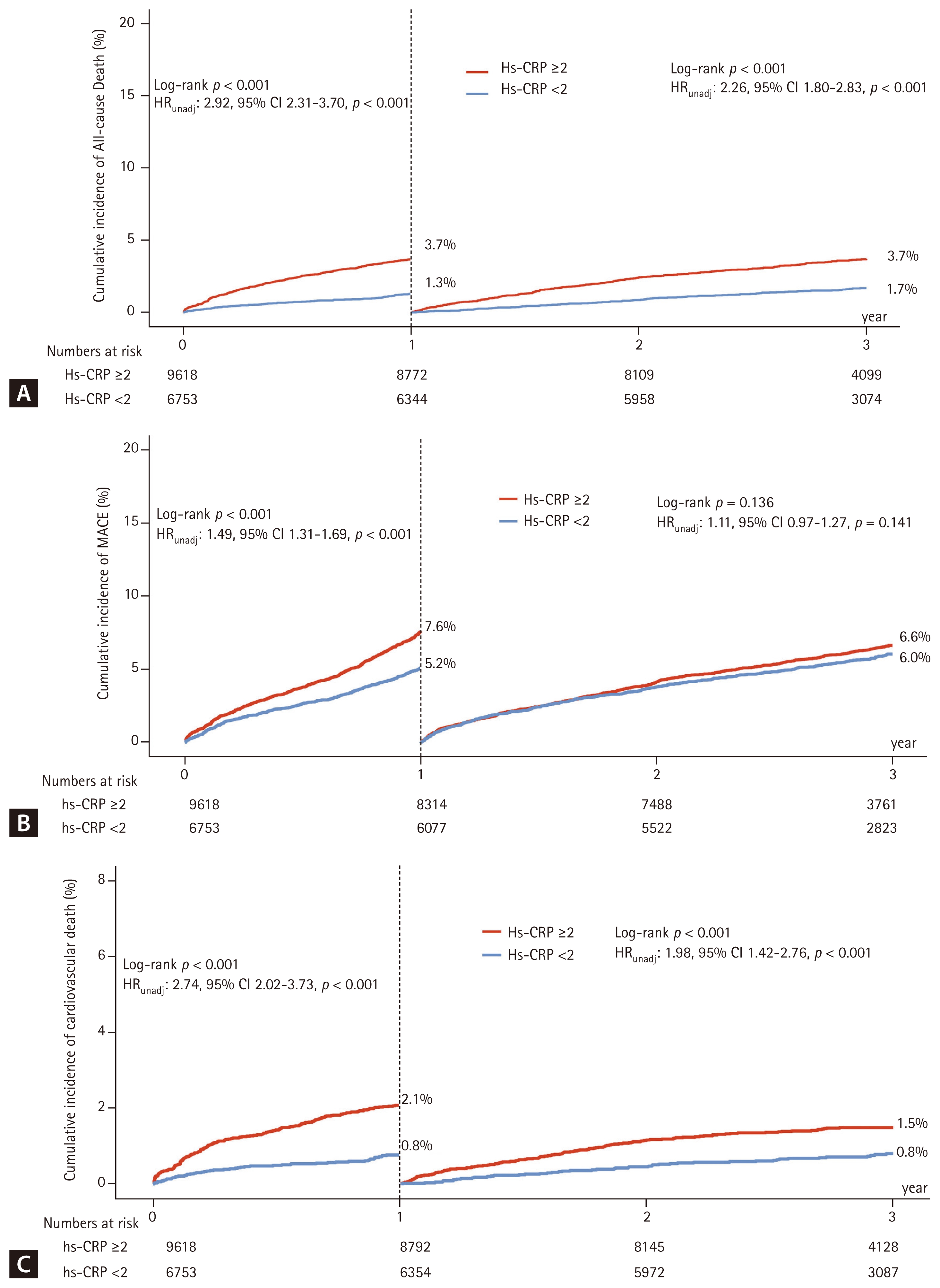
During the 3-year follow-up, patients with baseline hs-CRP ≥ 2 mg/L demonstrated significantly increased cumulative incidence of all-cause death (7.3% vs. 3.0%, log-rank p < 0.001), MACE (13.7% vs. 10.9%, log-rank p < 0.001), and cardiovascular death (3.5 % vs. 1.6 %, log-rank p < 0.001) (Table 3, Fig. 2). These associations were pronounced within the first year post-PCI, with significantly higher rates of all-cause deaths, MACE, and cardiovascular death in the high hs-CRP group (Table 3).
In multivariable Cox regression, high baseline hs-CRP was independently associated with increased risk of all-cause death (HR 2.49, 95% CI 1.95–3.18), MACE (HR 1.38, 95% CI 1.21–1.57), cardiovascular death (HR 2.29, 95% CI 1.66–3.15), MI (HR 1.62, 95% CI 1.20–2.19), and stroke (HR 1.78, 95% CI 1.26–2.53) within the first year post-PCI. Beyond 1-year, the risk associated with baseline hs-CRP was attenuated for all-cause mortality, MACE, and cardiovascular death (Table 4).
Clinical outcomes based on 1-year hs-CRP
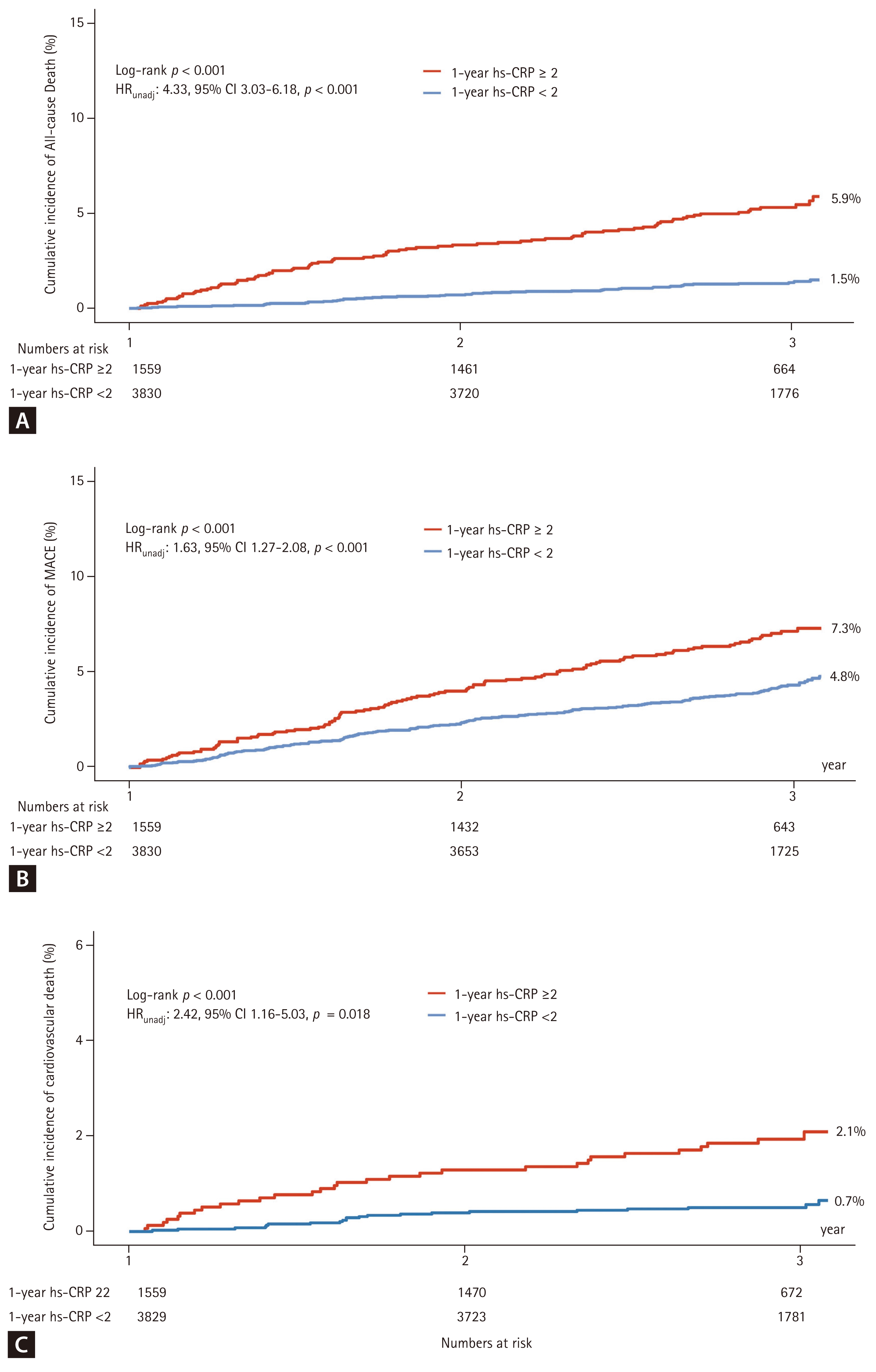
Total 5,389 patients were utilized to evaluate the association between 1-year hs-CRP levels and long-term cardiovascular outcomes. From 1 to 3 years after the index event, patients with elevated 1-year hs-CRP (≥ 2 mg/L) had significantly higher cumulative incidence of all-cause (5.9% vs. 1.5%), MACE (7.3% vs. 4.8%), and cardiovascular death (2.1% vs. 0.7%) than those with hs-CRP < 2 mg/L (all log-rank p < 0.001; Table 5, Fig. 3).
In multivariable Cox regression analysis, elevated 1-year hs-CRP remained an independent predictor of all-cause death (HR 2.93, 95% CI 1.90–4.53; p < 0.001), MACE (HR 1.33, 95% CI 1.01–1.77; p = 0.045), and cardiovascular death (HR 2.42, 95% CI 1.16–5.03; p = 0.018) (Table 4).
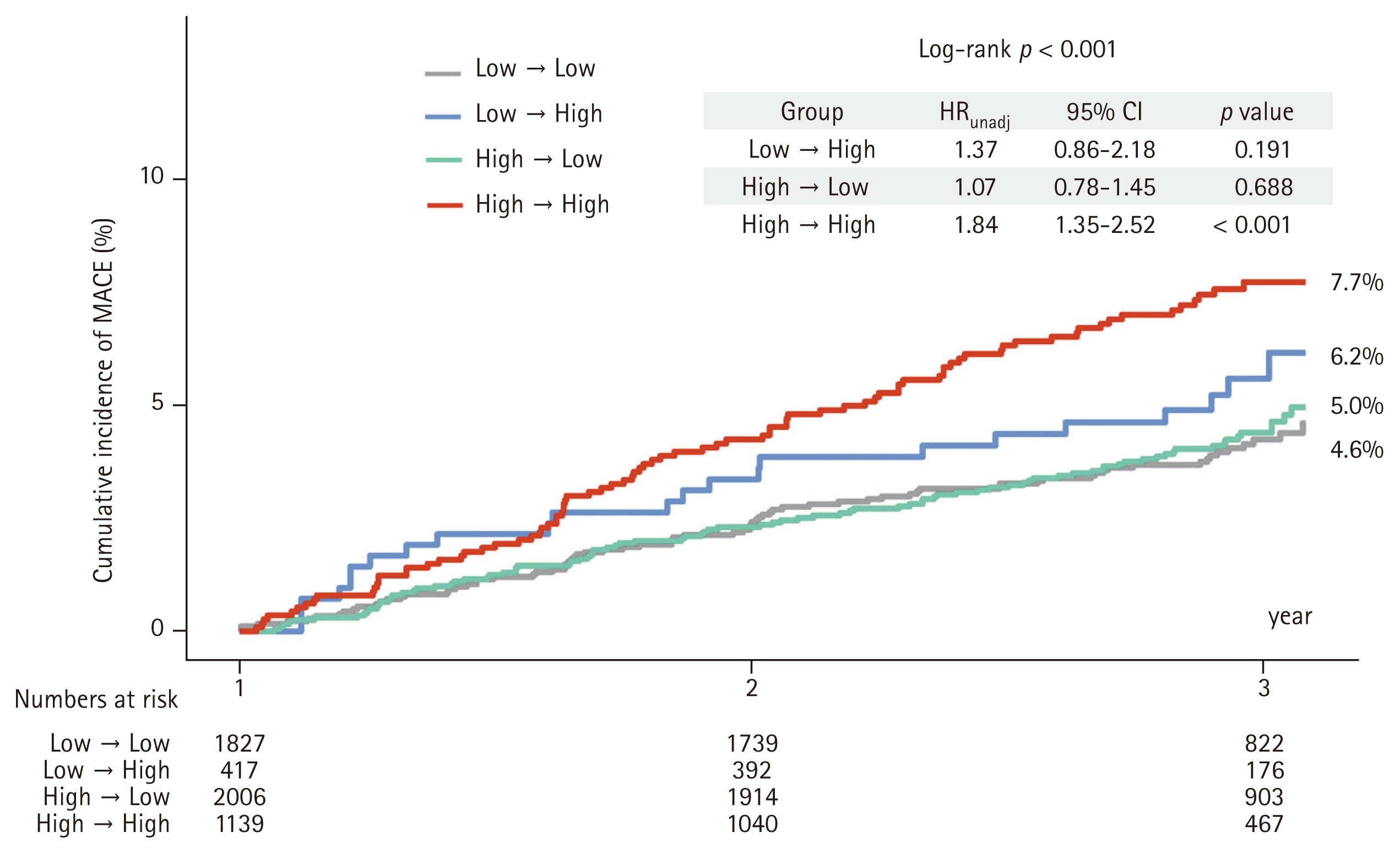
Transition patterns in hs-CRP status between baseline and 1 year are demonstrated in Supplementary Figure 2. Among 5,389 patients, 3,145 (58.3 %) had high hs-CRP levels initially. Among patients with elevated hs-CRP (≥ 2 mg/L) at baseline (n = 3,145), 1,139 (36.2%) remained in the persistent high category (high → high) at 1 year, whereas 2,006 (63.8%) transitioned to the resolved high group (high → low). Conversely, among the low hs-CRP group (n = 2,244) at baseline, 417 (18.7%) of patients with initially low hs-CRP moved into the worsening category (low → high) and persistent low category at 1 year. Patients in the persistent high group exhibited the highest 3-year cumulative incidence of MACE (7.7%), followed by the worsening (6.2%), resolved high (5.0%), and persistent low (4.6%) groups (log-rank p value < 0.001; Fig. 4). In multivariable Cox regression, using the persistent low group as the reference, persistent high status was significantly associated with an increased risk of 3-year MACE (adjusted HR 1.49, 95% CI 1.08–2.06; p = 0.015). Neither the incident high (adjusted HR 1.21, 95% CI 0.76–1.94; p = 0.424) nor the resolved high group (adjusted HR 0.99, 95% CI 0.73–1.35; p = 0.950) showed statistically significant differences in risk (Supplementary Table 2).
In sensitivity analyses modeling hs-CRP continuously, restricted cubic spline curves demonstrated a graded association between hs-CRP levels and subsequent risk, without an apparent stepwise threshold effect (Supplementary Fig. 3).
Discrimination Analysis Using Harrell’s C-index
Baseline hs-CRP revealed modest discrimination for 1-year MACE (C-index 0.583, 95% CI, 0.565–0.601), but discrimination attenuated substantially for events occurring beyond 1 year in the landmark analysis (12–36 months: C-index 0.519, 95% CI, 0.500–0.539). Conversely, 12-month hs-CRP demonstrated higher discrimination for subsequent events after the 1-year landmark (C-index 0.592, 95% CI, 0.541–0.644), supporting the greater prognostic relevance of stable-phase inflammatory status (Supplementary Table 3).
DISCUSSION
In this prospective registry of patients with AMI, elevated hs-CRP levels—measured both at baseline and 1 year—were remarkably associated with increased risk of adverse cardiovascular outcomes. Notably, baseline hs-CRP was a strong predictor of events occurring within the first year following the index event; however, its prognostic value attenuated thereafter. Contrarily, hs-CRP measured at 1 year remained independently associated with clinical events over the subsequent 2 years, underscoring its utility in identifying patients with sustained RIR. These temporal trends highlight the limited long-term relevance of a single baseline measurement and underscore the value of serial hs-CRP monitoring for chronic-phase risk stratification.
Inflammation and atherosclerosis
Inflammation is a key driver of atherosclerosis, contributing to both plaque formation and its subsequent rupture [1–3].
Large-scale trials, such as PROVE IT–TIMI 22 and IMPROVE-IT, have shown that elevated hs-CRP levels during follow-up are linked to higher coronary event rates, even when LDL-C goals are attained [21,22]. These results highlight the importance of inflammation beyond lipid control and support incorporating hs-CRP into cardiovascular risk assessment.
Unlike LDL-C, which stabilizes with lipid-lowering therapy, hs-CRP levels may vary substantially over time owing to individual differences in inflammation and comorbidities. In AMI, hs-CRP rises acutely, peaks within a few days, then declines; however, in some patients, levels remain elevated, indicating persistent vascular inflammation [13,23]. Hence, a single acute-phase measurement may not adequately reflect long-term inflammatory risk.
Previous studies have highlighted the time-dependent prognostic value of hs-CRP. Measurement at 1 month after ACS provided stronger predictive power than admission levels, and persistent elevation at both time points identified patients at the highest risk [24]. Kang et al. [25] further reported that baseline hs-CRP predicted MACE predominantly within 6 months after AMI (adjusted HR 1.69, 95% CI 1.27–2.25), but its prognostic impact attenuated thereafter despite statin therapy.
Similarly, Klingenberg et al. [26] revealed that persistent hs-CRP elevation at 12 months was associated with higher adverse outcomes compared with consistently low levels (10.5% vs. 7.2%; adjusted HR 1.71, 95% CI 1.08–2.70). Collectively, these findings highlight the temporal variability of hs-CRP and support the need for serial monitoring to capture SIR beyond the acute phase.
This study leverages a large, well-characterized national registry with standardized 1-year hs-CRP sampling and uniform follow-up, enabling a robust assessment of RIR in the chronic phase after AMI. We characterize the time-dependent and distinct prognostic roles of baseline and 1-year hs-CRP, offering a more refined understanding of inflammation-related cardiovascular risk.
Emerging role of anti-inflammatory therapy in cardiovascular disease
Recent landmark trials, including CANTOS, COLCOT, and LoDoCo2, have established RIR as a modifiable target for reducing cardiovascular events [9–11]. However, the lack of benefit observed in recent early-intervention trials, such as CLEAR [27] and the heterogeneous results from CONVINCE trial [28], underscore that anti-inflammatory strategies cannot be uniformly applied to all patients. This highlights the critical necessity of precise patient selection based on persistent inflammatory burden.
The 2024 ESC Guidelines upgraded colchicine for chronic coronary syndromes to class IIa, consistent with meta-analytic evidence supporting the efficacy and safety of low-dose colchicine in coronary disease [29]; however, discordant results from recent trials—including CLEAR, CONVINCE, and CHANCE-3 [27,28,30]—suggest that a more personalized approach based on residual inflammatory burden and clinical context is warranted. In this context, our findings provide a practical framework for identifying the optimal target population. We demonstrated that approximately 30% of post-AMI patients exhibited sustained high hs-CRP (≥ 2 mg/L) at 1 year despite standard lipid-lowering therapy, and this phenotype was strongly associated with long-term adverse outcomes. Unlike baseline measurements, which are confounded by acute injury, 1-year hs-CRP serves as a reliable marker of the stable, chronic inflammatory phenotype. Therefore, routine assessment of hs-CRP during the chronic phase—rather than broadly administering anti-inflammatory agents—could serve as a valuable tool for secondary prevention. It allows clinicians to stratify patients who harbor “sustained residual inflammation” and may require more intensive risk factor modification or closer surveillance in the era of personalized medicine.
Because hs-CRP is a nonspecific marker of systemic inflammation, an elevated hs-CRP level at 1 year may reflect not only persistent vascular inflammation but also intercurrent infection, chronic inflammatory/autoimmune conditions, occult malignancy, or worsening heart failure [31]. Therefore, the observed association between 1-year hs-CRP and subsequent outcomes should be interpreted as capturing a broader “inflammatory burden” rather than a direct measure of atherosclerotic inflammation alone. In clinical practice, an elevated, stable-phase hs-CRP should prompt careful evaluation for potential non-cardiovascular inflammatory conditions and heart failure, in addition to optimization of secondary prevention for CAD. Future studies with more granular data on intercurrent illnesses around follow-up visits may further clarify the relative contribution of these competing sources of inflammation.
Clinical implications and risk stratification
Although prior studies have linked persistently elevated hs-CRP with adverse outcomes [32,33], our findings should be viewed as consistent with—yet extending—this evidence base. Using a large nationwide prospective AMI registry, we directly compared acute-phase (index) vs. stable-phase (1-year) hs-CRP within the same analytic framework and quantified time-evolving RIR using a landmark design and four-group transition analyses with adjusted Cox HRs, providing pragmatic AMI-specific evidence to support serial inflammatory assessment for long-term risk stratification in Asian patients.
Our findings offer key insights for long-term management of patients post-AMI. Although baseline hs-CRP predicted early adverse events, 1-year hs-CRP provided stronger prognostic value for long-term outcomes, supporting its use in chronic risk assessment. This indicates that a single in-hospital measurement may not be adequate to identify patients with persistent RIR. Follow-up hs-CRP can be a practical tool to refine risk stratification beyond lipid parameters, helping identify high-risk patients who—despite optimal therapy— may benefit from anti-inflammatory treatment or closer monitoring. Serial measurements may further enhance individualized care.
Incorporating follow-up hs-CRP into routine assessment could improve risk prediction and guide emerging inflammation-targeted therapies. The discriminatory performance of baseline hs-CRP diminished beyond the early phase, whereas 12-month hs-CRP provided comparatively better discrimination for subsequent events, consistent with the concept that stable-phase hs-CRP better captures RIR relevant to long-term prognosis. Landmark analysis excluded early post-MI events to specifically evaluate chronic-phase inflammation. Notably, serial hs-CRP assessment revealed meaningful risk reclassification, particularly in patients whose levels increased from low to high, highlighting its value in capturing dynamic inflammatory risk.
Although we evaluated hs-CRP at 1 year because it was the standardized follow-up time point in our registry, this should not be interpreted as establishing 1 year as the definitive optimal timing for inflammatory risk assessment after AMI. Future studies evaluating hs-CRP at multiple stable-phase time points are warranted to define the most informative timing and intervals for serial inflammatory monitoring.
Strengths and limitations
This study has several limitations. First, residual confounding may remain due to the observational design despite multivariable adjustment. Second, hs-CRP is a nonspecific inflammatory marker and may be influenced by subclinical infection, comorbid inflammatory conditions, malignancy, or other unmeasured factors; likewise, statin intensity and dose changes could affect hs-CRP, but detailed longitudinal data on statin intensity were not systematically captured, so related residual confounding cannot be excluded. Third, anti-inflammatory agents (e.g., colchicine or interleukin-1β inhibitors) were not routinely used, limiting the assessment of treatment-modifiable inflammatory risk. Fourth, requiring 1-year follow-up hs-CRP introduced survivor/selection bias by preferentially including clinically stable survivors (Supplementary Table 1); however, baseline hs-CRP was similar between included and excluded patients, suggesting minimal bias in initial inflammatory severity. Incident heart failure could not be directly assessed, but the landmark design excluded all patients with MACE within the first year, focusing on event-free survivors in whom persistent hs-CRP more likely reflects RIR. Finally, as this multicenter registry spanned over a decade, hs-CRP assays may have varied across centers and over time, and the absence of a centralized core laboratory is an inherent limitation.
Despite these limitations, this large multicenter prospective registry with standardized 1-year hs-CRP assessment, combined with landmark and spline analyses, provides robust evidence on the time-dependent prognostic implications of RIR after AMI.
Conclusion
These findings underscore the dynamic nature of RIR and underscore the limitations of single-time-point measurements obtained during the acute phase, especially 1-year hs-CRP. Serial assessment of hs-CRP may provide additional value in identifying high-risk patients who are otherwise managed in accordance with guideline-based secondary prevention. Incorporating inflammation-based risk stratification—particularly during the chronic recovery phase—may facilitate a more personalized approach to post-AMI care and inform the potential use of adjunctive anti-inflammatory therapies.
KEY MESSAGE
1. In patients with AMI undergoing PCI, baseline hs-CRP predicted adverse events only within the first year, and its prognostic value attenuated thereafter.
2. hs-CRP measured at 1 year independently predicted subsequent cardiovascular events, providing stronger long-term prognostic information than baseline measurement.
3. Patients with persistently elevated hs-CRP (≥ 2 mg/L at both baseline and 1 year) had the highest long-term risk, supporting serial hs-CRP assessment to identify candidates for targeted anti-inflammatory strategies in secondary prevention.


 PDF Links
 PubReader
 ePub Link
 XML Download
 Full text via DOI
 Download Citation
 Supplement figure 1
 Print
Print