


INTRODUCTION
Lung cancer remains a major challenge in oncology, characterized by increasing incidence and persistently high mortality [1]. Over the past two decades, the median overall survival in lung adenocarcinoma has more than doubled, increasing from 8.5 months in 2000 to 20.7 months in 2020 [2]. The introduction of targeted therapies directed at specific oncogenic drivers and immune checkpoint inhibitors that restore antitumor immunity has been the major factor underlying this improvement. Despite advances in diagnostics and treatment, early detection and accurate prediction of lung cancer remain essential [3].
Tuberculosis (TB) remains a major global health threat, with approximately 10 million new cases reported annually [4]. In the Republic of Korea, the incidence of active TB has steadily declined over the past decade (from ~39,500 cases in 2011 to ~18,300 in 2021) [5]. However, many TB survivors continue to live with chronic structural lung damage attributable to previous infection and treatment, including fibrotic changes and impaired lung function [6]. Successful treatment also has long-term consequences [7], including persistent inflammation, pulmonary scarring, and fibrosis, which contribute to lung cancer development [8]. Recent meta-analyses and nationwide population-based studies have identified previous TB infection as an independent risk factor for lung cancer, with a pooled odds ratio of 2.0–2.3, alongside age, sex, smoking status, and the presence of obstructive pulmonary disease [9,10]. This association is consistent across diverse populations, including never-smokers, suggesting that TB-induced lung injury may trigger oncogenic processes [11,12]. Despite these insights, the risk profiles of TB survivors who develop lung cancer are not well characterized. Previous TB infection represents a highly heterogeneous condition marked by varied structural and functional sequelae [6], and this heterogeneity complicates efforts to define high-risk groups. Moreover, aside from age and smoking history, no consensus exists regarding which pulmonary functional features confer the highest risk of lung cancer [13].
Therefore, this study aimed to identify the characteristics of TB survivors that influence lung cancer development within a large cohort of relatively young and generally healthy individuals.
METHODS
Study participants
The Kangbuk Samsung Health Study is a large, ongoing cohort that collects anonymized data from Korean adults aged ≥ 18 years who undergo annual or biennial health screenings at Kangbuk Samsung Hospital Total Healthcare Centers located in Seoul and Suwon since January 2002. Data are obtained using questionnaires, blood tests, and imaging studies. The study population for this analysis consisted of 357,374 individuals examined between 2002 and 2020, with cancer outcomes confirmed through December 31, 2021.
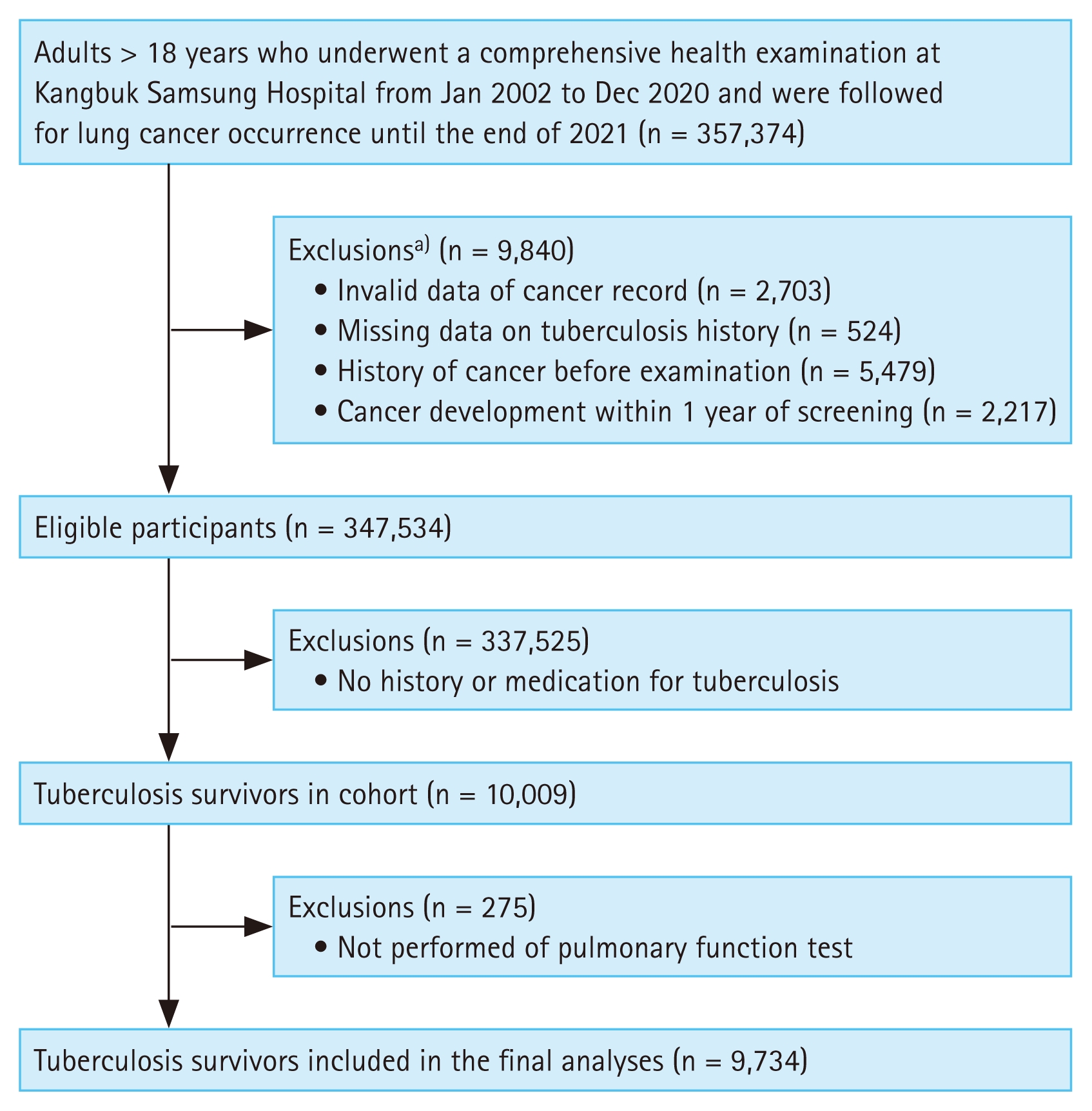
Participants were excluded if they had invalid cancer records (n = 2,703), missing data on TB history or medication use (n = 524), a cancer diagnosis before enrollment (n = 5,479), or cancer development within one year of their first screening (n = 2,217). After applying these criteria, 347,534 individuals remained, of whom 10,009 were identified as TB survivors. Following the exclusion of 275 survivors without spirometry data, 9,734 were included in the final analysis (Fig. 1).
Definition of TB exposure and lung cancer diagnosis
TB exposure was defined using self-reported questionnaire data. Participants were classified as having a history of TB if they reported previous active disease with completed treatment or if they were currently taking anti-TB medications for pulmonary TB or pleurisy. Lung cancer diagnoses were ascertained through linkage with the Korea National Cancer Incidence Database, a national population-based registry. The database provided the date of lung cancer diagnosis and summary stage (limited, locally advanced, or metastatic), although detailed histologic subtypes were not available. To minimize reverse causality, only lung cancer cases diagnosed > 1 year after baseline examinations were included.
Measurements
Demographic characteristics, health behaviors (alcohol intake and smoking status), medical history, and medication use were assessed using standardized, self-reported questionnaires administered during health evaluations [14]. At cohort entry, spirometry tests were performed on the same day as the health screening and questionnaires, following American Thoracic Society guidelines, using Vmax 22 spirometers (SensorMedics, Yorba Linda, CA, USA). The highest forced vital capacity (FVC) and forced expiratory volume in 1 s (FEV1) were recorded from at least two acceptable maneuvers. Absolute FEV1 and FVC values were obtained, and the percent predicted values were calculated using reference equations derived from a Korean representative sample [15]. Pulmonary function status was categorized based on prebronchodilator spirometry as normal (FEV1/FVC ≥ 0.7 and FVC percent predicted ≥ 80%), restrictive (FEV1/ FVC ≥ 0.7 and FVC percent predicted < 80%), or obstructive (FEV1/FVC < 0.7) [16]. To isolate the impact of restrictive lung physiology, all patients with obstructive patterns were classified exclusively into the obstructive group, and only those without any obstruction were included in the restrictive group. Consequently, the obstructive group may include individuals with mixed obstructive and restrictive patterns, whereas the restrictive group consisted strictly of those without any evidence of obstructive lung disease.
Statistical analysis
The primary outcome was to identify risk factors for incident lung cancer among TB survivors. Demographic data across groups were compared using chi-square tests for categorical variables and independent t-tests for continuous variables. Follow-up time was defined as the interval from cohort enrollment to the date of lung cancer diagnosis or the end of follow-up as of December 31, 2021. Kaplan–Meier estimates were employed to assess time to lung cancer development from the date of cohort enrollment, and differences between groups were evaluated using the log-rank test. Univariate and multivariate Cox regression proportional hazards models were used to identify significant factors for lung cancer. A forward stepwise selection method was applied to construct the multivariate model, optimizing variable combinations and model dimensionality by retaining only statistically significant predictors. Variables with p < 0.10 in univariate analysis were entered into the multivariate model. A two-tailed p value < 0.05 was considered significant. All statistical analyses were conducted using Stata 18.0 (Stata Corp LP, College Station, TX, USA).
RESULTS
Baseline characteristics of the study population
The baseline characteristics of the 9,734 TB survivors are summarized in Table 1. Participants were predominantly male (65.4%), with a mean age of 41.2 years. Over a follow-up period of 83,990 person-years, lung cancer developed in 22 participants. Among these 22 patients, 11 (50.0%) had limited-stage disease, 5 (22.7%) had locally advanced disease, and 6 (27.3%) had metastatic disease. A significant age difference was observed between those who developed lung cancer and those who did not (54.0 vs. 41.2; p < 0.001). The prevalence of lung cancer was higher in the older age groups. Individuals who developed lung cancer were more likely to be smokers and heavy alcohol consumers. In addition, those with restrictive or obstructive spirometry patterns were more likely to develop lung cancer (p = 0.009). No clear associations were observed with sex, body mass index, family history of lung cancer, or comorbidities, except for dyslipidemia.
Risk factor analysis for lung cancer development in TB survivors
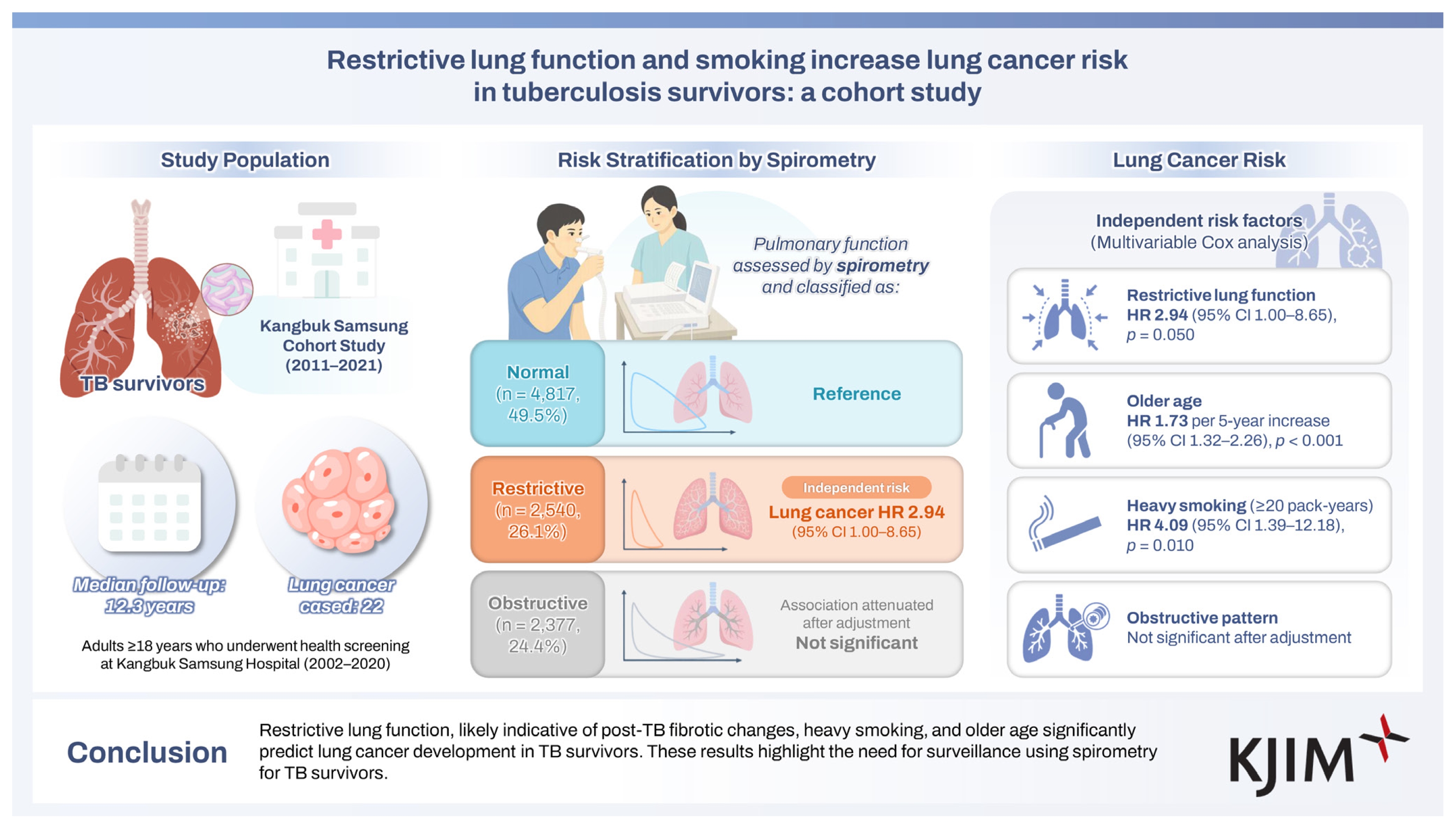
Table 2 summarizes the risks of lung cancer development in the univariate and multivariate analyses. In the univariate analysis, pulmonary dysfunction showed a significant association with lung cancer development. The hazard ratios (HRs) were 2.58 (95% confidence interval [CI] 1.00–6.65, p = 0.050) and 6.48 (95% CI 2.05–20.43, p < 0.001) for restrictive and obstructive lung functions, respectively. Age was also a significant factor, with an HR of 2.35 per age category increase (95% CI 1.86–2.96; p < 0.001). Other significant factors included alcohol intake (≥ 20 g/day, HR 3.05, p = 0.019), diabetes (HR 6.40, p = 0.003), and smoking status (≥ 20 pack-years, HR 6.62, p < 0.001). In multivariable analyses, the association between restrictive pulmonary function and lung cancer risk remained significant, with an HR of 2.94 (95% CI 1.00–8.65, p = 0.050). Obstructive pulmonary function was not significant after adjusting for covariates (p = 0.279). A smoking history of 20 pack-years or more continued to be associated with nearly a fourfold higher likelihood of lung cancer development (p = 0.010). Smoking exposure differed significantly across pulmonary function categories (Supplementary Table 1). Individuals with obstructive impairment had higher cumulative smoking exposure than those with restrictive or normal function (p < 0.001). No significant interaction effect was observed between smoking status and pulmonary function pattern (p for interaction = 0.17), indicating that the association between pulmonary function and lung cancer risk was not modified by smoking exposure.
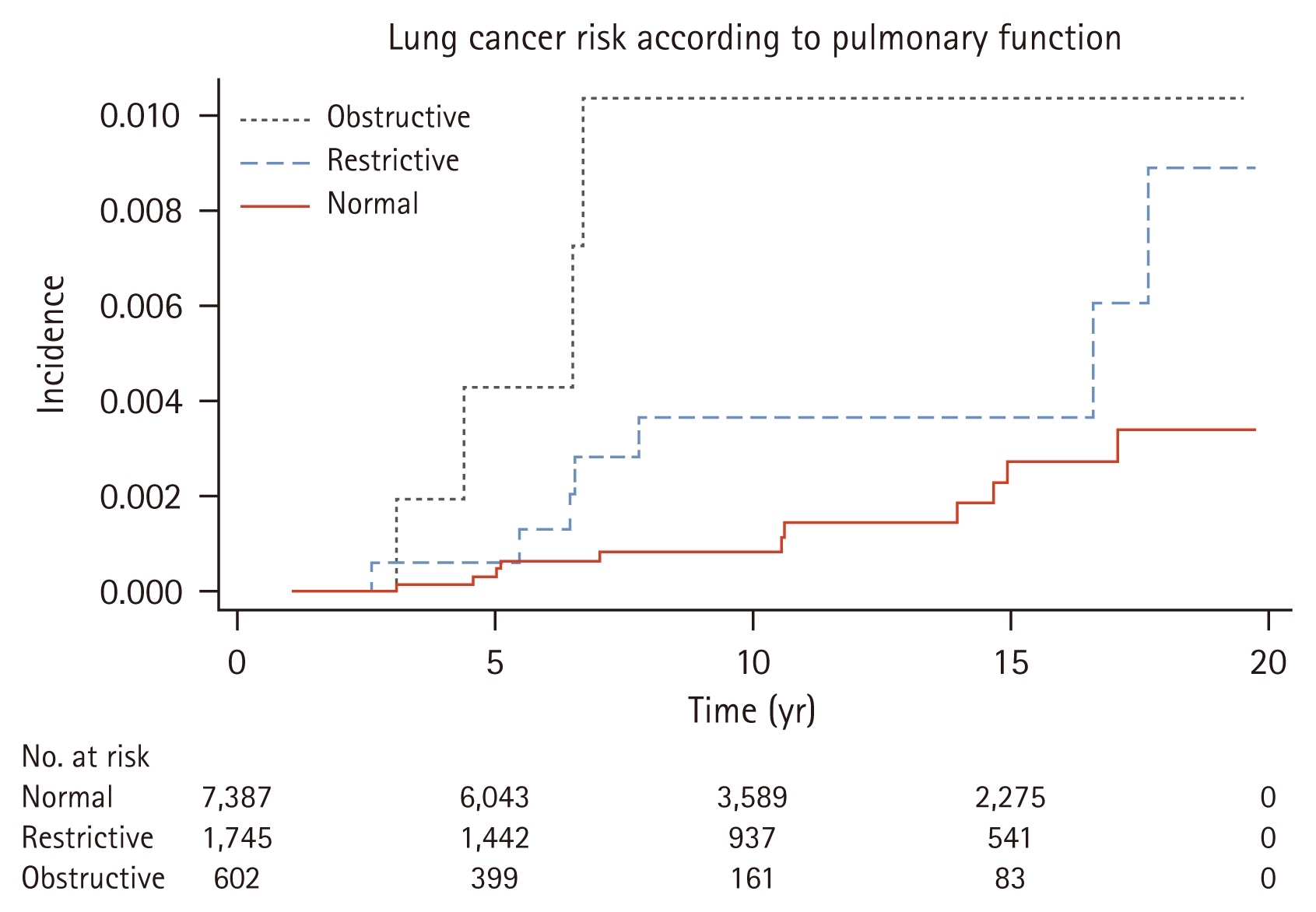
The Nelson–Aalen cumulative incidence curves illustrating lung cancer risk stratified by pulmonary function status among TB survivors are shown in Figure 2. TB survivors with abnormal pulmonary function exhibited a significantly higher cumulative incidence of lung cancer than those with normal function, with curves separating and rising sharply within the first 5 years of follow-up. When unadjusted for smoking, the incidence was highest among TB survivors with obstructive pulmonary impairment.
DISCUSSION
The findings of this study underscore the association between restrictive pulmonary function and lung cancer development in TB survivors. This highlights the potential utility of spirometry as an early predictor of lung cancer development in this high-risk population. Previous studies have primarily examined the relationship between TB infection and lung cancer risk [9], whereas the present study focuses on identifying risk factors that influence lung cancer development among posttreatment TB survivors. A major strength of this work is the use of spirometry, a readily accessible tool for assessing lung function, to stratify risk in this population.
A large national cohort study previously demonstrated that chronic obstructive pulmonary disease (COPD) confers a lung cancer risk comparable to that of smoking history in never smokers [17]. Interestingly, our multivariate analyses indicated that the effect of obstructive pulmonary dysfunction was neutralized after adjusting for age and smoking, indicating confounding in TB survivors. The attenuation of the association between obstructive function and lung cancer after multivariable adjustment likely reflects confounding by smoking exposure, as individuals with obstructive impairment exhibited the highest cumulative pack-years. Smoking, the principal cause of obstructive lung disease, therefore appears to act as a confounder. This interpretation is supported by the lack of a significant interaction between smoking status and pulmonary function pattern. To the best of our knowledge, this study is the first to identify restrictive pulmonary dysfunction as an independent risk factor for lung cancer development among TB survivors.
Pulmonary TB infection can lead to diverse structural sequelae, including lung cavitation, pulmonary fibrosis, and bronchiectasis, which may result in functional impairment with either obstructive or restrictive patterns [18]. The effects of COPD on lung cancer development remain controversial, with some studies demonstrating a significant association [10,12] and others, including one aligned with our findings, reporting no clear association [19]. The reasons for these inconsistencies are not fully understood, although smoking may be an important explanation. Ongoing or prior cigarette smoke exposure is a major driver of both COPD and TB [20,21]. In the study conducted in Taiwan, a key limitation was the exclusion of smoking as a covariate, which likely influenced the observed associations [12].
Moreover, because conventional screening spirometry relies on the patient’s active participation (i.e., deep inhalation and forceful exhalation), its ability to detect obstructive dysfunction may underestimate the negative impact of TB treatment on these conditions. This technique can overestimate FEV1 relative to FVC, which elevates the FEV1/FVC ratio. In addition, functional airway debility may go undetected in screening spirometry among otherwise healthy individuals, since an FEV1/FVC < 0.7 primarily reflects large airway obstruction [22]. Therefore, careful interpretation is required when assessing obstructive dysfunction using screening spirometry, particularly in healthy young and middle-aged patients such as those in the present study.
Although interstitial lung diseases are the primary causes of restrictive ventilatory defects, pulmonary fibrosis can also develop after infections, including TB [23]. One study reported restrictive ventilatory defects in 57% of patients at baseline and in 24% at the end of TB treatment [24]. Structural lung changes arising from aberrant tissue repair, such as bronchovascular distortion, fibrotic bands, and pleural thickening, may contribute to airflow restriction in TB survivors [25–27]. Lung function in TB survivors progressively declines with each additional TB episode, and more pronounced reductions in FVC are observed when radiological sequelae are present [28–30].
Permanent alterations in lung architecture following TB may partly result from dysregulated wound-healing processes [31]. Excessive collagen deposition and fibrotic scarring can occur throughout the course of TB infection and treatment. Cytokines such as tumor necrosis factor-α, transforming growth factor-β, and interleukin-1β, which mediate fibrogenesis, may contribute to restrictive ventilatory defects in patients with prior TB infection [32]. Given that lung scars identified on chest radiographs increase the risk of lung cancer [33], the present study suggests that restrictive ventilatory defects associated with pulmonary scarring may represent a significant risk factor for lung cancer development.
As post-TB lung disease is increasingly recognized alongside improvements in treatment outcomes, greater attention is needed to understand its long-term consequences [34]. Pulmonary function impairment is common among patients with post-TB lung disease [35]. Most studies examining the link between impaired pulmonary function and lung cancer risk have focused on COPD, providing extensive evidence for the association between obstructive impairment and lung cancer [36]. Restrictive or nonobstructive spirometric patterns have also been shown to confer increased risk [37], although there is a paucity of research specifically examining pulmonary dysfunction–related lung cancer in post-TB lung disease. Therefore, our study is meaningful because it shows that restrictive lung dysfunction independently increases the risk of lung cancer among TB survivors.
This study has several limitations. First, the identification of TB survivors was based solely on self-reported history, which may introduce recall or misclassification bias. Second, the interval between TB onset and lung cancer development could not be determined. However, a strength of this study is the real-world applicability of the cohort, which comprised individuals undergoing routine health checkups without specific enrollment criteria. The inclusion of pulmonary function test results, which are difficult to obtain in large-scale studies, is another notable strength. Third, most participants were employees and their spouses, many of whom voluntarily paid for the health screening program, potentially indicating a higher level of health awareness and higher socioeconomic status. Therefore, these findings may not be generalizable to the general population. These individuals may also have been more likely to receive and adhere to TB treatment. Fourth, the Korea National Cancer Incidence Database lacks information on lung cancer histologic subtypes, preventing differentiation between adenocarcinoma and squamous cell carcinoma, which may have distinct pathophysiologic links to prior TB. Finally, although the cohort size was large, the absolute number of lung cancer cases (n = 22) was small, reflecting the low incidence of lung cancer in this relatively young and health-screened population. Moreover, the association between restrictive lung function and lung cancer reached borderline statistical significance (HR 2.94; 95% CI, 1.00–8.65; p = 0.050). Consequently, the statistical power to detect modest associations was limited, and the estimates should be interpreted with caution. Larger pooled analyses or longer follow-up will be needed to confirm these findings and improve their generalizability. However, the large sample size, detailed lifestyle information, and availability of pulmonary function testing represent the important strengths of this cohort.
In conclusion, advanced age, heavy smoking, and restrictive pulmonary function emerged as significant risk factors for lung cancer development among TB survivors. Notably, restrictive pulmonary function was an independent risk factor. These findings highlight the importance of vigilant lung cancer screening and the implementation of preventive strategies for individuals with prior TB infection, particularly those with additional risk factors.


 PDF Links
 PubReader
 ePub Link
 XML Download
 Full text via DOI
 Download Citation
 Supplement table 1
 Print
Print