


INTRODUCTION
Valvular heart disease (VHD) is a prevalent condition that significantly impacts global morbidity and mortality rates. In the general population, VHD is estimated to affect approximately 2.5% of people, but in individuals aged 75 years and older, this prevalence surges to between 10–15% [1]. Notably, findings from the OxVALVE study reveal that heart valve abnormalities, detected through transthoracic echocardiography, are present in as much as 50% of the population aged 65 and older, even when VHD had not been previously diagnosed [2]. As the elderly population continues to grow, the burden of VHD on global cardiovascular health is steadily on the rise.
Despite its substantial health implications, VHD often evades diagnosis due to inadequate screening efforts [3]. This is particularly concerning as symptomatic VHD indicates substantial disease progression. Therefore, identifying high-risk population for VHD is crucial to facilitate active screening and early detection of asymptomatic cases. While the etiology of VHD is multifactorial, the increasing global burden is primarily attributed to calcific aortic valve disease and degenerative mitral valve disease [4,5]. Calcific aortic valve disease is associated with metabolic components such as hypertension, diabetes, dyslipidemia, and obesity [6,7], whereas the prevalence of degenerative mitral valve disease is independent of cardiovascular risk factors [5,8].
Given the documented association between cardiovascular diseases and serum uric acid (SUA) [9,10], there has been growing interest in understanding the broader health implications of elevated SUA. Emerging evidence suggests that SUA may play a comprehensive role in cardiovascular pathophysiology beyond conventional metabolic risk factors. Various mechanisms, including oxidative stress, endothelial dysfunction, inflammation, and activation of the renin-angiotensin-aldosterone system, have been proposed to explain the link between hyperuricemia and cardiovascular disease [11]. Building on these insights, further research has been conducted to explore the clinical implications of hyperuricemia on cardiovascular health beyond atherosclerotic cardiovascular diseases. SUA has been independently associated with calcific aortic stenosis in Chinese retrospective cross-sectional studies [12,13]. In other observational studies, SUA also predicts heart failure, a clinical outcome of VHD, and the prognosis of surgical management of VHD [14–16]. However, evidence for the clinical impact of SUA on incident VHD, especially mitral valve disease, is still lacking.
Here, we unveil the potential relationship between SUA level and incident VHD by leveraging the extensive data from the UK Biobank cohort. In this comprehensive study involving a large population of middle-aged and older adults, we examined baseline SUA levels and meticulously tracked VHD occurrence over an extended follow-up period. Given the potential interconnectedness of hyperuricemia, metabolic disorders, and VHD, we assessed the risk of VHD stratified by metabolic profile across different SUA levels. Furthermore, we investigated the influence of obesity, a modifiable metabolic component, aiming to elucidate the role of weight management in the prevention of VHD with respect to SUA level.
METHODS
Study population
The current study population was obtained from the UK Biobank dataset, consisting of 502,409 participants aged 40 to 69, recruited from across the UK between 2006 and 2010. All participants provided written informed consent at the time of recruitment. During the initial assessment, participants completed questionnaires regarding sociodemographic characteristics and health behaviors. They also underwent interviews conducted by trained healthcare professionals to gather health-related information and provided biological samples. In this study, a total 39,704 participants were excluded due to missing SUA level measurements (n = 33,001), having a history of VHD (n = 6,636) prior to recruitment, or being diagnosed with congenital heart disease (n = 67). The participant selection process is illustrated in Supplementary Figure 1. The UK Biobank received ethical approval from the Northwest Multicenter Research Ethics Committee (reference No. 16/NW/0274). The present research using the UK Biobank Resource was approved under Application Number 67855.
Variable measurement
Information on demographics, lifestyle habits, and medical history was collected at enrollment in the UK Biobank through self-administered touchscreen questionnaires and personal interviews. During the interviews, trained staff used standardized procedures to measure participants’ height, weight, and waist circumference. Body mass index (BMI, kg/m2) was calculated by dividing weight (kg) by the square of height (m2). Obesity and abdominal obesity statuses were determined based on the World Health Organization (WHO) classification and the International Diabetes Federation (IDF) consensus report. To minimize errors arising from racial differences, race-specific criteria were applied [17,18]. Smoking status was categorized as non-smoker, former smoker, and current smoker. Physical activity was divided into two groups: those reporting engaging in moderate activity for at least five days a week (classified as active) and those not meeting this criterion (considered inactive). Dietary patterns were defined based on recommended guidelines for cardiovascular health. If participants failed to meet more than half of the recommended items on the food frequency questionnaire, their diet pattern was considered unfavorable [19]. Alcohol consumption was categorized by the frequency of alcohol intake: never or special occasions only, 1–2 times per week, 3–4 times per week, and daily or almost daily. More detailed information on the biological sampling procedures can be found in related publications [20]. The components of metabolic syndrome were determined in accordance with the criteria specified in the IDF consensus report [17]. Baseline metabolic and cardiovascular diseases were defined through three sources: 1) self-reported information obtained during in-person interviews or via touchscreen questionnaires during enrollment, 2) diagnostic or procedure codes found in the electronic health records database linked to hospital admission records, and 3) the initial occurrence of the comorbidity in the health outcomes database, which is interconnected with hospital in-patient records and primary care records.
The primary exposure variable was SUA level. SUA was measured using the Uricase PAP analysis conducted on a Beckman Coulter AU5800 instrument (Beckman Coulter, Brea, CA, USA). It was noted that later measurements of SUA collected in 2012–2013 were strongly correlated with the baseline level [21]. SUA level was categorized into clinically interpretable groups defined as normal (6.0 mg/dL), high (6.0–8.9 mg/dL), and very high (≥ 9.0 mg/dL). Although universally accepted SUA thresholds for cardiovascular outcomes in the general population have not been established, these categories were informed by widely recognized gout research. The threshold of 6.0 mg/dL reflects the established therapeutic target in gout management, while ≥ 9.0 mg/dL corresponds to levels associated with a markedly increased risk of gout onset and recurrence in large cohort studies [22,23].
Ascertainment of VHD outcomes
We confirmed the prevalence of VHD at enrollment using diagnostic International Classification of Diseases (ICD)-9 or 10 codes and self-report information. Cases of incident VHD during the follow-up period were ascertained based on first occurrence of disease and on hospitalization records. Congenital heart diseases were also identified through the database of first occurrences, which was likewise encoded using ICD-10 diagnostic codes. The classification of VHD outcomes based on ICD codes was informed by previously published UK Biobank research [24]. Detailed information, including the definitions of mitral and aortic VHD and aortic stenosis, is provided in Supplementary Table 1.
Statistical analysis
To investigate differences in baseline characteristics between groups, we conducted t-tests and chi-squared tests. Continuous variables were reported as mean ± standard deviation, while categorical variables were presented as percentages. The primary exposure variable, SUA level, was analyzed both as a continuous and categorical variable. Multivariable-adjusted Cox proportional hazard regression models were constructed to assess the association of SUA level with the risk of future VHD occurrence. Multicollinearity among covariates included in the multivariable models was assessed using generalized variance inflation factors (GVIFs) (Supplementary Table 2). To examine changes in VHD risk associated with changes in SUA level, restricted spline curves were adjusted for age, sex, and race, evaluated using the rms R package. The Cox proportional hazard regression models were adjusted for potential confounding factors related to overall lifestyle, metabolic indicators, and medications. Individuals with missing data were excluded from each model (Supplementary Table 3). To further assess the robustness of the findings, the multivariable Cox regression models were subsequently reconstructed after excluding participants using diuretics or urate-lowering therapy at baseline. Subgroup analyses were performed based on age, gender, race, obesity, metabolic disorders, and the presence of cardiovascular diseases. To assess the synergistic effect of obesity and abdominal obesity with increased SUA, we conducted a joint effect analysis. Additionally, to examine the impact of obesity on the risk of VHD based on SUA levels, we stratified VHD risk by obesity and abdominal obesity within SUA level categories. Statistical analyses were performed using R (version 3.9.0). The significance level was set at p <0.05, and values below this threshold were considered statistically significant.
RESULTS
Participant categorization by SUA level
After exclusion of individuals with missing SUA levels, baseline VHD, and congenital heart disease, a total of 462,705 participants were included in the analysis. Of those, 340,793 (73.7%) had SUA levels below 6.0 mg/dL, 118,861 (25.7%) had levels ranging from 6.0 to 8.9 mg/dL, and 3,051 (0.7%) had levels of 9.0 mg/dL or higher. The mean age of participants was 56.0 years, with females accounting for 54.2% of the study population. The baseline characteristics of the participants categorized by SUA level are presented in Table 1. Patients with higher SUA level exhibited older age, a higher proportion of males, and a higher prevalence of obesity. Hyperuricemia was also associated with elevated systolic blood pressure, reduced estimated glomerular filtration rate, and increased HbA1c. Accordingly, the prevalence of metabolic diseases such as hypertension, dyslipidemia, and type 2 diabetes demonstrated an upward trend with increasing SUA level.
Association between SUA level and VHD risk
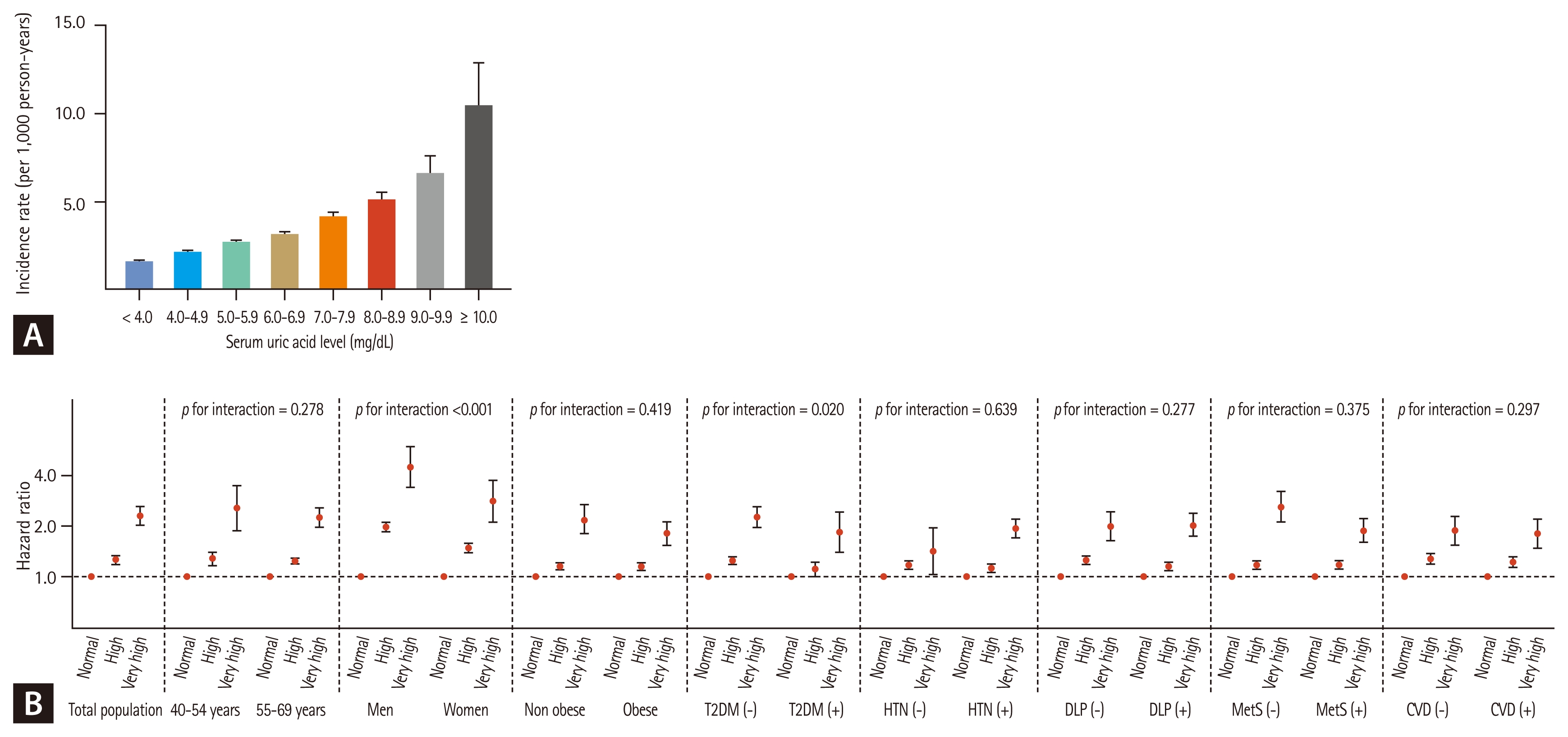
Among the 462,705 participants without a baseline diagnosis of VHD, a total of 14,573 subjects (3.1%) developed VHD during a mean follow-up period of 12.3 years. The incidence of all VHD demonstrated a significant correlation with SUA level. Using SUA < 6.0 mg/dL as reference group, we observed a proportional rise in the hazard ratio of VHD with each 1.0 mg/dL increase in SUA level (Fig. 1A, Table 2, Supplementary Table 4). In the sensitivity analysis excluding participants using diuretics or urate-lowering therapy (n = 9,487), the association between SUA level and incident VHD remained consistent, demonstrating similar effect sizes and statistical significance across all models (Supplementary Table 5).
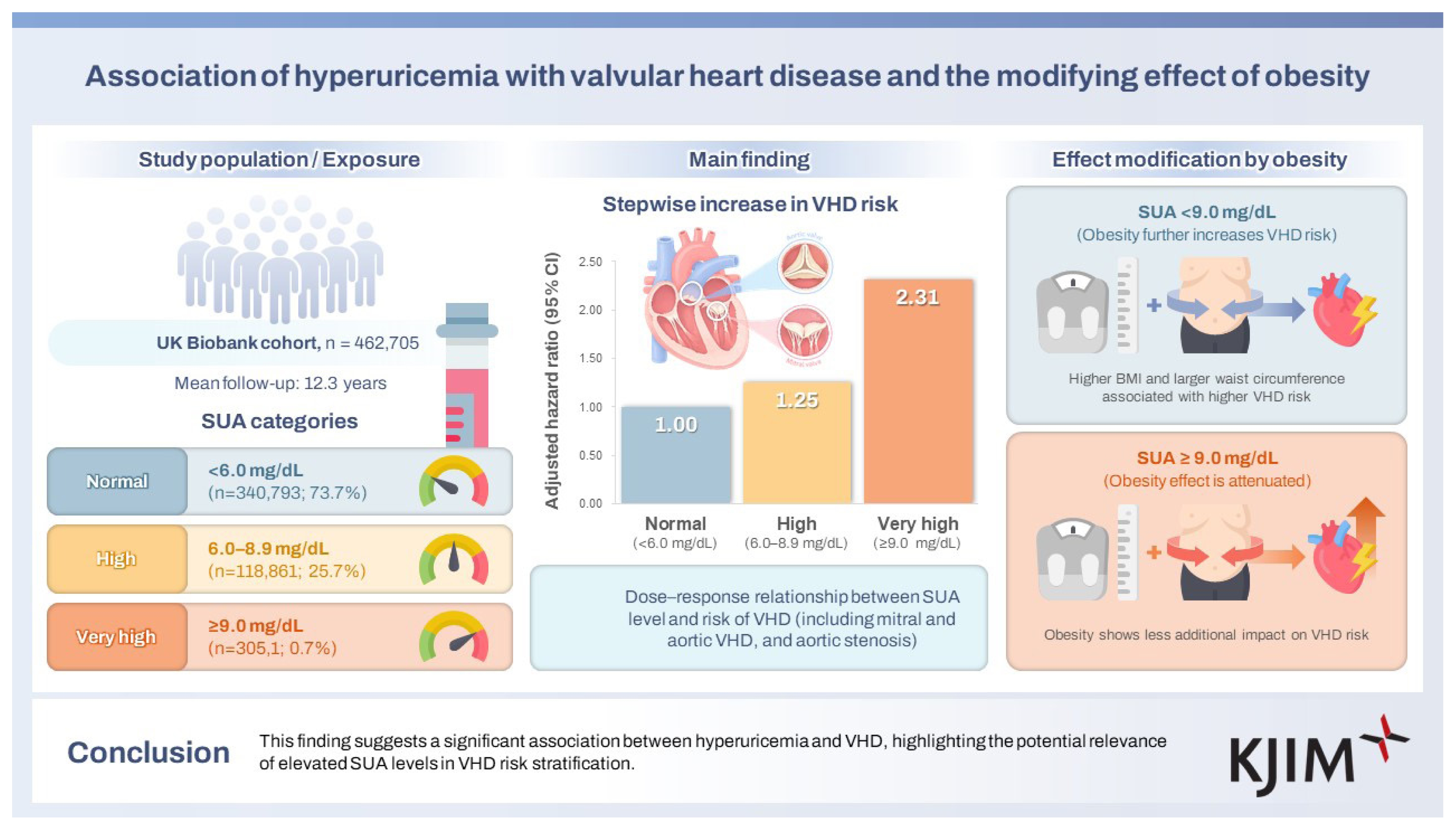
When we categorized participants into groups with normal (< 6.0 mg/dL), high (6.0–8.9 mg/dL), and very high SUA (≥ 9.0 mg/dL), we observed a stepwise increase in VHD risk that corresponded to the SUA categories. The association between SUA level and VHD risk remained consistent after adjusting for demographic characteristics, lifestyle behaviors, metabolic parameters, and treatment for metabolic diseases.
The risk of VHD was assessed separately by VHD subtype. Mitral and aortic VHD, as well as aortic stenosis, showed associations with SUA level. Following adjustment for potential confounding factors, the hazard ratio for mitral VHD exhibited the most notable statistical significance.
In the restricted cubic spline analysis adjusted for age, sex, and race, the lowest estimated risk of incident VHD was observed at SUA levels around 4.0–4.9 mg/dL (Supplementary Fig. 2). Based on this observation, we performed an additional multivariable-adjusted analysis using SUA 4.0–4.9 mg/ dL as the reference group. In this analysis, both the lower SUA group (< 3.0 mg/dL) and those with higher SUA levels demonstrated elevated VHD risk (Supplementary Table 6).
Subgroup analysis of SUA level and VHD risk
To address the potential confounding effects of age, sex, obesity, and metabolic profile on the association between SUA level and VHD, we performed subgroup analyses assessing VHD risk based on SUA level. These analyses involved stratification by age, sex, obesity status, metabolic disorders, and cardiovascular disease (Fig. 1B, Table 3).
In line with our overall findings, subgroups stratified by age, sex, and obesity status demonstrated a consistent and significant increasing trend in VHD risk with higher SUA level. Moreover, the association between SUA level and VHD risk remained consistent across subgroups defined by the presence of hypertension, dyslipidemia, type 2 diabetes, metabolic syndrome, and cardiovascular disease. Significant interactions between SUA level and clinical profiles were found only within subgroups stratified by sex and type 2 diabetes (p for interaction < 0.001 and 0.02, respectively).
Impact of weight management on VHD
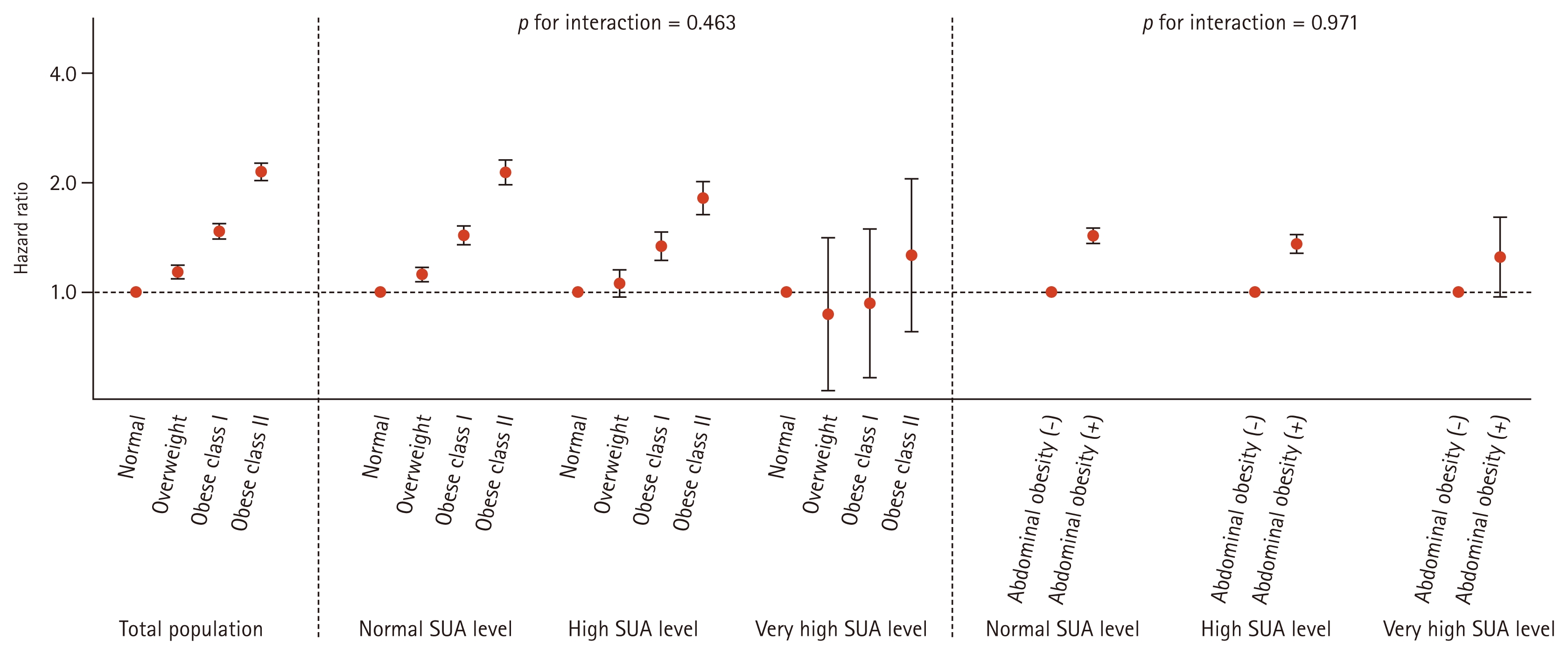
Obesity has been identified as a causal risk factor for the development of numerous cardiovascular conditions, including aortic stenosis, heart failure, and coronary artery disease [25,26]. To access the impact of weight management on incident VHD, we investigated VHD risk based on obesity status as determined by BMI and waist circumference, which is a critical anthropometric parameter (Fig. 2, Table 4).
In the overall population, both BMI and abdominal obesity showed significant correlation with incident VHD. Given the documented association between obesity and hyperuricemia in previous studies, we analyzed the risk of VHD based on obesity status in different SUA categories. Among participants with SUA levels below 9.0 mg/dL, we consistently observed an upward trend in VHD risk with higher BMI and abdominal obesity, which aligns with the findings observed in the overall population. However, this trend was not apparent among participants with SUA levels exceeding 9.0 mg/dL, indicating that VHD risk is not stratified based on obesity status in those with very high SUA levels. In formal interaction analyses, the association between BMI and incident VHD differed significantly accordingly to SUA category (p for interaction < 0.0001). A similar pattern was observed for abdominal obesity (p for interaction = 0.008), suggesting effect modification by SUA level.
DISCUSSION
This study investigated the association between hyperuricemia and VHD, and the potential role of weight management within this context. We observed a dose-response relationship between SUA levels and VHD risk after adjusting for potential confounding variables, with relevance noted in both mitral and aortic VHD. The association between SUA level and incident VHD was consistently observed across subgroups with similar metabolic profiles, supporting this association to extend beyond traditional metabolic risk factors. In individuals with SUA levels below 9.0 mg/dL, higher BMI and abdominal obesity were associated with a more pronounced elevated risk of VHD. However, this correlation was not observed in those with very high SUA exceeding 9.0 mg/dL.
In line with previous studies [12,13], we identified a significant correlation between SUA level and aortic stenosis. In addition, the risk of mitral VHD increased according to SUA level. Despite the acknowledged role of SUA in various aspects of cardiovascular health, the association between SUA level and incident VHD, especially on the mitral valve, remains uncertain. Previous research in the Framingham Offspring Cohort suggested a potential link between SUA level and incident heart failure, but failed to demonstrate a similar correlation with VHD [15]. This discrepancy may arise from variations in the definition of VHD and the categorization of SUA level. The Framingham Offspring Cohort study defined VHD as the presence of cardiac murmur; however, the sensitivity and specificity of cardiac auscultation for diagnosis of VHD are suboptimal [27]. Furthermore, many previous investigations that have examined the association of SUA level with cardiovascular health have classified SUA into quartile or quintile ranges [15,28–30]. Our study adopted a distinct approach by categorizing SUA into normal, high, and very high groups using thresholds informed by gout research rather than purely data-driven divisions.
Currently, clinical guidelines for uric acid-lowering therapy are yet to be established in individuals without a history of gout. Given the broader clinical implications of SUA level on cardiovascular mortality, research is ongoing to establish relevant cut-off values for cardiovascular health. Notably, a comprehensive nationwide Italian cohort study investigating the impact of SUA on cardiovascular health identified prognostic cut-off values of 4.7 mg/dL for total mortality and 5.6 mg/dL for cardiovascular mortality [31].
However, the clinical benefit of reducing SUA to its lowest level remains a matter of controversy, as lower extremes of SUA have been linked to adverse outcomes, especially within malnourished populations [32–34]. Importantly, our spline analysis suggested a potential nonlinear association between SUA and incident VHD risk, with the lowest risk observed at SUA levels of approximately 4.0–4.9 mg/dL. The therapeutic target for patients with gout is to achieve an SUA level below 6.0 mg/dL [35], based on both in vitro saturation levels of uric acid associated with crystal deposition and clinical studies on uric acid-lowering therapy [36,37]. The “treat-to-target” strategy, maintaining SUA level under 6.0 mg/dL, has demonstrated significant effectiveness in preventing recurrent gout attacks [38–40]. Here, we have presented evidence demonstrating elevated risk of VHD to be associated with SUA levels exceeding the therapeutic target range. Particularly, in individuals with SUA levels above 9.0 mg/dL, the absolute risk of VHD was 9.11% during a follow-up duration of 12.3 years. Given the substantial health impact of symptomatic VHD, these findings suggest that elevated SUA levels may be relevant for identifying individuals at higher risk of VHD, particularly in older populations. Future studies are warrant to determine population-specific and outcome-specific SUA thresholds relevant to cardiovascular and valvular risk stratification.
The etiology of VHD encompasses a spectrum of factors. Calcific aortic valve disease, increasingly prevalent in high-income Western countries [4,41], shares metabolic components with atherosclerotic cardiovascular disease, including diabetes, hypertension, dyslipidemia, and smoking. Although metabolic mechanisms contribute substantially to VHD development, our study demonstrated a consistent association between SUA level and incident VHD even after extensive adjustment, suggesting that SUA may be involved in pathways beyond conventional cardiovascular risk factors. Prior studies have reported uric acid deposition on cardiac valves and coronary vasculature [42–45], supporting a potential link with valvular pathology. Emerging experimental evidence suggests that uric acid may directly participate in valvular disease process through valve interstitial cell osteogenic differentiation and endothelial dysfunction [46]. Interestingly, while SUA has been traditionally discussed in relation to calcific aortic valve disease, we observed a comparatively stronger association with mitral VHD. Mitral annular calcification has been closely associated with atherosclerosis and chronic kidney disease and is increasingly recognized as an active process involving inflammation and oxidative stress [47,48], which share conceptual pathophysiological overlap with hyperuricemia. Structural and hemodynamic differences between the mitral and aortic valves may further contribute to differential susceptibility to metabolic and inflammatory influences. Thus, our findings may provide insights into valve-specific disease pathways.
Of particular interest is the observation that the influence of BMI and abdominal obesity was less pronounced among participants with very high SUA exceeding 9 mg/ dL. Obesity has been firmly established as a risk factor for VHD development, primarily through promotion of systemic inflammation and deposition of epicardial adipose tissue [25,26,49,50]. In a Mendelian randomization study, genetically determined obesity was positively correlated with hyperuricemia, whereas genetically determined hyperuricemia had no causal effect on body fat mass [10]. This underscores the prominent role of genetic variants of urate transporters, particularly GLUT9, URAT1, and ABCG2, in hyperuricemia, rather than modifiable lifestyle behaviors [51]. Taken together, our findings suggest that although weight status may modify the association between hyperuricemia and VHD risk, very high SUA levels may reflect pathogenic pathways not fully captured by obesity-related mechanisms alone.
This study has several limitations that warrant consideration. First, the UK Biobank cohort predominantly comprises white British volunteers, which limits the generalizability of our findings to other ethnic populations. Given that uric acid metabolism, obesity distribution, and the epidemiology of VHD may vary across ethnic groups [4], caution is warranted when extrapolating these results to non-European populations. Further studies in diverse populations, including Asian cohorts, are needed to validate the observed associations. Second, our analysis only incorporated baseline data on SUA level and body composition, without accounting for potential changes during the follow-up period. Third, VHD outcomes were defined using ICD-based diagnostic codes, which may introduce outcome misclassification and limit the ability to account for disease severity. Fourth, while we adjusted the hazard ratios to account for potential sources of bias, the presence of unmeasured confounding factors cannot be completely ruled out. Finally, the number of participants with very high SUA levels was relatively small, which may have limited statistical power for subgroup and interaction analyses. Nonetheless, our study reveals the critical interconnectedness between SUA level, weight management, and VHD risk. Further clinical trials are warranted to validate the impact of weight management and uric acid-lowering therapy on VHD risk.
In conclusion, our study highlights the significant link between hyperuricemia and VHD, as well as the impact of weight management on VHD prevention. Hyperuricemia exhibited a robust association with elevated VHD risk in middle-aged and older adults, even after accounting for traditional risk factors. These findings underscore the potential relevance of SUA level as a marker associated with VHD development, highlighting the importance of future research into the role in VHD risk stratification. While weight management may provide a degree of protection against VHD, our results suggest a necessity for more comprehensive interventions in individuals with very high SUA levels. Given the global impact of VHD on cardiovascular health, SUA levels may be relevant when interpreting VHD risk in the context of overall cardiometabolic health.
KEY MESSAGE
1. Hyperuricemia is independently associated with an increased risk of incident VHD.
2. The stepwise increase in VHD risk across SUA categories remains consistent regardless of metabolic profiles.
3. Obesity modifies the association between SUA levels and VHD risk, with a less pronounced effect observed at SUA levels exceeding 9.0 mg/dL.


 PDF Links
 PubReader
 ePub Link
 XML Download
 Full text via DOI
 Download Citation
 Supplement figure 1
 Print
Print